People’s Republic of China


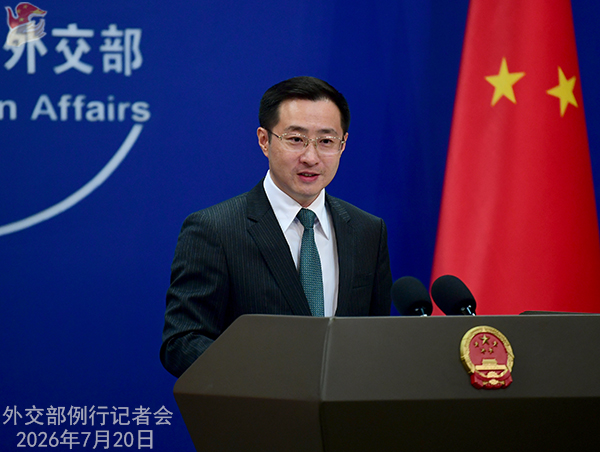
On July 22, Member of the Political Bureau of the CPC Central Committee and Foreign Minister Wang Yi will attend the China-ASEAN Foreign Ministers’ Meeting in Manila, the Philippines. From July 23 to 25, Foreign Minister Wang Yi will travel to Cholpon-Ata, Kyrgyzstan, to attend the Meeting of the Council of the Ministers of Foreign Affairs of the Shanghai Cooperation Organization Member States and visit Kyrgyzstan.
The Paper: The recently-concluded 2026 World AI Conference and High-Level Meeting on Global AI Governance has continued to draw global attention as a new platform for global AI exchanges. Many believe that China, with its open innovation philosophy and open-source AI ecosystem, is breaking Western technological monopoly and enabling more countries to boost capacity building. Would you like to comment on this? Do you have further information to share about the outcomes and highlights of this event?
Lin Jian: The 2026 World AI Conference and High-Level Meeting on Global AI Governance (WAIC 2026), held from July 17 to 20 in Shanghai, was a great success. President Xi Jinping attended the opening ceremony and delivered a keynote speech. Official representatives, business leaders, scholars and researchers from more than 100 countries and international organizations gathered in Shanghai for discussions on how to promote global AI development for good and for all, delivering a host of important outcomes.
First, the conference sets a clear direction for AI global governance. As AI technologies evolve at a faster pace, bringing with it immense opportunities as well as risks, global AI governance has come to a critical juncture. President Xi elaborated on China’s vision of building a just and equitable system for global AI governance from the four perspectives of development, security, civilizations and governance, throwing light on the future of AI development and governance. His propositions have been well received in the international community and bear historical significance as well as practical relevance.
Second, the conference helps bridge the global AI divide. Global AI development remains uneven with a yawning gap between the North and the South. President Xi announced three major practical measures to support AI development and advance capacity building around the world, especially in the Global South. This will surely give a strong boost to inclusive AI development for all.
Third, the conference marks major progress in establishing the World Artificial Intelligence Cooperation Organization (WAICO). The Signing Ceremony of the Agreement on the Establishment of WAICO was held during the conference. Twenty nine countries from Asia, Africa, Latin America and Europe signed the agreement at the event as founding members. The major progress in establishing the organization, an initiative championed by China, has significantly enhanced the representation and voice of the Global South in global AI governance and makes this conference a milestone in the history of AI development.
Fourth, the conference pools together broad consensus on global AI governance. Representatives from around 80 countries and international organizations have participated in the High-Level Meeting on Global AI Governance and had an in-depth exchange of views on AI development and governance. As the host, China, on the basis of extensive consultations and after summing up important views from participating parties across various sectors, released a Chair’s Statement of WAIC 2026, pooling together broad international consensus.
Fifth, the conference promotes international cooperation on AI development. During the conference, more than 150 thematic forums and dozens of bilateral and multilateral exchanges and business talks were held. An AI exhibition covering more than 100,000 square meters was staged, bringing together over 1,100 Chinese and international exhibitors and showcasing over 3,000 cutting-edge exhibits. All these activities have served as a platform for supply-demand collaboration, facilitated the global flow of innovation resources, and injected new impetus into AI development.
As a responsible major country, China is always committed to providing international public goods relating to AI. China is ready to work with various parties to take a people-centered approach, develop AI for the positive and for good, and join hands to build a just and equitable system for global AI governance so as to ensure that AI truly promotes shared prosperity and benefits whole humanity.
Reuters: You have confirmed that Foreign Minister Wang Yi will be traveling to Manila for the ASEAN meetings. Rubio, the U.S. Secretary of State is also on his way to the ASEAN meetings. And he has said that he is open to meeting with Foreign Minister Wang Yi while in Manila. I’m wondering whether there are any arrangements made for a meeting between Minister Wang Yi with Rubio?
Lin Jian: As I just announced, Foreign Minister Wang Yi will attend the China-ASEAN Foreign Ministers’ Meeting. Further information will be released in due course. Please stay tuned.
CCTV: Could you share China’s expectations for the upcoming China-ASEAN Foreign Ministers’ Meeting, which Foreign Minister Wang Yi is to attend, as you just announced?
Lin Jian: ASEAN is a friendly close neighbor, an important cooperation partner, and a priority in China’s neighborhood diplomacy. China supports ASEAN centrality in the regional cooperation architecture and hopes to see booming East Asia cooperation contributing more to stability, development and prosperity in the region and beyond.
This year marks the beginning of China’s 15th Five-Year Plan period and the fifth anniversary of the establishment of the China-ASEAN comprehensive strategic partnership. Under the strategic guidance of leaders of the two sides, China-ASEAN relations have been growing with sound momentum. At the upcoming Foreign Ministers’ Meeting, we look forward to expanding consensus on development and cooperation, making new progress in jointly fostering a peaceful, safe and secure, prosperous, beautiful and amicable home, and striving to forge a closer China-ASEAN community with a shared future.
Xinhua News Agency: Can you share the agenda of the Foreign Ministers Council meeting of the Shanghai Cooperation Organization member states? What does China hope to achieve through the meeting?
Lin Jian: The Meeting of the Council of the Ministers of Foreign Affairs of the Shanghai Cooperation Organization (SCO) Member States will be held in Cholpon-Ata, Kyrgyzstan from July 23 to 24. During the meeting, Foreign Minister Wang Yi will have in-depth exchanges of views with foreign ministers of other member states on the current international and regional situation, the future development of the SCO, cooperation in various fields, and other issues of mutual interest, and make full preparations for the SCO Summit to be held in Bishkek later this year.
This year marks the 25th anniversary of the SCO. Over the past 25 years, SCO member states have followed the fundamental guidance of the Shanghai Spirit, practiced true multilateralism, deepened cooperation in the political area, security, economy, culture and people-to-people exchange, set an example of a new type of international relations, and demonstrated how we can work together to build a community with a shared future for humanity. In September 2025, President Xi Jinping chaired the SCO Tianjin Summit, during which he reached important common understandings with participating leaders on deepening cooperation in various fields, improving the SCO mechanism, and building a more just and equitable global governance system, leading the SCO into a new stage of high-quality development featuring greater solidarity, coordination, dynamism and productiveness. China stands ready to work with other parties to continue carrying forward the Shanghai Spirit, effectively deliver on the outcomes of the Tianjin Summit, deepen solidarity and mutual trust, actively expand cooperation in various areas, and enable the SCO to make new contribution to regional peace, stability, development and prosperity.
Bloomberg: A couple of questions. First, U.S. Secretary of State Marco Rubio said that Chinese leader’s upcoming trip to the U.S. later this year is on track. I would like to ask, is that correct? Is it the Chinese foreign ministry’s understanding that the trip is still on track? And then related to that is a report from the South China Morning Post that Vice Foreign Minister Ma Zhaoxu will be visiting the U.S. this week. Is that accurate? Is that the case? And if so, can you give more details? Finally, related to the ASEAN foreign ministers’ meeting, Chinese Foreign Minister Wang Yi is scheduled to meet with his Philippine counterpart Theresa Lazaro on the sidelines of ASEAN. This is according to the Philippine side. Can you confirm that this meeting is going to happen? It is the first meeting between the two representatives of the countries in two years, so kind of keen to know some context around that.
Lin Jian: To answer your first question, head-of-state diplomacy plays an irreplaceable role in providing strategic guidance to bilateral relations. China and the U.S. are in communication regarding interactions between the two heads of state within the year.
On your second question, I have no information to offer at the moment.
For the last one, further information will be released in due course. Please stay tuned.
People’s Daily: Can you brief us on the backdrop, considerations and China’s expectations of Foreign Minister Wang Yi’s visit to Kyrgyzstan?
Lin Jian: Kyrgyzstan is China’s friendly neighbor and important cooperation partner under the Belt and Road Initiative. Under the strategic guidance of President Xi Jinping and President Sadyr Japarov, the China-Kyrgyzstan comprehensive strategic partnership in the new era has maintained robust development with fruitful cooperation of mutual benefit in various fields and solid progress in building a China-Kyrgyzstan community with a shared future.
To carry forward traditional friendship and enhance political mutual trust between the two countries, Foreign Minister Wang Yi, apart from attending the meeting of the SCO Council of Ministers of Foreign Affairs, will visit Kyrgyzstan where he will meet with leaders of Kyrgyzstan and hold talks with Foreign Minister Zheenbek Kulubaev to have in-depth exchanges of views on bilateral relations and international and regional issues of mutual interest.
China believes that the trip will help the two sides further act on the important common understandings reached between leaders of China and Kyrgyzstan, deepen high-quality Belt and Road cooperation and inject more positive energy for regional peace, stability and common development.
Global Times: It’s reported that since the Takaichi administration came to power, a total of 82 local assemblies across Japan including those in Hiroshima and Nagasaki have submitted written opinions to the central government or the parliament urging the administration to uphold Japan’s three non-nuclear principles or enshrine them into law. The Japan Innovation Party of the governing coalition advised to the Japanese government to discuss the revision of the three non-nuclear principles. What’s China’s comment?
Lin Jian: Japanese local assemblies strongly call for upholding the three non-nuclear principles — a clear sign that the people want peace. Tokyo’s rush to abandon the pacifist Constitution and remilitarize the country at a faster pace is out of step with the public. We urge the Japanese authorities to stop going further down the wrong path and not to stubbornly go against the overwhelming trend on the nuclear issue.
Since Takaichi came into office, Japanese right-wing forces have laid bare their intention to revive militarism, breaking free from the three non-nuclear principles, seeking to possess nuclear weapons and speeding down the wrong path. If the Japanese authorities stick to their miscalculation on the nuclear issue, push to revise the three non-nuclear principles, and deploy allies’ nuclear weapons in Japan, they not only gravely challenge the postwar international order and the international nuclear non-proliferation regime, but also breach the commitment to peace, defy what the Japanese people want and will eventually pay heavy price for it.
As a non-nuclear-weapon state party to the NPT, Japan bears indisputable, undeniable and non-negotiable obligations under international law to refrain from receiving, manufacturing, acquiring or transferring nuclear weapons. Takaichi in February this year reiterated the commitment to the three non-nuclear principles. Japanese delegates attending the Review Conference of the Parties to the NPT this May reaffirmed the stance of making no changes to the three non-nuclear principles. The world will wait and see whether Japan could honor its words that are still ringing in our ears.
China calls on the international community and all peace-loving people in Japan to urge the Japanese authorities to earnestly abide by its NPT obligations, completely abandon remilitarization and the intention to possess nuclear weapons, stop pushing to revise the three non-nuclear principles, stop the so-called “extended deterrence” cooperation with other countries, not to seek the introduction of allies’ nuclear weapons to Japan and immediately take effective steps to address the great imbalance between the supply and demand of sensitive nuclear materials so as to earn trust from its Asian neighbors and the international community with concrete actions.
Bloomberg: China and Thailand have agreed to sign a 2+2 dialogue on foreign and defense issues. I’m wondering if you could elaborate a little bit about this structure, the 2+2, and perhaps give us some context as to why this is happening now, why are the two countries pursuing this at this point of time?
Lin Jian: As you know, Thai Prime Minister Anutin Charnvirakul is on an official visit to China. He just attended the 2026 World AI Conference and High-Level Meeting on Global AI Governance held in Shanghai. President Xi Jinping met with him in Shanghai.
During the meeting, President Xi noted that China-Thailand friendship stretches back over a thousand years and grows even stronger with time. The two countries enjoy a close family-like bond forged through a long course of sincere exchanges. China places the development of ties with Thailand in an important position in its neighborhood diplomacy and has always been a trustworthy and reliable strategic cooperative partner for Thailand. The two sides need to further deepen strategic mutual trust, step up strategic coordination, jointly rise to challenges, and accelerate efforts to build a more stable, prosperous and sustainable China-Thailand community with a shared future to bolster respective modernization and contribute to peace, stability, development and prosperity in the region.
President Xi also noted that the two sides need to have more frequent high-level exchanges and make good use of the “2+2” strategic dialogue mechanism involving foreign and defense ministers to further improve strategic coordination. The two sides also held in-depth exchanges on deepening mutually beneficial cooperation.
Phoenix TV: Saudi Arabia’s Defense Ministry said its forces intercepted missiles attacking the Abha International Airport a few days ago. Does China have any comment on that?
Lin Jian: China opposes attacks on civilian facilities. Saudi Arabia and other countries’ sovereignty and security should be respected. China advocates that relevant parties resolve disputes through political and diplomatic means to create conditions for an early restoration of peace and tranquility in the region.
Shenzhen TV: It is reported that on July 17, Taiwan’s “foreign affairs office” decided to remove Cambodia from visa facilitation programs, saying that Cambodia had failed to reciprocate Taiwan’s goodwill and instead echoed China in supporting the one-China policy. Cambodian Ministry of Foreign Affairs and International Cooperation responded that Cambodia viewed Taiwan as a province of China. Its commitment to the one-China principle will remain unchanged. What’s your response?
Lin Jian: Taiwan is an inalienable part of China’s territory. This is a prevailing consensus in the international community. By exploiting people-to-people facilitation measures to coerce other countries, the DPP authorities’ moves constitute a blatant challenge to the one-China principle, a basic norm in international relations, and once again lay bare the malignant nature of their “Taiwan independence” separatist agenda. The firm commitment of the Cambodian government to the one-China principle fully proves that the DPP authorities’ separatist playbook finds no support and will lead nowhere.
Our message to the DPP authorities is clear: The historical trend is unstoppable, and “Taiwan independence” is a dead end. The Chinese people’s just cause to oppose the “Taiwan independence” separatism and seek national reunification will win more and more understanding and support.