


People’s Republic of China


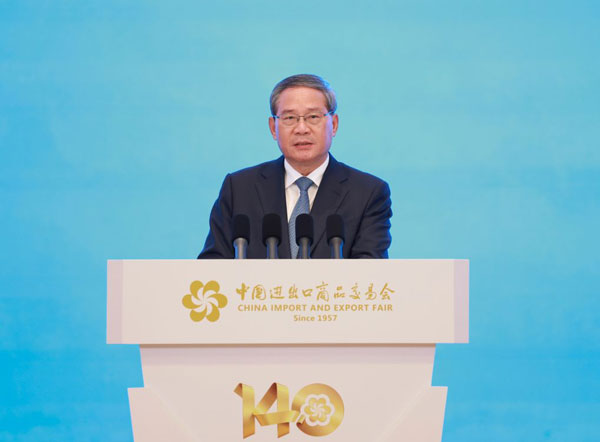
Guangzhou, October 14, 2026
Distinguished Guests,
Ladies and Gentlemen,
Friends,
It is a great pleasure to join you in the beautiful Flower City Guangzhou for the 140th Session of China Import and Export Fair (Canton Fair). On behalf of the Chinese government, I would like to extend a warm welcome to you all, and express heartfelt appreciation for your long-standing, positive contribution to the economic and trade cooperation and development between China and other countries.
This year marks the 70th anniversary of the Canton Fair. President Xi Jinping has sent a congratulatory letter to the Fair, acknowledging its past achievements and reaffirming China’s commitment to expanding high-standard opening up. Over the past 70 years, the Canton Fair has grown from strength to strength. Its exhibition area has expanded from 9,600 square meters in the first year to 1.55 million square meters today. The number of buyers has increased from 1,200 in the beginning to more than 300,000 this year. Among all the international trade exhibitions hosted by China, the Canton Fair has the longest history, the largest participation and the highest transaction volume. It is also an important window for the international community to observe China. Through this window, the world has witnessed the surging vitality of China’s economy and society, the enterprising journey undertaken by hundreds of millions of Chinese people, and the deepening connection between China and the world.
First, a China that keeps opening itself creates new opportunities for the world. Over the past 70 years, the Canton Fair has established itself and thrived on openness. Its circle of friends has grown bigger, with buyers coming from over 220 countries and regions, and the total value of business deals reaching US$1.6 trillion. What underlies this success is China’s strategic choice of boosting development through openness, and the practical need for countries around the world to leverage their economic strengths for mutual empowerment. China is now a key trading partner of over 160 countries and regions, and the top export destination for nearly 80 countries and regions. China’s stock of overseas investment has reached US$3.4 trillion. While developing itself, China has also brought benefits to the world.
Second, a China that keeps innovating itself provides new impetus for the world. Over the past 70 years, exhibits at the Canton Fair have been continuously transformed and upgraded. From agricultural and subsidiary products and local specialties in the 1960s and 70s, to industrial and electromechanical products in the 1980s and 90s, and to embodied artificial intelligence (AI) and smart medical services today, each session of the Canton Fair presents an updated selection of exhibits. What underlies this transformation is China’s rapid progress in innovation-driven development, and the world’s scientific and technological revolution and industrial transformation. In recent years, new technologies, products and business forms in such areas as AI, green energy and biomedicine have continued to emerge in China, and generated new dynamism and space for the world economy.
Third, a China that always keeps its promise brings certainty to the world. Over the past 70 years, no matter how the international situation evolved, the Canton Fair has never been interrupted, and its commitment to the principle of honoring contracts and maintaining credibility remains steadfast. What underlies such commitment is the Chinese philosophy of matching words with actions, and the world’s recognition of and trust in China. China has all along kept its policies stable and consistent, firmly delivered on its commitment of lowering tariffs, increasing development assistance and addressing climate change, and undertaken the responsibilities of a major country in this turbulent and changing world.
Looking back on the past 70 years, the Canton Fair has stood the test of international vicissitudes and brimmed with new vigor and vitality. This is because it has all along followed the trend of economic globalization and answered the call of the international community for joint development. The journey of the Canton Fair offers some simple yet profound takeaways worthy of deep reflection. Here, I would like to share with you three main observations.
First, market connectivity is not a tool for zero-sum games between countries, but an effective measure to foster new space for growth. The past few years have seen a notable rise in manmade market barriers of various sorts around the globe. Some have even chosen to politicize, instrumentalize, and weaponize economic and trade issues. However, no matter their forms, protectionism is always at the core. It has been fully proven by both theories and practices that the market is not static—it is more like a network that reaches out in all directions. Only when connected to more such networks, can a market achieve economy of scale, match supply with demand more efficiently, and create more value and space. Protectionism may seem effective for a country to sustain its market, but it also makes it impossible for the country to broaden its market. Worse still, it may even lose its place in the new global network of markets. At the end of the day, protectionism will only produce more losses than gains.
Throughout the years, China has been committed to integrating its domestic market with the international markets for joint growth. China has been the second largest importer in the world for 17 consecutive years, exceeding RMB 18 trillion yuan last year, and growing by another 22.3 percent in the first three quarters this year. Decades have passed since China opened itself to the world, yet its market has not contracted. Instead, the introduction of new products and industries from other countries, such as automobiles and home appliances, has unlocked and cultivated new market demands. Meanwhile, the export of quality Chinese products, especially innovative products, is opening up new space for the global marketplace. China is ready to work with all countries to build an open world economy and strengthen market connectivity so as to make the global market bigger and deliver greater benefits to all.
Second, international trade is not just statistics in the books, but a voluntary choice aimed to improve people’s well-being. Recently, there have been quite some discussions about the issue of trade balance globally. The laws of economics tell us that a balanced position in trade is temporary and relative, while an imbalanced position is more common and non-static. This is determined by countries’ differences in comparative strengths, economic structures, distribution of labor, and other variables. We need to see that trade is mutually beneficial in nature. One cannot simply view surplus as “taking advantage” and deficit as “being ripped off.” A balanced trade would naturally arrive when the parties can satisfy their respective demands through positive interactions. It is not achieved by building walls, setting up barriers, or even suppressing and containing others. It is simply unrealistic to impose export control on others while looking for balanced trade at the same time. Such a practice will only push up costs, disrupt industrial and supply chains, and further aggravate the imbalance. What we need is “upward balance” achieved by opening up wider and making the economic pie bigger, not “downward balance” resulting from market closure and the inevitable market contraction that follows.
Some current discussions about China’s trade focus on import and export statistics, but overlook the real effects behind them. China is both a “super seller” and a “super buyer.” As a “super seller,” China brings benefits to its trading partners. Quality, affordable goods made by diligent Chinese workers with their labor and wisdom have significantly increased the actual purchasing power of global consumers, improved their quality of life, and helped countries strengthen their capacity for industrial development. As a “super buyer,” China helps to boost the prosperity of other countries. China is a major buyer of agricultural, industrial, and consumer goods from many countries, which translate into profits for local businesses, income for the people, and revenues for the governments. China never seeks surplus intentionally, not to mention the fact that most of the times, the benefits are shared by all parties, despite the surplus being recorded in China. A large number of foreign-invested enterprises in China export their products across the world and secure big returns. We would like to buy more products from across the world, especially high value-added products. Since last year, we have hosted around 70 events themed “Big Market for All: Export to China.” Next month, we will host the ninth China International Import Expo in Shanghai. China hopes that more countries will work together in the same direction, lift restrictions, and pursue better, balanced development of trade.
Third, win-win cooperation does not mean one-sided concession but mutual empowerment and success. On the path toward global prosperity and development, win-win cooperation is the only right choice. A zero-sum approach hurts everybody. For true win-win cooperation to happen, we cannot rely on a simple quid pro quo, still less compromise or concessions under pressure. What we need is to treat each other as equals, meet each other halfway, and make progress together. With all the links of global industrial and supply chains interlocked and closely connected, it is possible to realize more sustainable win-win cooperation at a higher level if countries work together in good faith and draw on each other’s strengths. In this process, developed countries should take more proactive actions, provide developing countries with more capital and technological support and preferential economic and trade policies to help boost their industries and strengthen the internal drivers of growth.
China, as the largest developing country, is committed to advancing common development. While developing itself, China has done its utmost to help and support other developing countries. Over the years, China has been advancing high-quality Belt and Road cooperation. More and more fellow developing countries, supported by China’s products, technology and capital, have improved their domestic industrial systems, raised high-end export capacity, kept accelerating industrial upgrade, and as a result, continued to move up the global value chain. There are over 50,000 overseas companies set up with Chinese investments, 90 percent of which are in Global South countries. Many of these countries have seen their manufacturing rapidly growing and foreign exchange earnings from exports rising significantly. China will always be a good friend that other developing countries can trust and rely on. China stands ready to help pave the way for other developing countries as they pursue modernization. We will join hands and move forward together with fellow developing countries.
Over the years, China has been actively carrying out global open cooperation and made important contribution to meeting the world’s needs with its utmost efforts. This year, confronted with global changes and turbulence, the Chinese economy has withstood pressure and forged ahead steadily, demonstrating robust resilience and vitality. We are confident and capable of accomplishing the goals and tasks for economic and social development this year. China will continue to advance high-quality development, expand high-standard opening up, and take more practical actions to inject more momentum into the world economy.
First, we will share more market opportunities. The demand of China’s supersized market is unleashing at a faster pace. Last year, total retail sales of consumer goods exceeded RMB 50 trillion yuan for the first time, and are expected to increase by about another RMB 10 trillion yuan in the next five years. We will firmly implement the strategy of expanding domestic demand and advance consumption upgrade, further lower the threshold of market access, and provide better services and safeguards for enterprises. We welcome more foreign companies to do business in China.
Second, we will expand more mutually beneficial cooperation. China is committed to pursuing progress together with the world and deepening alignment of development strategies with other countries. We support capable Chinese companies in investing overseas in an orderly manner, strengthening technological exchanges, expanding cooperation in emerging sectors, and conducting more localized operations, to help upgrade local industries and boost local economy.
Third, we will firmly uphold international economic and trade order. China will always stand on the right side of history, firmly uphold multilateralism and free trade, and support WTO reform and development. We will work with all parties to explore and make future-oriented international economic and trade rules, reform and improve global economic governance, and advance a universally beneficial and inclusive economic globalization.
Seven decades of hard work have yielded fruitful results. I believe the Canton Fair will make new and even better progress going forward. I hope that you will make more friends here, carry out more cooperation, and reap more fruits. Let us work together to usher in a better future.
Thank you.