People’s Republic of China


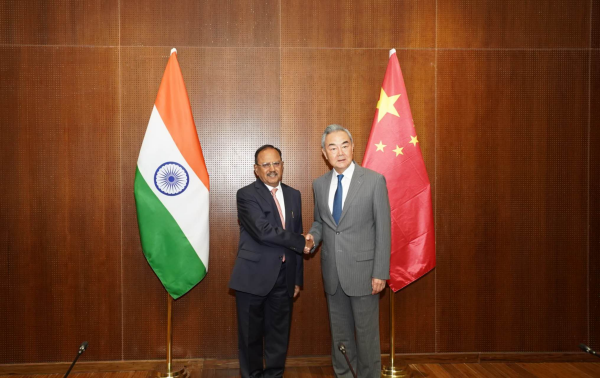
On June 22, 2026, Member of the Political Bureau of the CPC Central Committee and Director of the Office of the Central Commission for Foreign Affairs Wang Yi met with Indian National Security Advisor Ajit Doval in New Delhi.
Wang Yi noted that India is an important neighbor of China. Under the joint guidance of President Xi Jinping and Prime Minister Narendra Modi, China-India relations have gradually emerged from the low ebb and returned to the track of recovery and improvement. The two leaders agreed that China and India are partners, not rivals, which constitutes the most important strategic consensus between the two sides and provides strong impetus and strategic guarantee for the sound and steady growth of bilateral relations. As the world’s two most populous economies, China and India should not only view bilateral relations with a long-term perspective, but also advance bilateral cooperation with a global vision. At present, the Global South, including China and India, is experiencing a collective rise. As the first echelon of the Global South, BRICS should actively champion and advance the process toward multipolarity, safeguard the legitimate rights and interests of developing countries, and work for a more just and equitable international order. China supports India in fulfilling its responsibilities as the BRICS Chair and working together to promote the growth of the BRICS mechanism.
Wang Yi said that thanks to the joint efforts of both sides, exchanges in various fields have gradually resumed, communication and cooperation are progressing in an orderly manner, and the border areas have remained generally peaceful. These outcomes are hard-won and should be doubly cherished. The two sides should take concrete actions to implement the important common understandings of the two leaders, boost each other’s development and rejuvenation through cooperation, and accelerate the modernization process of the Global South. It is important to respect each other’s core interests, properly handle sensitive issues, and keep the China-India boundary question at an appropriate place in bilateral relations so as to prevent it from affecting the overall relationship. The two sides should speed up the resumption of dialogue mechanisms and promote exchanges in trade, finance, law enforcement, media and other fields. Efforts should be made to actively guide all sectors of society to form a correct perception of each other, thus building a solid base of public opinion and social support for improving bilateral relations.
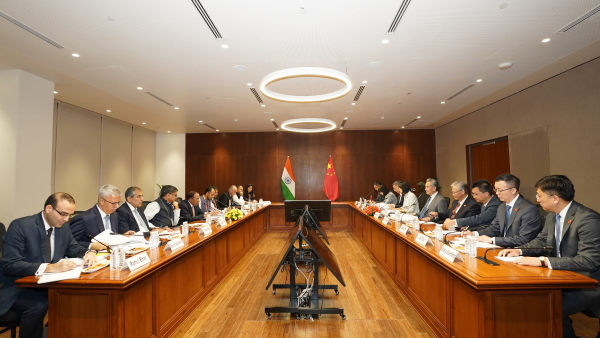
Ajit Doval noted that through their meetings in Kazan and Tianjin, the leaders of India and China have charted the course for the development of bilateral relations, and agreed that India and China are partners, not rivals. They believe that a stable India-China relationship serves the common interests of both sides. India is ready to continue to view its relations with China from a strategic perspective, work with China to implement the common understandings of the two leaders, take a forward-looking approach in viewing and accelerating the development of bilateral relations, properly handle differences, and strive for win-win outcomes. India is one of the first countries to recognize the People’s Republic of China, and its position on the Taiwan question remains unchanged. India is ready to work with China to support each other’s core concerns, jointly uphold multilateralism, and protect the legitimate rights and interests of developing countries.
The two sides also exchanged views on international and regional issues of mutual interest.