


People’s Republic of China


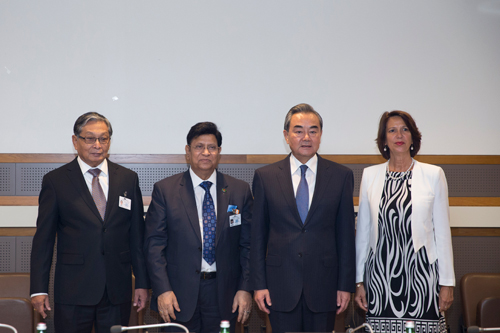
On September 23, 2019 local time, State Councilor and Foreign Minister Wang Yi presided over an informal meeting among China, Myanmar, and Bangladesh at the United Nations (UN) Headquarters in New York, the United States. U Kyaw Tint Swe, Minister for the Office of the State Counsellor of Myanmar, A.K. Abdul Momen, Foreign Minister of Bangladesh, and Christine Schraner Burgener, Special Envoy on Myanmar of UN Secretary-General attended the meeting.
Wang Yi expressed, since last year, China, Myanmar and Bangladesh have held three informal Foreign Ministers' meetings, with each of them having made progress. All parties have done a lot of work on the issue of the repatriation of displaced people who fled from the Rakhine State. The conditions for solving the issue are accumulating and becoming mature. All parties should further strengthen communication and consultation to push for substantial progress in the repatriation work as soon as possible. As a mutual friend of Myanmar and Bangladesh, the Chinese side is willing to provide help within its capacity to this end.
U Kyaw Tint Swe, A.K. Abdul Momen, and Christine Schraner Burgener highly appreciated and thanked the Chinese side for the huge amount of constructive efforts to promote a proper solution to the repatriation of displaced people from the Rakhine State, and agreed to further seek effective ways to solve the issue through cooperation as soon as possible.
A three-point consensus was reached at the meeting. First, realizing the repatriation as soon as possible is a strong political will and an important political consensus of the three countries. Both Myanmar and Bangladesh believe that the repatriation of displaced people can no longer be delayed and should be resolved as soon as possible. Second, all parties agreed to establish a joint working group mechanism among China, Myanmar, and Bangladesh, with Myanmar and Bangladesh as the main body and China participating, to be responsible for the concrete implementation of repatriation-related work under the political guidance of the Foreign Ministers of the three countries. Third, development is the fundamental way to solve the Rakhine State issue. The three sides agreed to strengthen tripartite cooperation, especially by making good use of the existing China-Myanmar and China-Bangladesh bilateral cooperation mechanisms, to help create more employment opportunities and improve people's livelihood in the Rakhine State and Myanmar-Bangladesh border areas, in a bid to fundamentally create conditions for the stability and development of the region.