People’s Republic of China


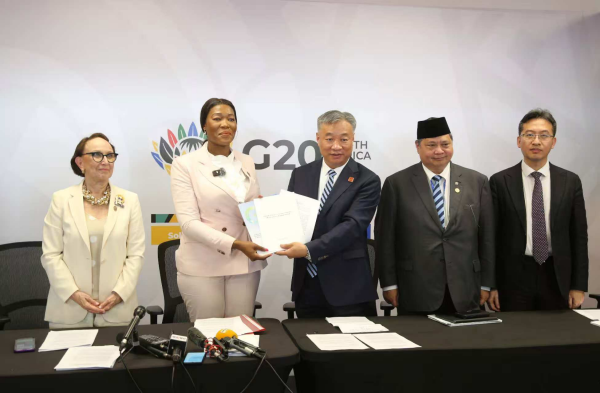
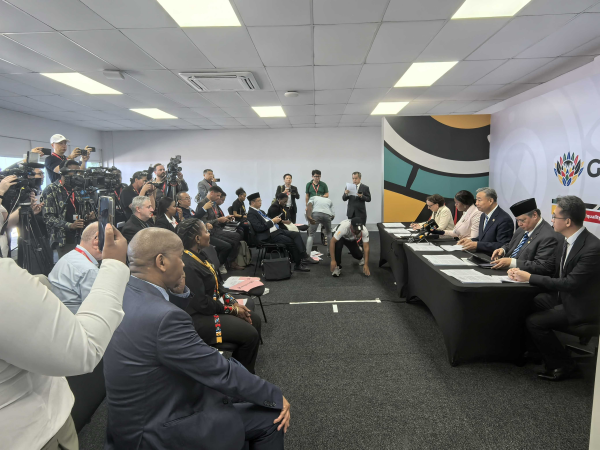
To implement the important common understandings reached between President Xi Jinping and South African President Cyril Ramaphosa at the Beijing Summit of the Forum on China-Africa Cooperation, on November 22, Premier of the State Council of China Li Qiang announced at the 20th G20 Summit the joint launch of an Initiative on Cooperation Supporting Modernization in Africa by China and South Africa. On November 23, Vice Foreign Minister Miao Deyu co-hosted the launch ceremony of the Initiative with South African Deputy Minister of International Relations and Cooperation Anna Thandi Moraka. The ceremony was attended by Secretary-General of the United Nations Conference on Trade and Development Rebeca Grynspan, and Coordinating Minister for Economic Affairs of Indonesia Airlangga Hartarto, as well as over 40 media outlets from developing countries including China, South Africa, Russia, Brazil, and India, and from the United States.
Miao Deyu stated that achieving modernization is a dream of all developing countries. As the largest developing country, China has proven through its own practice of Chinese modernization that modernization is not a single solution, nor a privilege of a few countries. The Global South can also achieve leapfrog development through hard work. Advancing modernization together was a key theme of the Beijing Summit, and the Initiative provides broader cooperation space and stronger support for Africa's modernization.
Miao Deyu said that the Initiative was jointly formulated by China and Africa and has distinct African characteristics. First, it reflects Africa's hopes, needs, and expectations, focusing on the African Union's Agenda 2063, closely aligning with the theme of the G20 Summit. It prioritizes cooperation in areas such as trade facilitation, green development, poverty reduction, people's welfare, climate change, development financing, localization of enterprises, and value chain enhancement, outlining a comprehensive plan for the implementation of Africa's modernization. Second, it sets out the principles for international cooperation in support of Africa, calling for adherence to six key principles in international cooperation with Africa: justice and equitability, openness and win-win, putting the people first, diversity and inclusiveness, sustainable development, and peace and security. It also supports African countries in their efforts to independently explore modernization paths suited to their national conditions. Third, it gathers the strong voice of promoting multilateralism in the current era, calling for upholding the principle of extensive consultation and joint contribution for shared benefit, advocating for equal dialogue among different civilizations, enhancing the voice and representation of African countries in international affairs, and achieving modernization that is diverse and inclusive.
Miao Deyu said that China is committed to supporting Africa's modernization process by continuously expanding unilateral openness to Africa. In June this year, President Xi Jinping announced that China will implement the policy of granting 53 African countries having diplomatic relations with China zero-tariff treatment for 100 percent tariff lines through the signing of joint development economic partnership agreements. This is a major measure by China to expand self-initiated opening-up, and it will help increase the export of high-quality African products to China. China has already signed an early harvest arrangement with the Republic of the Congo and reached a consensus with Ghana in principle. China will work together with African countries to ensure that the zero-tariff treatment benefits more African people.
Miao Deyu said that last month, the fourth plenary session of the 20th Central Committee of the Communist Party of China deliberated over and adopted the Recommendations for Formulating the 15th Five-Year Plan. China will move faster to create a new pattern of development, steadily enhance institutional opening up, and share opportunities and pursue development with countries around the world. African countries are also making unremitting efforts to achieve the bright prospects envisioned in the African Union's Agenda 2063. The Chinese side calls on more African countries, countries outside the region, and international organizations to participate in the Initiative, forming strong synergy for supporting Africa's modernization and contributing to the building of a community with a shared future for humanity.
Anna Thandi Moraka said that Africa is grateful for President Xi Jinping's proposal of the eight actions for global development at the G20 Summit in Rio de Janeiro. The joint launch of the Initiative by South Africa and China aims to support African countries in their efforts to independently explore modernization paths suited to their national conditions and realize the aspirations of the African people for a better life. With China's support, Africa will break free from its reliance on raw material exports, achieve diversified economic development, and realize peace and security across the African continent.
Rebeca Grynspan said that China plays a leading role in supporting the modernization of developing countries. Its zero-tariff treatment not only strongly defends multilateralism but also demonstrates China's rejection of predatory trade practices and its commitment to writing a new story of inclusiveness and shared prosperity. In the face of unprecedented changes unseen in a century, all parties should establish sustainable partnerships with China to achieve genuine technology transfer and industrial upgrading.
Airlangga Hartarto said the Initiative reflects China's firm support for the realization of industrialization and the enhancement of economic resilience in Global South countries. China is an important partner in helping developing countries develop local processing capabilities, access financing, and acquire technology.