People’s Republic of China


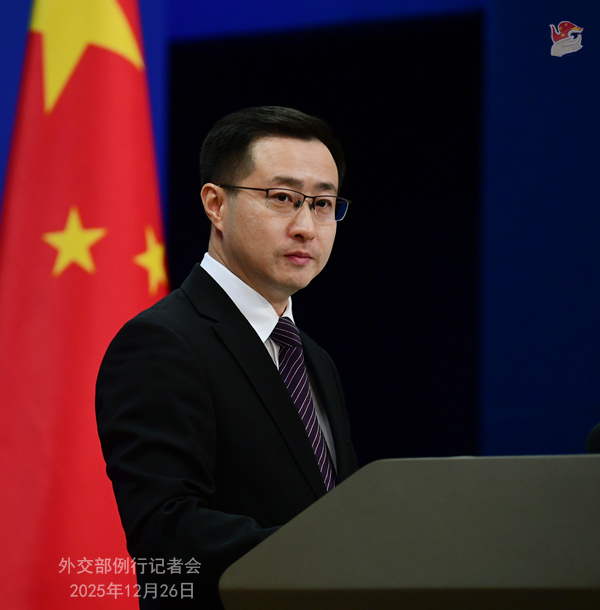
RT TV: The Japanese government approved the draft budget for fiscal year 2026 on December 26, with the defense budget exceeding JPY nine trillion, hitting a new record. What is China’s comment?
Lin Jian: We noted the reports. Despite recent international criticism over latest military and security developments in Japan, the Japanese side has shown no inclination to mend its conduct, and instead plans to again hike defense budget, further revealing Japanese right-wing forces’ motive to remilitarize Japan and resurrect militarism.
Given the Japanese militarists’ innumerable war crimes, Japan’s military and security moves have always been closely watched by its Asian neighbors and the international community. Since the new Japanese government took office, it has been notably accelerating military buildup. From Prime Minister Takaichi’s erroneous remarks on Taiwan that threatens the use of force against China, to the remarks of a senior official of the Japanese Prime Minister’s office calling for Japan’s possession of nuclear weapons, and to the proposed revision of the three national security documents and the idea of altering the three non-nuclear principles, Japan is deviating further and further away from the path of peaceful development and moving in a dangerous direction.
In recent years, Japan has removed the ban on exercising the right to collective self-defense, developed the so-called “capability to strike enemy bases,” strengthened cooperation on extended deterrence, and built its frontier islands into front lines, which clearly goes beyond Japan’s “exclusively defense-oriented” policy. Terms such as “self-defense” and “counterstrike” are used by Japanese right-wing forces to gloss over their attempt to breach the postwar international order and stipulations in Japan’s Constitution, and deceive and stoke public opinion. These moves have put the international community on high alert.
The Japanese people are also victims of militarism. Some in Japan pointed out that raising defense spending does not bring peace and stability. Rallies have been held across Japan in strong protest of the Japanese government’s military expansion. Some scholars also note that the defense budget hike will weigh heavily on Japan’s economy and eventually be borne by the ordinary people in Japan.
China will work with all peace-loving countries to push back any dangerous move designed to resurrect militarism or cultivate neo-militarism, and jointly defend the outcomes of WWII victory.
RT TV: On December 25 local time, Russian Foreign Ministry Spokesperson Maria Zakharova at a briefing responded to a question about Japanese leader’s possible visit to Yasukuni Shrine and recommended that Tokyo should build a memorial hall for victims of Japanese militarism to repent for its crimes. In the context of Russia and China standing together against distortion to historical facts, what is China’s comment?
Lin Jian: We appreciate Russia’s statements. The Yasukuni war shrine is a spiritual tool and symbol of Japanese militarists’ war of aggression. The shrine honors 14 convicted Class-A war criminals responsible for Japan’s aggression in the 1930s and 40s. This year marks the 80th anniversary of the victory of the Chinese People’s War of Resistance against Japanese Aggression and the World Anti-Fascist War. The Japanese side should face squarely and deeply reflect on Japan’s history of aggression, take concrete actions to show remorse for the crimes committed by Japanese militarists and respect to the victims, and not further compound the wrongdoing. China stands ready to work with the international community, including Russia, to firmly defend the outcomes of the WWII victory and the post-war international order, strictly prevent the resurgence of Japanese militarism and jointly safeguard world peace and stability.
People’s Daily: It’s reported that earlier this week, the Japanese Cabinet adopted a new cybersecurity strategy, enabling the police and the Self-Defense Forces to take “active cyber defense” measures to respond to cyberattacks. In May this year, Japan enacted a law introducing the so-called active cyber defense, which makes clear that the Japanese government will preemptively infiltrate and destroy the cyber devices of so-called “threat actors.” What’s China’s comment?
Lin Jian: China is gravely concerned over Japan’s newly adopted cybersecurity strategy that enables “active cyber defense,” a major policy shift from cyber defense to offense. This is yet another case of Japan, a defeated belligerent of WWII, seeking to defy the postwar international order.
In recent years, Japan has drastically expanded its cyber forces. The term “active cyber defense” in Japan’s new strategy is simply designed to loosen restriction on active offense. Japan has more than once waged war of aggression against other countries in the name of responding to potential attacks. The Japanese side owes the world an explanation: Is the latest move a prelude to Japan’s attempts to once again break free from the international law and domestic laws and use self-defense as a pretext to launch preemptive “cyber aggression” as it once did in WWII?
The interconnectedness of cyberspace demands joint effort to ensure peace and stability in cyberspace. China firmly opposes Japan’s dangerous moves in the cyber domain, and calls on Japan to strictly abide by its pacifist Constitution and observe existing international rules and order. Any move that harms China’s sovereignty, security and development interests will be met with China’s firm response.
The Paper: Morgan Stanley said in its recently released Robot Almanac that China has pulled far ahead in the race to build humanoid robots, and the total number of related patents issued by China over the past five years topped the world. The analysis also highlighted the cost advantage China brings to the global humanoid robot supply chain. Can I have your comment on that?
Lin Jian: “Innovated in China” has become a global buzzword for the year 2025. China has broken into the top ten of the Global Innovation Index for the first time, and has been leading the world for three consecutive years with the most clusters in the global top 100 innovation clusters. From the launch of large-scale AI model to the deep integration of AI and robots, China’s achievements in sci-tech innovation have dazzled the world.
Innovation drives China’s robust economic growth, boosts global economic recovery and enhances the wellbeing of people of all countries. China’s technology and solution of building high-speed railways and smart ports have been introduced to the world, helping other countries build better infrastructure. China’s Beidou services cover more than 140 countries and regions in such areas as disaster early warning, transportation and agriculture. The China-Brazil Science and Technology Innovation Center has made clean energy accessible for remote areas. China also shared with Mongolia, Saudi Arabia and other countries its technologies in combating desertification. China’s smart agriculture has enabled Egypt to better cope with water shortages and food security challenges.
Pursuing innovation-driven development and accelerating the cultivation of new growth drivers is one of the major tasks envisioned by the Central Economic Work Conference that was held earlier this month. Looking forward, China will continue speeding up its effort and enhancing cooperation in sci-tech innovation, providing more public goods for the world and making greater contribution to global sci-tech and economic development.