People’s Republic of China


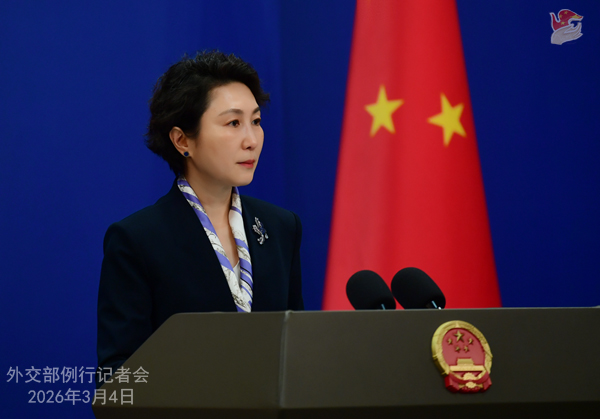
People’s Daily: Could you update us on what the Chinese government has done in protecting the Chinese nationals in Iran and neighboring countries as well as what is planned next?
Mao Ning: Since the security situation in Iran turned tense, the Chinese side has made démarches to relevant parties, urging them to ensure the safety of Chinese nationals in Iran and its neighboring countries. The Ministry of Foreign Affairs and Chinese diplomatic missions in relevant countries have issued alerts more than once. They have worked in various ways to call on Chinese citizens in Iran to evacuate as soon as possible and offer them assistance and advise those in neighboring countries to take safety precautions. These Chinese diplomatic missions have been working around the clock to assist with the evacuation. After the strikes began, another 470-plus Chinese citizens have been evacuated by our missions in Iran.
Given the severe security situation in Iran, we once again advise Chinese citizens in Iran to take extra safety precautions and leave as soon as possible while keeping the diplomatic missions informed of their latest condition. At present, they can leave the country via the following border crossings: Astara in Azerbaijan, Agarak in Armenia, Van, Ağrı, and Hakkari in Türkiye, Shalamcheh in Iraq, and Bajgiran in Turkmenistan. Chinese citizens can enter Azerbaijan, Armenia, and Türkiye visa-free with their passports. They may enter Iraq after applying for an e-visa in advance, and enter Turkmenistan after submitting documents required and obtaining a visa in advance. Working groups from Chinese embassies and consulates in relevant countries are already at these border crossings ready to offer assistance. Their contact information can be found in the consular alerts posted by their respective missions.
As some of Iran’s neighboring countries affected by the military operations close airspace and suspend international flights, some Chinese citizens’ travel plans may have been disrupted. We advise those planning to travel to affected countries and regions near Iran to postpone their trip. For those already there, do take stronger precautions and avoid sensitive zones including military facilities and demonstrations and assemblies. In case of emergency, call the police and contact the Chinese embassies or consulates for assistance.
AFP: A question related to Iran also. Iran’s Revolutionary Guards said today they control the Strait of Hormuz, a vital shipping route for oil and gas. They say any vessels seeking to pass through the Strait risk damage from missiles or drones. Is China concerned about this new development and are you in contact with the relevant Iranian authorities on this subject?
Mao Ning: The Strait of Hormuz and its adjacent waters are an important international trade route for goods and energy. To keep the region secure and stable serves the common interests of the international community. China urges relevant parties to immediately stop military operations, avoid further escalation of the tense situation and prevent regional turmoil from causing greater damage to global economic growth.
EFE: According to some international media, Iran has announced the blockade of the Strait of Hormuz to international shipping with an exception for Chinese and Russian vessels. Can the Chinese Foreign Ministry confirm whether it has received any such notification from Iran? What is China’s comment on these reports?
Mao Ning: I’m not familiar with what you mentioned. I just shared China’s stance.
Beijing Daily: We noted that the Permanent Mission of China to the United Nations Office at Geneva and Other International Organizations in Switzerland launched the “Group of Friends of Global Governance” (GFGG) in Geneva last week. Can you give us more details?
Mao Ning: President Xi Jinping solemnly put forward the Global Governance Initiative (GGI) in September last year, contributing China’s wisdom and proposal for building a more just and equitable global governance system. Since its proposal, the GGI has received support from over 150 countries and international organizations. In December last year at the UN Headquarters in New York, China proposed to establish the “Group of Friends of Global Governance,” which has been warmly received at the UN.
Geneva is an important hub of global governance, home to many UN entities and specialized agencies that address agendas vital to countries’ development and people’s livelihood. On February 27, China held the launch ceremony of the “Group of Friends of Global Governance” in Geneva. Representatives from nearly 60 countries attended the meeting, including 42 founding members of the GFGG. Parties expressed strong recognition and support for the GGI, commended China’s leading role in global governance, and looked forward to the GFGG strengthening communication and coordination and promoting dialogue and cooperation on the Geneva platform.
The launch of the GFGG in New York and then in Geneva as well as the positive progress achieved within several months fully demonstrates that the GGI proposed by President Xi Jinping responds to the needs of the world and wishes of the people. As the noble cause of peace and development for humanity is confronted with severe challenges, it is more imperative than ever for us to recommit to the founding mission of the UN, uphold multilateralism, defend international fairness and justice, and work for peace, stability and development. China welcomes the participation of all countries sharing the same vision, and through the launch of the GFGG stands ready to work with the international community to explore pathways for reforming and improving global governance, jointly tackle global challenges and build a community with a shared future for humanity.
EFE: According to reports, U.S. President Donald Trump has threatened to cut all trade ties with Spain after Madrid refused to allow the United States to use Spanish air bases for strikes against Iran. What is China’s comment on this?
Mao Ning: The U.S.-Israeli military strikes against Iran violate international law. Trade should not be used as a tool or weapon.
Reuters: A follow-up on the situation in Iran. You shared with us the evacuation numbers, but I was wondering how many remain stranded if the Ministry knows. And also in terms of casualties or injured, are there further information about that?
Mao Ning: Chinese embassies and consulates in relevant countries are actively assisting Chinese citizens there with their evacuation. We have not received information of further casualties among Chinese citizens to date.