People’s Republic of China


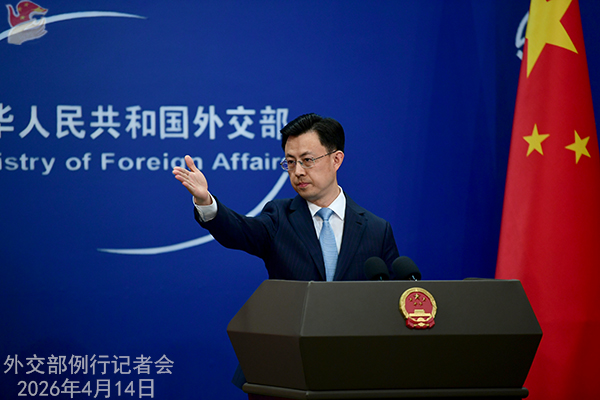
At the invitation of President of the Republic of the Congo Denis Sassou-N’Guesso, President Xi Jinping’s Special Envoy and Vice Chairperson of the National Committee of the Chinese People’s Political Consultative Conference Shao Hong will attend the inauguration of President Sassou-N’Guesso in Brazzaville on April 16.
Phoenix TV: According to reports, U.S. Central Command announced that it would begin implementing a blockade against all vessels entering or departing Iranian ports and coastal areas from 10 p.m. April 13 Beijing time. Iran’s Parliament Speaker Mohammad Baqer Qalibaf has said that the country will not bow to any threats. Meanwhile, Iran’s Islamic Revolutionary Guard Corps has warned military vessels not to approach the Strait of Hormuz. Tracking data by monitoring groups show that commercial shipping through the Strait ground to a halt on the night of April 13. What’s China’s comment?
Guo Jiakun: With the temporary ceasefire agreement still in place, the United States ramped up military deployment and resorted to a targeted blockade. This will only aggravate confrontation, escalate tension, undermine the already fragile ceasefire and further jeopardize safe passage through the Strait of Hormuz. It is a dangerous and irresponsible move. China believes that only a complete ceasefire can fundamentally create conditions for easing the situation. We urge relevant parties to honor the ceasefire agreement, stick to the direction of peace talks and take concrete actions to deescalate the situation so that normal traffic via the Strait will be able to resume as soon as possible.
Xinhua News Agency: The Chinese side announced that President of the Republic of Mozambique Daniel Francisco Chapo will visit China. Could you share the arrangements and China’s expectations on this visit? How does China view its relations with Mozambique?
Guo Jiakun: It is President Chapo’s first visit to China since he took office. During President Chapo’s visit, President Xi Jinping will hold a welcome ceremony and a welcome banquet for him. The two presidents will have talks. Premier Li Qiang and Chairman of the NPC Standing Committee Zhao Leji will meet with President Chapo. He will also visit Hunan and Qinghai.
China and Mozambique enjoy long-standing friendship. For over half a century since the establishment of diplomatic ties, facing the changing international landscape, China-Mozambique friendship has been growing stronger. Now, political mutual trust between the two countries is deepening with fruitful outcomes in cooperation in various fields and close cooperation on international and regional issues.
It is believed that this visit will promote the in-depth development of China-Mozambique comprehensive strategic cooperative partnership, and make contributions to building the all-weather China-Africa community with a shared future for the new era and reinforcing the solidarity and cooperation in Global South.
AFP: U.S. Vice President JD Vance said in an interview yesterday that it is now up to Iran to make the next move towards restarting talks. What is China’s comment on this? And what does it think should be the next step to resolving the war?
Guo Jiakun: The current ceasefire is highly fragile and the regional situation has come to a critical stage. The pressing priority is to prevent by all means a relapse in fighting and maintain the momentum for ceasefire that did not come easy. Relevant parties should adhere to the temporary ceasefire and stick to resolving disputes through political and diplomatic means. China will continue working with the international community for peace, bring parties to the table and strive for the early return of peace and stability to the Middle East.
China Daily: On April 10, China’s Ministry of Civil Affairs published the sixth batch of names that should be used for places in Zangnan region. Two days later, the spokesperson for India’s Ministry of External Affairs expressed rejection to China assigning names to places in “Arunachal Pradesh,” adding that these actions detract from ongoing efforts to stabilize bilateral ties. What is China’s response?
Guo Jiakun: Zangnan region is China’s territory. China does not recognize the so-called “Arunachal Pradesh” illegally set up by India. It is fully within China’s sovereign rights for the Chinese government to issue standard names for some of the places in Zangnan.
China-India relations are generally stable at the moment. China’s commitment to improving and growing China-India relations has not changed. We hope the two sides will work in the same direction and act more in ways conducive to bilateral relations.
The Paper: It’s reported that the U.S. military is planning to build a fuel depot in the Davao region of the Philippines. Some commented that it aims to strengthen U.S. fuel replenishment and logistics capacity in the Western Pacific, and serves as an important part of its Indo-Pacific defense strategy and the consolidation of the “first island chain” operational system. This could be in preparation for a potential conflict. What’s your comment on this?
Guo Jiakun: The world is witnessing intertwined transformation and turbulence, and is being battered by unilateralism and military bullying. The hard-won overall development and stability in the Asia-Pacific region brooks no disruption from any party. Certain country is setting up military bases, building up arms and fuel storage, and making combat preparation across the world. This has heightened the risk of regional military confrontation and has triggered high alert among regional countries. If certain country in the region continues to seek support from external countries regardless of the consequences, it will only backfire. We urge the relevant countries to earnestly respect the common aspiration in the region for peace, development, and stability, and do more things conducive to regional peace and stability, rather than undermining them.
People’s Daily: It’s reported that China has provided military support to Iran. U.S. President Donald Trump stated that if China is found to be supplying weapons to Iran, the U.S. will impose an additional 50 percent tariff on China. What’s your comment on this?
Guo Jiakun: China always acts prudently and responsibly on the export of military products, and exercises strict control in accordance with China’s laws and regulations on export control and due international obligations. Relevant media reports are purely fabricated. If the U.S. goes ahead with the tariff hikes on China on the basis of these accusations, China will respond with countermeasures.
China News Service: The spokesperson for the ROK foreign ministry said this afternoon that the ROK government has consistently reaffirmed its respect for the 1992 joint communiqué on the establishment of diplomatic relations between China and the ROK and the subsequent joint communiqués, in which the government promised to respect the Chinese position that there is only one China and Taiwan is part of China, and the ROK government remains unwavering in its respect for the one-China position. The measures related to the electronic entry form this time are merely administrative and technical measures aimed at simplifying the immigration management system to enhance convenience for visitors and aligning the paper and electronic entry declaration forms. A few days ago, ROK media reported that an official from the ROK foreign ministry said the ROK decided to remove the “previous departure place” and “next destination” fields from its e-arrival card system, adding that this is aimed at simplifying the immigration management system, and unifying the forms between paper and electronic declarations. Some ROK media also reported that the Taiwan authorities expressed displeasure over the ROK’s practice of listing the Taiwan region as “China (Taiwan)” in the previous departure and next destination fields. What is China’s comment?
Guo Jiakun: We would like to reiterate that the joint communiqué on the establishment of diplomatic relations between China and the ROK explicitly states that the government of the Republic of Korea recognizes the government of the People’s Republic of China as the sole legal government of China, and respects China’s position that there is but one China and Taiwan is part of China. ROK President Lee Jae Myung clearly expressed his respect for the one-China position in his interview with Chinese media during his state visit to China early this year.
Taiwan is part of China. It is only right to list it as “China (Taiwan).” China’s position on the Taiwan question is clear and consistent. The one-China principle is a basic norm governing international relations and a prevailing international consensus. It is also the political foundation for all countries, including the ROK, and for relevant international organizations to establish and develop relations with China. We hope the ROK government fully recognize that the Taiwan question bears on the national sentiment of over 1.4 billion Chinese people, uphold the spirit of the joint communiqué on the establishment of diplomatic relations between China and the ROK, adhere to the one-China principle, oppose “Taiwan independence” in any form, and work with China to promote the sound and steady development of China-ROK relations through concrete actions.