People’s Republic of China


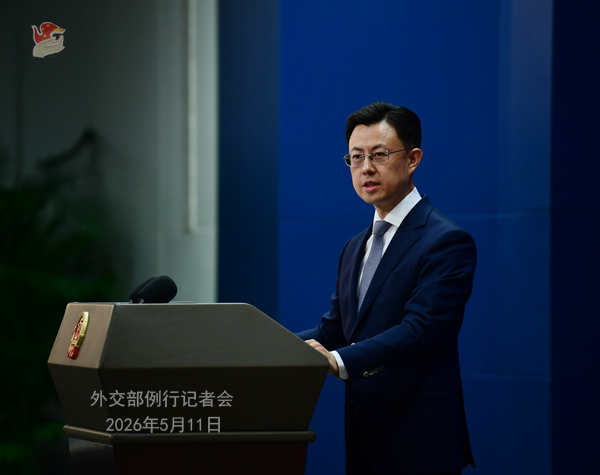
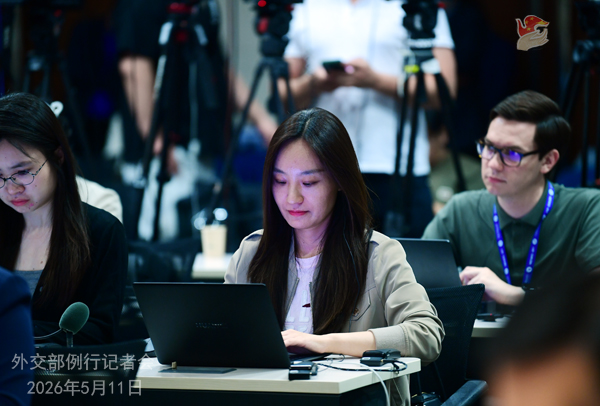
CCTV: My question is about President Trump’s state visit to China. Can you share more details about its program? What does China hope to achieve through the visit?
Guo Jiakun: At the invitation of President Xi Jinping, President Donald Trump is set to pay a state visit to China later this week. The two presidents will yet again meet each other in person since their Busan meeting last October. This will be the first visit to China by a U.S. president in almost nine years. President Xi will have in-depth exchanges of views with President Trump on major issues concerning China-U.S. relations and world peace and development.
Heads-of-state diplomacy plays an irreplaceable role in providing strategic guidance for China-U.S. relations. China stands ready to work with the U.S. to expand cooperation and manage differences in the spirit of equality, respect and mutual benefit, and provide more stability and certainty for a transforming and volatile world.
Phoenix TV: The 79th World Health Assembly (WHA) will open on May 18. Taiwan has not yet been invited to attend. Does the Chinese government have any comment on that?
Guo Jiakun: There is but one China in the world. Taiwan is an inalienable part of China’s territory. The Government of the People’s Republic of China is the sole legal government representing the whole of China. China’s position on the Taiwan region’s participation in the activities of international organizations, including the WHO, is consistent and clear. That is, this must be handled in line with the one-China principle, which is also a fundamental principle recognized by UNGA Resolution 2758 and WHA Resolution 25.1.
China’s Taiwan region, unless given approval by the Central Government, has no basis, reason or right to participate in the WHA. Due to the DPP authorities’ persistent separatist stance, the political foundation for the Taiwan region to participate in the WHA no longer exists. To uphold the one-China principle as well as the sanctity and authority of relevant UNGA and WHA resolutions, China has decided not to approve the Taiwan region’s participation in this year’s WHA. Any attempt to play the “Taiwan card” for political manipulation in defiance of the one-China principle is doomed to fail.
Ukrinform News Agency: Russian presidential aide Yury Ushakov last week stated that continuing trilateral negotiations in the U.S.-Ukraine-Russia format is pointless until Kyiv withdraws its troops from the part of Donbas under its control. How will China comment on Russia’s refusal to resolve the conflict throughout negotiations, which the Chinese side, and Ukraine the same, constantly calls for?
Guo Jiakun: China’s position on the Ukraine issue is consistent and clear.
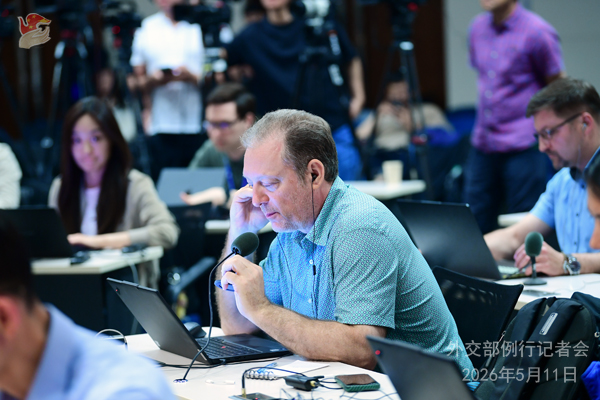
AFP: I was wondering if the foreign ministry could provide details on the U.S.-China trade talks in Seoul. What specific items will be discussed in preparation for Donald Trump’s China visit?
Guo Jiakun: The department responsible has released information on that and I’d refer you to them for anything specific.
AFP: On Friday, the U.S. State Department sanctioned three China-based satellite companies for enabling Iran’s military operations, including providing imagery assisting Iran strikes against the U.S. What is China’s comment on this, especially in the context of Donald Trump’s visit here this week?
Guo Jiakun: China firmly opposes illicit unilateral sanctions that have no basis in international law or the authorization of the UN Security Council. The Chinese government always asks Chinese companies to operate in accordance with laws and regulations. We will firmly protect Chinese businesses’ legitimate rights and interests.
As to the Iran situation, we have made clear our position on many occasions. The pressing priority now is to prevent by all means a relapse in fighting, rather than exploit the situation to throw mud at other countries.
Antara: At the conclusion of the ASEAN Summit last week, ASEAN called the need for a legally binding code of conduct (COC) in the South China Sea in accordance with international law, including the United Nations Convention on the Law of the Sea (UNCLOS) and even at a press conference following the summit, President Marcos expressed optimism that there would be a COC by year-end. Does the ministry have any comment on this?
Guo Jiakun: Formulating a code of conduct in the South China Sea (COC) is an important measure of implementing the Declaration on the Conduct of Parties in the South China Sea (DOC), and also an important agreement between China and ASEAN countries. It will help parties better manage differences, advance cooperation, and keep the South China Sea peaceful and stable. China is having close consultation with ASEAN countries on the text of the COC. We hope parties will stick to our shared goal, focus on common ground, resist disruptions, and strive to reach a COC at an early date.
Xinhua News Agency: At the press conference after the Victory Day ceremonies, Russian President Putin underscored the importance of Russia-China strategic coordination, calling the interaction between Russia and China a key factor of restraint and stability. What is China’s comment?
Guo Jiakun: China and Russia are comprehensive strategic partners of coordination for a new era. Over recent years, under the strategic guidance of President Xi Jinping and President Vladimir Putin, bilateral relations have maintained robust development, providing important stability for a world undergoing changes and turbulence.
This year marks the 30th anniversary of the China-Russia strategic partnership of coordination, the 25th anniversary of the signing of the China-Russia Treaty of Good-Neighborliness and Friendly Cooperation, and the first year of the China-Russia Years of Education, which provides fresh opportunities for further advancing the China-Russia relationship. China stands ready to work with Russia to act in the spirit of ever-lasting good-neighborliness and friendship, comprehensive strategic coordination and mutually-beneficial cooperation, advance cooperation in various areas, and promote the building of a more just and equitable global governance system.
Bloomberg: We’ve reported that President Donald Trump is expected to press China over Beijing’s approach to Iran. Would the ministry like to comment on this?
Guo Jiakun: China’s position on the Iran situation is consistent. We will continue playing a positive role in promoting peace talks and bringing about an end to the conflict.