People’s Republic of China


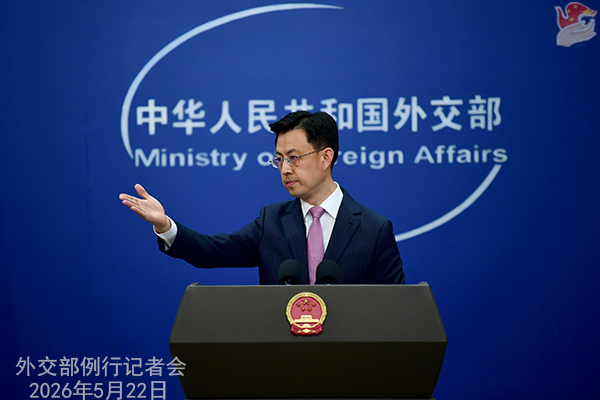
As the rotating president of the UN Security Council for May, China will hold a Security Council high-level meeting on May 26. The theme of this meeting is “Upholding the Purposes and Principles of the UN Charter and Strengthening the UN-centered International System.” Member of the Political Bureau of the CPC Central Committee and Foreign Minister Wang Yi will chair the meeting in New York. He will also attend the meeting of the Group of Friends of Global Governance in New York on May 28, and will have meetings with the UN Secretary General and the foreign ministers from other countries.
At the invitation of Canada’s Minister of Foreign Affairs Anita Anand, Foreign Minister Wang Yi will visit Canada from May 28 to 30.
At the invitation of Member of the Political Bureau of the CPC Central Committee and Foreign Minister Wang Yi, Singaporean Foreign Minister Vivian Balakrishnan will pay a working visit to China from May 24 to 26.
CCTV: Can you share China’s thoughts on holding a high-level meeting at the UN Security Council? What message does Foreign Minister Wang Yi hope the meeting will send?
Guo Jiakun: Today’s world is witnessing accelerating transformations unseen in a century, interwoven reforms and turbulence, and incessant wars and conflicts. The international system with the UN at its core faces unprecedented blows and challenges. As the rotating chair of the Security Council for May, China proposed to hold a high-level meeting at the Security Council. It will focus on issues of extensive interest in the international community, including the relevance of the UN Charter in our times, observing and practicing the purposes and principles of the UN Charter, and enhancing the authority and efficacy of the UN and its Security Council. The meeting will be chaired by Foreign Minister Wang Yi, and open to all member states of the UN. Foreign ministers and high-level representatives of multiple countries have confirmed their attendance, and UN Secretary-General António Guterres will brief the event.
We hope that through the meeting, parties will renew the lofty goals enshrined in the UN Charter, reiterate their firm commitment to multilateralism, and unite closer together and step up to their responsibility to revitalize the status and role of the UN and pool greater synergy for reforming and improving global governance.
CGTN: On May 20, China and Russia issued a joint statement on advocating a multipolar world and a new type of international relations, systemically clarifying the four propositions on advocating an equal and multipolar world and building a new type of international relations. The statement clearly answers the question of the times regarding the future of international relations. A CGTN poll shows that the concept of mutual respect, fairness and justice and win-win cooperation advocated in the new type of international relations has become a prevailing international consensus. The interviewees refused to divide the world into various regions and blocs engaging in confrontation, and emphasized that an international community with greater solidarity must be built, in which members respect each other’s core interests, treat each other as equals and conduct mutually beneficial cooperation. What’s your comment?
Guo Jiakun: Transformation not seen in a century is accelerating across the globe, and the international situation is fluid and turbulent. As resurgent unilateralism and hegemonism deals a heavy blow to the international system with the UN at its core and the international order based on international law, the world risks regressing to the law of the jungle. As permanent members of the UN Security Council and responsible major countries, China and Russia must step up to their bound duty and jointly safeguard the authority of the UN and international fairness and justice. The statement elaborates on the positions and propositions shared by China and Russia on the current international situation and makes it clear that the two sides will further deepen strategic coordination on building a multipolar world and improving global governance, make a strong call of the times, and be a source of stability and strength for the cause of world peace and development.
AFP: The acting U.S. navy secretary said Thursday that arm sales to Taiwan had been put on pause to ensure that the American military had sufficient munitions for its Iran operations. Taiwan said Friday that there was no information indicating that the U.S. intends to make any adjustments to this arms sale. What is the Chinese foreign ministry’s comment on this?
Guo Jiakun: China’s opposition to U.S. arms sales to China’s Taiwan region is consistent, clear and firm.
People’s Daily: Could you share the considerations behind Foreign Minister Wang Yi attending the meeting of the Group of Friends of Global Governance?
Guo Jiakun: President Xi Jinping put forward the Global Governance Initiative in September last year, which offers Chinese solutions to building a more just and equitable global governance system. It has been recognized and supported by nearly 160 countries and international organizations within a short period of time. In December last year, the Group of Friends of Global Governance was inaugurated in New York. Within just five months, the group was successively launched in Geneva and Vienna. With growing membership, its influence and cohesion has also been on the rise. This fully shows that the Global Governance Initiative stands at the forefront of our times and meets the need of all countries. It is where the arc of history bends and public opinion trends,
We hope all parties will take the upcoming Group of Friends meeting as an opportunity to build consensus on reforms, strengthen coordination and cooperation, find effective solutions to global challenges, jointly safeguard the authority and stature of the United Nations, and foster a more just and equitable global governance system.
CCTV: Yesterday, you briefed us on the outcomes of President Putin’s visit. We noted that the two presidents signed the joint statement on further strengthening comprehensive strategic coordination and deepening good-neighborliness and friendly cooperation. What’s the significance of the joint statement?
Guo Jiakun: This year marks the 30th anniversary of the China-Russia strategic partnership of coordination and the 25th anniversary of the signing of the Treaty of Good-Neighborliness and Friendly Cooperation Between China and Russia. The joint statement you mentioned highlights the two anniversaries, covers nearly all sectors of bilateral cooperation and is the most important document of political outcomes of the meeting between the two presidents.
The two sides spoke highly of the historical significance and the relevance of the Treaty of Good-Neighborliness and Friendly Cooperation Between China and Russia and announced to further extend the treaty. The two sides expressed readiness to enhance high-level exchanges, deepen mutually beneficial cooperation in economy and trade, energy, science and technology, culture, people-to-people exchanges and other fields. The two sides made clear shared proposition and just position on strategic stability, shipping security, climate change as well as international and regional hotspot issues. The two sides will step up communication and coordination on multilateral platforms, such as the UN, SCO, BRICS, APEC and the G20, jointly advocate an equal and orderly multipolar world and a universally beneficial and inclusive economic globalization, and build a more just and equitable global governance system.
The joint statement further consolidates the foundation of China-Russia comprehensive strategic partnership of coordination for the new era, and charts the course for future China-Russia cooperation in various fields. As the two presidents signed and issued the joint statement, China stands ready to work with Russia to carry forward the spirit of equality, mutual respect, good faith and win-win cooperation, and work for higher-quality development of China-Russia relations.
Xinhua News Agency: Could you brief us on the background, main program and China’s expectations of Foreign Minister Wang Yi’s visit to Canada?
Guo Jiakun: China-Canada relations have maintained a positive momentum of growth after experiencing a turnaround. The two sides have been working towards building a new strategic partnership.
As the first visit by a Chinese foreign minister to Canada in ten years, Foreign Minister Wang Yi’s trip is of great significance for consolidating the positive momentum in the turnaround of bilateral relations. During the visit, Foreign Minister Wang Yi will have in-depth exchanges with the Canadian side on how to implement the important common understandings at the leadership level and the outcomes of Prime Minister Mark Carney’s recent China visit in January, and how to build a truly substantive China -Canada new strategic partnership, as well as international and regional issues of mutual interest.
It is our hope that through this visit, the two sides could enhance political mutual trust, expand mutually-beneficial cooperation, properly manage differences, and ensure that bilateral ties will continue to move forward on the track of sound, steady, and sustainable development to deliver more benefits to both peoples.
AFP: Taiwanese prosecutors are investigating three people for allegedly smuggling Nvidia AI chips to China in violation of U.S. export controls. Does the foreign ministry have a comment on this?
Guo Jiakun: It is not a question about foreign affairs. I’m not aware of that.
Beijing Daily: It is reported that Japan’s Liberal Democratic Party has drafted proposals for increasing defense spending, citing countries with defense budget accounting for 3-3.5 percent of their GDP, far higher than Japan’s current level of 1.4 percent. Meanwhile, recent years have seen a large increase in defense-related sales revenue of Japanese key defense contractors. What is China’s comment?
Guo Jiakun: According to the latest statistics, Japan’s defense expenditure increased by 9.7 percent in 2025, which hit a record high. Its imports of weapons increased by 76 percent over the past five years. Japan’s defense budget has been increasing for 14 consecutive years, but Japanese right-wing forces are still clamoring for increasing defense spending. It once again shows that Japan’s “country for peace” mask is coming off and it is slipping towards neo-militarism.
The Potsdam Proclamation, the Japanese Instrument of Surrender and a series of documents with full legal effect under international law explicitly require Japan to be “completely disarmed” and not to maintain industries that “would enable her to re-arm for war.” After WWII, Japan’s Constitution also made strict restrictions on the country’s military forces, the right of belligerency and the right to war, and Japan has established the “exclusively defense-oriented principle” through legislation. Japanese defense contractors were major engines for Japanese militarism to take the country hostage and invade others. Now, Japan’s right-wing forces are pursuing a surge in defense budget, relaxing its export restrictions on lethal weapons, supporting the development of the defense industry and even attempting to turn it into a pillar of the economy to serve its agenda of military buildup and remilitarization.
Countries in the Asia Pacific need to watch out against and firmly resist reckless moves of Japanese neo-militarism to jointly safeguard order of peace in this region.
China News Service: Starting from May 1, 2026, China has extended zero-tariff treatment to 53 African countries having diplomatic relations with China across the board. Various sectors of Africa pay high attention to this policy and African leaders have spoken highly of it. African Union Commission Chairperson Mahmoud Ali Youssouf said that President Xi Jinping’s decision to grant zero-tariff treatment to products from African countries is a “very timely” move, and appreciated this very brotherly gesture. The presidents of South Africa, Kenya, Sierra Leone, Seychelles and other countries have expressed their firm support and expectations on the zero-tariff policy. Can you share with us how the zero-tariff treatment is implemented?
Guo Jiakun: China is the first major economy to voluntarily extend zero-tariff treatment to all African countries having diplomatic ties with China. We have practiced President Xi Jinping’s solemn commitment to African leaders with concrete actions. Since the implementation of the zero-tariff policy over 20 days ago, multiple shipments of goods from Africa have cleared customs at various ports and entered China smoothly. At midnight on May 1, 24 tons of South African apples became the first batch of imports to China under the zero-tariff policy. In addition, multiple African distinctive quality products including avocados from Kenya, fresh citrus fruits from Egypt, gypsum from Morocco, bovine bone chips from Nigeria and wine and pharmaceutical raw materials from South Africa have entered China tariff-free and are now available for Chinese consumers in supermarkets. The zero-tariff treatment has not only enriched the supplies in Chinese market and lowered the cost of trade between China and Africa, but greatly boosted African manufacturers and sellers’ confidence.
The zero-tariff policy is not a standalone tax arrangement, but part of a broader package of coordinated supporting measures. China has upgraded the “green lanes” for import of African agricultural and food products to China, streamlined the quarantine clearance procedures and introduced facilitation measures such as tiered risk-based management, translating the zero-tariff policy into tangible benefits that can be seen, felt and enjoyed.
As part of the broader symphony between China and Africa, the zero-tariff policy underscores the China-Africa relationship featured by sincerity, real results, amity, good faith, people-to-people bond and common development. China will continue to sign agreements on economic partnership for shared development with African countries and build institutional safeguards on long-term, stable and predictable economic cooperation to ensure the sustained and effective implementation of the zero-tariff treatment so as to better serve the high-quality cooperation between China and Africa in the future.
Global Times: It’s reported that the U.S military is set to deploy its Typhon mid-range capability missile system in Japan’s Kanoya Airbase in Kagoshima prefecture during the U.S.-Japan military exercises scheduled between June and September. After the exercises conclude, the system will be transferred to a U.S. military base in Japan. Can I have your comment on this?
Guo Jiakun: We noted the reports. China opposes the U.S. deployment of mid-range capability missile systems in Asian countries, and has expressed concerns over this on multiple occasions. The deployment of Typhon, a strategic offensive weapon, will harm the legitimate security interests of other countries, threaten regional strategic security, and push up the risk of military confrontation and arms race. It will bring nothing but harm to peace and stability in the region. Over the years, people from multiple Asian countries, including Japan, have voiced their opposition to the deployment. China urges the U.S. and Japan to listen to the calls of regional countries, correct the erroneous practice, and play a positive role with concrete actions for regional peace and stability.
This move is yet another example of Japan’s accelerated remilitarization. Various signs show that Japanese right-wing forces are seeking to have an overall restructuring of Japan’s military capabilities and preparing for a so-called “extended conflict.” This essentially will hollow out Japan’s Constitution and the rules of international and domestic laws, and challenge the postwar international order, which is inconsistent with Japan’s self-claimed image as a “country for peace.” The malevolent emergence of Japanese neo-militarism may once again become a source of regional turbulence. The international community must keep in mind the lessons from history, stay on high alert, and jointly restrain this dangerous momentum.