People’s Republic of China


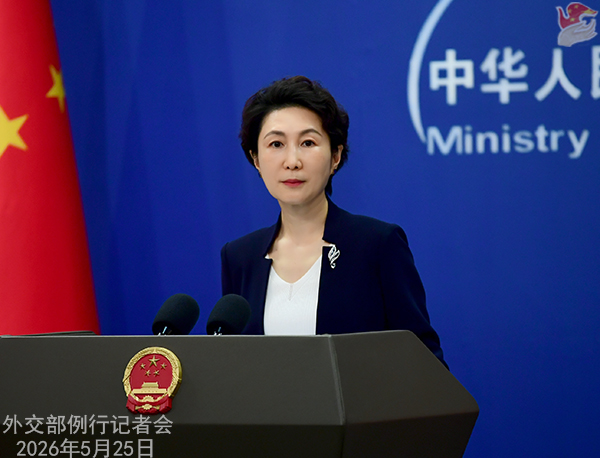
Beijing Youth Daily: Recently, Ms. Yin Yuzhen, a national model worker who has devoted her life to transforming the Maowusu Desert in northern China through afforestation, took to social media to find an American known to her only as Mr. Sakolsky, who donated to her cause many years ago. Just a few days later, they were reconnected online. Many have applauded the acts of kindness and friendship that transcend borders highlighted in this story. Would you like to comment on it?
Mao Ning: More than 20 years ago, Mr. Ronald Sakolsky, then working in China as an American teacher, managed to secure a donation of US$5,000 to support the afforestation efforts of Ms. Yin Yuzhen and her husband. Today, the saplings planted with that donation have grown into a forest of over 50,000 trees. This story is a vivid example of friendly people-to-people exchanges between the two countries. Just as President Xi Jinping noted, the stories of China-U.S. relations are written by our peoples. We are confident that the two peoples will keep adding new chapters of friendship and injecting fresh vitality into bilateral ties.
AFP: The U.S. and Iran appear to be close to an agreement to end war in the Middle East. Is China playing a diplomatic role to achieve this agreement and what does China hope to see as the outcome of this agreement?
Mao Ning: China’s position on the Iran situation is very clear. It is a conflict that should not have happened in the first place and there is no point in prolonging it any more. To find an early way to resolve the situation is in the interest of not only the U.S. and Iran, but also regional countries and the rest of the world.
The recent U.S.-Iran ceasefire and effort to explore resolving issues through negotiation is welcomed by regional countries and the international community. China always believes that dialogue and negotiation is the right way forward, and the use of force is a dead end. It is important to steady the momentum in easing the situation, keep to the direction of political settlement, engage in dialogue and consultation, and reach a settlement that accommodates the concerns of all parties. It is important to reopen the shipping lanes as soon as possible to respond to the call of the international community and jointly keep the global supply chains stable and unimpeded. It is important to reach a comprehensive and lasting ceasefire as soon as possible and enable peace and stability to return to the Middle East and Gulf region at an early date.
Since the conflict began, China has been working for peace and an end to the conflict. President Xi Jinping put forward the four propositions on safeguarding and promoting peace and stability in the Middle East. China will continue to act in line with these propositions, and work with the international community to provide stronger support for peace talks and play a constructive role in achieving lasting peace in the Middle East.
CGTN: The 11th Review Conference of the Treaty on the Non-proliferation of Nuclear Weapons (NPT) concluded at the UN headquarters in New York on May 22. It is reported that the review conference ends without consensus outcome due to the divisions between the U.S. and Iran. What’s China’s comment?
Mao Ning: The 11th Review Conference was convened at a time when the global strategic balance and stability was severely disrupted and the multilateral arms control process has become increasingly politicized, bloc-based and fragmented. China regrets the conference’s failure to reach a final document.
China believes that the NPT is still the cornerstone of the international non-proliferation and nuclear disarmament regime. It is an indispensable pillar of the international security architecture after WWII. It serves the interests of all states parties to continue to firmly support the purposes and goals of the NPT.
China attaches great importance to the treaty, and supports the universality, effectiveness, and authority of the treaty. Chinese delegation has intensively and constructively participated in the review conference in the spirit of solidarity and coordination. China calls on all states parties to uphold true multilateralism and the concept of common security, improve the international and regional security environment, earnestly safeguard global strategic stability, eliminate the root causes of the proliferation of nuclear weapons, create more favorable conditions for orderly advancing the process of nuclear disarmament, peacefully resolve the hotspot issues related to nuclear non-proliferation through dialogue and negotiation, earnestly defend the legitimate rights and interests of all countries to the peaceful uses of nuclear energy, and fully leverage the important role of the NPT for peace and development in this era.
Reuters: It’s reported that President Xi and U.S. President Trump talked about Japan and its “remilitarisation” at their summit almost two weeks ago. The media reports said that Trump defended Japan and Prime Minister Takaichi when criticism of her came up during their talks. Was Japan a topic during the summit between Trump and Xi? If so, what was the discussion focused on?
Mao Ning: On the meetings between the Chinese and U.S. presidents, we’ve released readouts. The report you mentioned is not consistent with the information that the Chinese side has. China’s position on its relations with Japan is clear.
China News Service: According to reports, a bomb attack targeting a passenger train in the Balochistan province of Pakistan on May 24 has caused heavy casualties. The Balochistan Liberation Army has claimed responsibility for the attack. Pakistani Prime Minister Shehbaz Sharif strongly condemned the attack and reaffirmed the country’s steadfast determination to eliminate terrorism. What’s China’s comment?
Mao Ning: We have noted the reports and strongly condemn this terrorist attack. We express deep condolences for the lives lost and heartfelt sympathies to the injured and the bereaved families.
China stands resolutely against terrorism in all its forms and will continue firmly supporting Pakistan in combating terrorism, maintaining solidarity and stability, and protecting public safety. We stand ready to further strengthen counter-terrorism cooperation with Pakistan to jointly safeguard regional peace, security and stability.
DPA: A multiparty delegation of lawmakers from Germany is starting a visit to Taiwan. A member of the delegation said that “Taiwan is a very important partner for Germany.” The delegation is set to meet with Lai Ching-te. What is the foreign ministry’s comment?
Mao Ning: There is but one China in the world, and Taiwan is an inalienable part of China’s territory. China firmly opposes official interactions of any form between China’s Taiwan region and countries having diplomatic ties with China. The one-China principle is a well-recognized norm in international relations and a prevailing international consensus. It is also the political foundation for China-Germany relations. We urge certain people from Germany to abide by the one-China principle, and stop sending wrong messages to “Taiwan independence” separatist forces. The DPP authorities’ attempt to solicit external support for their “independence” agenda will surely end in failure.
Reuters: China has stopped exporting to Japan several heavy rare earths and other materials for at least four months, according to the Chinese customs data. The timing coincides with the dispute between China and Japan over Taiwan. Can we confirm if Beijing has effectively stopped these exports in response to Japanese Prime Minister Takaichi’s remarks on Taiwan?
Mao Ning: For anything specific, I’d refer you to competent authorities. Let me say that China banned the export of dual-use items to Japanese military users and for military purposes in accordance with laws and regulations to contain Japan’s remilitarization and its attempt to possess nuclear weapons.
AFP: The Pakistani prime minister is in China right now. Will Iran and war in the Middle East be discussed during his visit?
Mao Ning: Pakistani Prime Minister Shehbaz Sharif is currently in China. We will release timely information about the visit. Please stay tuned.
AFP: A similar question regarding the visit from Serbian president, who is currently in China too. He will meet with Chinese President Xi Jinping. So what will be discussed during this meeting and what are China’s expectations?
Mao Ning: Leaders of the two countries will exchange views on issues of mutual interest. We will release information about the visit in a timely manner.
AFP: According to press reports, Chinese leader will visit the DPRK. Is it true? And if so, when will he go?
Mao Ning: China and the DPRK are friendly socialist neighbors. The two parties and two countries have a long-term tradition of friendly exchanges, which serves the interests of the two sides as well as peace and stability in the region. For your specific question, I have no information to offer at the moment.
AFP: Taiwanese authorities claim that the Chinese mainland deployed more than 100 vessels to the region last week from the Yellow Sea to the South China Sea. So some are located near South Korea, Japan and the Philippines, according to the map they provided. What is your response to this claim by the Taiwanese authorities?
Mao Ning: The remarks of “Taiwan independence” separatists are not worth commenting. Let me say that the Chinese military carries out activities in accordance with international law and international practice. China is always a constructive force for peace and stability in the region.