People’s Republic of China


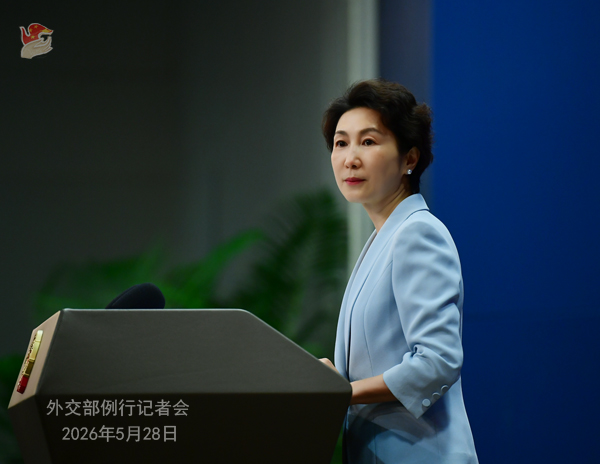
At the invitation of Member of the Political Bureau of the CPC Central Committee and Minister of Foreign Affairs Wang Yi, Minister of Foreign Affairs of Brazil Mauro Vieira will pay an official visit to China from May 31 to June 2.
Hubei Media Group: To follow up on the visit by Brazilian Foreign Minister Mauro Vieira that you just announced, how does China see its current relations with Brazil? Could you share the program of the visit and the outcomes that China hopes it will yield?
Mao Ning: China and Brazil, each the largest developing country in its hemisphere, are both important members of BRICS and the Global South. China-Brazil relations have long been at the forefront of China’s relations with fellow developing nations. In recent years, under the strategic guidance of the heads of state of the two countries, bilateral ties have maintained a sound momentum of growth. There has been smooth progress in building a China-Brazil community with a shared future and synergizing development strategies, and fruitful outcomes in practical cooperation in various areas. The relationship is demonstrating increasing global, strategic and long-term influence.
During this upcoming visit, Foreign Minister Wang Yi will co-chair with Foreign Minister Mauro Vieira the fifth China-Brazil Foreign Ministerial-Level Comprehensive Strategic Dialogue. It is our hope that through the visit both sides will further consolidate political and strategic mutual trust, make continued progress in building a community with a shared future, demonstrate a sense of responsibility in promoting solidarity and cooperation among Global South countries, and contribute to world peace and stability.
Yonhap News Agency: Responding to a recent statement in which the Quad nations reaffirm their commitment to the complete denuclearization of the DPRK, a foreign ministry spokesperson of the country stressed today that the denuclearization of the DPRK will never happen. What does China think of this position?
Mao Ning: China has made clear its position on the Quad grouping more than once. We are consistently against forming exclusive groupings and inciting bloc confrontation. As to the Korean Peninsula issue, China’s position and policy maintain continuity and consistency.
Global Times: It’s reported that Japan’s House of Councillors this week passed legislation to establish a national intelligence council and a national intelligence bureau. The bill aims at building a national system to centralize information, the first of its kind since WWII. With the national intelligence council at the core and the national intelligence bureau as an implementation body, the system will be in charge of coordinating intelligence activities. What’s your comment?
Mao Ning: We’re concerned over the reports and noted that Japan’s move has already been questioned amid widespread skepticism both in Japan and the international community. Some Japanese experts pointed out that the legislation may blur the boundary of national security and be used to build an all-round system to prepare for war. People with insights also said that it is not only Japan’s internal affair but also a major issue concerning constitutional system and domestic and foreign security policies. Looking back, Japan’s intelligence community paved the way for the country to fully advance militarism and launch war of aggression, which led to innumerable crimes against its Asian neighbors and Japan’s own people. Japanese lawmakers need to learn lessons from history and act prudently.
AFP: The European Union’s industry chief told the Financial Times newspaper ahead of a meeting of EU commissioners on Friday that the EU plans to expand tools to address imbalanced trade with China which includes stepping up the use of import quotas and tariffs to protect certain sectors like chemicals and clean technology against unfair competition. I wonder if China has any comment?
Mao Ning: International trade is a two-way street. There’s no forced trade. The China-EU trade relations are win-win in nature. China does not aim for trade surplus. Focusing only on trade in goods while ignoring trade in services and investment returns, on pure quantities while overlooking trade structure and profit flows, and on imports from China while neglecting one’s own export restrictions—anyone who sees trade this way sees nothing but imbalance.
Whatever the terms—“de-risking,” “reducing reliance” or “trade imbalance,” they are just different names for protectionism, and will only hurt the interest of European consumers, raise companies’ costs and weaken Europe’s industry competitiveness in the long run. The EU needs to put trade ties with China in perspective and honor its commitment to free trade. China will closely follow the EU’s moves and take all measures necessary to safeguard legitimate rights and interests.
RT: The Chinese Embassy in the U.S. said in a recent post that China implements rare earth export controls in accordance with laws and regulations. However, the Chinese and U.S. teams had agreed earlier to suspend the restrictive measures till November 10 this year. Why is China resuming relevant export controls ahead of schedule?
Mao Ning: As I’ve learned, the Chinese embassy in the U.S. shared information about the preliminary outcomes of China-U.S. economic and trade consultations. China and the U.S. need to work together to deliver on the important common understandings between the two presidents and uphold the momentum of steady development of China-U.S. economic and trade ties.
Reuters: The International Institute for Strategic Studies has come out with its strategic assessment report. It says that a major conflict between the U.S. and China over Taiwan could risk escalation, potentially to a nuclear level, and both sides could target each other’s commands and communication hubs. How does the ministry view this assessment?
Mao Ning: The Taiwan question is China’s internal affair. Resolving the question is a matter for the Chinese ourselves that brooks no external interference. To keep the Taiwan Strait peaceful and stable, it is absolutely essential to unequivocally oppose “Taiwan independence.” The U.S. side should earnestly implement the important common understandings between the two presidents in their meetings and exercise extra caution in handling the Taiwan question.