People’s Republic of China


Folha de S.Paulo: Yesterday, President Donald Trump designated two criminal organizations in Brazil as terrorist organizations, a decision that the Brazilian government disagrees with and that government allies and experts have described as a form of U.S. intervention in Brazil. U.S. Secretary of State Marco Rubio said that the United States is committed to dismantling these criminal organizations, which have already been the target of Brazilian law enforcement efforts for many years. What is China’s comment on this U.S. decision to make such a designation?
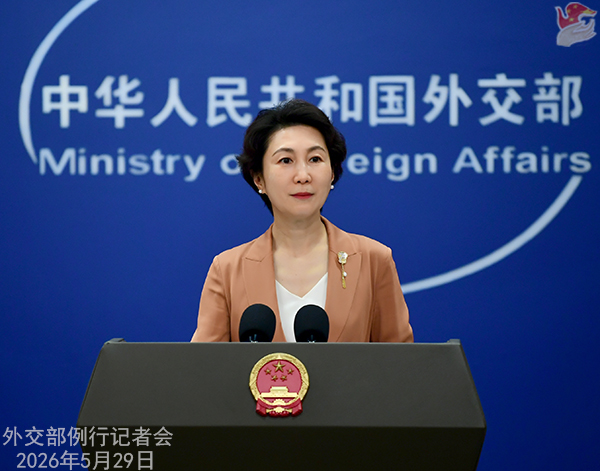
Mao Ning: We have noted relevant reports. China always advocates non-interference in other countries’ internal affairs.
China News Service: Since China proposed the Global Governance Initiative last year, the initiative has received warm response from the international community. Foreign Minister Wang Yi yesterday attended the meeting of the Group of Friends of Global Governance at the UN Headquarters in New York. Can you give us more details?
Mao Ning: Amid turbulence and changes in the international landscape, countries call for fairness, justice, solidarity and cooperation and aspire for peace and stability. In September last year, President Xi Jinping put forward the Global Governance Initiative and received immediate support and response from nearly 160 countries and international organizations. The Group of Friends of Global Governance was established in New York, Geneva and then in Vienna. Member countries had extensive discussions on reforming and improving global governance and reached common understandings on five topics, namely working for greater democracy in international relations, upholding the purposes and principles of the UN Charter, defending the central role of the UN, gradually bridging the South-North gap, and focusing on addressing real problems.
Yesterday, the meeting of the Group of Friends of Global Governance was held at the UN Headquarters in New York and was attended by representatives from over 60 countries. Foreign Minister Wang Yi attended and addressed the meeting. He proposed nine aspects for reforming and improving global governance. First, promote the reform and increase the efficiency of the UN. Second, improve the authority and efficacy of the Security Council. Third, enable peacekeeping operations to keep abreast with the times. Fourth, pool international consensus for faster growth. Fifth, revise the direction of international human rights governance. Sixth, deepen the reform of the economic and financial system. Seventh, establish rules for AI management. Eighth, enhance governance of new frontiers including the cyberspace and outer space. Ninth, promote exchanges between civilizations for broader-based inclusiveness and mutual learning. Representatives from various countries at the meeting spoke highly of the Global Governance Initiative. They noted that the nine aspects China proposed align with the goals of the UN80 Initiative, and expressed the hope to jointly work for a more just and equitable global governance system. A joint communiqué was issued at the meeting.
The Group of Friends of Global Governance is a stabilizing factor and just force in the volatile world. China stands ready to work with various parties to make good use of and strengthen the mechanism, make joint plans for reforming and improving global governance, and build a community with a shared future for humanity.
AFP: The European Commission is holding a meeting today where it is expected to introduce measures to shield European industry from Chinese competition. Does China have a message to the EU ahead of this meeting?
Mao Ning: The China-EU trade relations are win-win in nature. China does not aim for trade surplus. Protectionism will only hurt the interest of European consumers and weaken Europe’s industry competitiveness. We hope the EU will put trade ties with China in perspective and honor its commitment to free trade. China is closely following the EU’s moves and will take measures necessary to safeguard legitimate rights and interests.
CCTV: Replying to a letter from Chinese and U.S. students participating in “A Shared Voyage: China-U.S. Youth Friendship Program”, President Xi Jinping noted that the target set in the “50,000 in Five Years” Initiative has been met two and a half years ahead of schedule. Do you have more information on this?
Mao Ning: A few days ago, President Xi Jinping replied to a letter from Chinese and U.S. students participating in “A Shared Voyage: China-U.S. Youth Friendship Program.” He noted in this letter that since he launched the initiative to invite 50,000 young Americans to China for exchanges and study over the next five years in November 2023, more than 50,000 young Americans have come to China for visits and exchanges, meeting the target two and a half years ahead of schedule. In the course of interactions, young people of China and the United States have reached out to one another, deepened mutual understanding, built profound friendship and turned a new page in the friendly exchanges between the two peoples.
Just as President Xi Jinping pointed out, young people are full of vitality and dreams. They represent the future and hope of China-U.S. relations, and also of the world. It is hoped that more young people from the two countries will take up the baton of the bilateral friendship, learn from each other and make progress together, act as “envoys of friendship” bridging the Pacific Ocean, and make new contributions to the stable, sound and sustainable development of China-U.S. relations.
Xinhua News Agency: From May 28 to 29, Shanghai Jiao Tong University and the Memorial Hall of the Victims in Nanjing Massacre by Japanese Invaders organized the International Symposium Commemorating the 80th Anniversary of the Opening of the Tokyo Trials. Experts and scholars from countries including China, Japan, the ROK, Malaysia, Russia, Germany, Spain, Australia, New Zealand and Brazil have exchanged views on the Tokyo Trials. What’s your comment?
Mao Ning: We noticed relevant reports. Recently, events commemorating the 80th anniversary of the opening of the Tokyo Trials have been held in China and Japan and by the international community. These days, scholars from multiple countries have come to Shanghai to attend the symposium on the Tokyo Trials. It is a strong testament to the international community’s strong emphasis on the significance of the Tokyo Trials, the common pursuit of humanity’s conscience, fairness and justice, which is embodied in the Tokyo Trials, and the common concern over defending the outcomes of the victory of World War II, safeguarding the postwar international order and urging Japan to not repeat its past mistakes of militarism.
The Tokyo Trials, a litmus test of humanity’s conscience, delivered historical justice. With neo-militarism rising in Japan and beginning to pose a real threat, it is all the more relevant to renew the backdrop, conclusion and principles of the Tokyo Trials. We will work with all peace-loving countries and people to firmly reject any attempts to reverse history’s verdict on aggression. We also admonish Japanese right-wing forces to listen to the calls for justice and stop plunging further down the dead-end path of neo-militarism. The lessons of the history are still fresh in memory. Anyone who undermines peace and challenges righteousness and consciousness is bound to be brought once again before the court of history and justice.
Reuters: There have been reports that a Canadian warship transited the Taiwan Strait. Is the foreign ministry able to confirm this and do you have any comment?
Mao Ning: China respects the right of navigation that all countries are entitled to under international law, but firmly opposes acts that undermine China’s sovereignty and security in the name of freedom of navigation.
Shenzhen TV: Media reports show that according to data recently released by the Japanese government, orders from the Ministry of Defense have tripled over the past five years, making up half of the government’s public procurement orders in fiscal year 2025, as a result of Japan’s policy to bolster defense capabilities. These figures stand out in particular. The reports also note that rising demand for surface-to-air missiles, aircraft and other weapons has driven the growth. What is China’s comment on this?
Mao Ning: We have noted the reports with deep concern. The reactivation and rapid rise of Japan’s military‑industrial complex represents another major development in Japan’s accelerating remilitarization. It is raising widespread concern both within Japan and across the international community.
Japan’s military‑industrial complex was once deeply embedded in its economy, hijacked state decision‑making and fueled its war machine. It served as a key behind‑the‑scenes driver and economic base for Japan’s growing military ambitions, which led eventually to full-blown militarist aggression and expansion. Bearing in mind the lessons of history, a series of legally binding international instruments including the Cairo Declaration, the Potsdam Proclamation and Japan’s Instrument of Surrender explicitly require Japan to be completely disarmed and not to maintain industries that would enable it to re-arm for war.
Today, however, the Japanese government keeps easing restrictions and providing support for its military industry through allocating more funds, increasing institutional support and easing export restrictions. Senior officials of the Japanese government spare no effort to promote arms sales in the world in an attempt to develop the military industry into an economic pillar of the nation. This contravenes Japan’s self-claimed image as a “pacifist nation.” Government budget that should have been used to improve people’s well-being is now used for military orders. Production lines that should have been used to produce home appliances are now churning out lethal weapons. Does Japan intend to return to the path of militarist expansion? All peace-loving people in the world, including the Japanese people, must stay on high alert.
CCTV: Yesterday during the Philippine President’s visit to Japan, the two countries issued a joint statement announcing the start of talks on the delimitation of exclusive economic zone and continental shelf between Japan and the Philippines. What’s China’s comment?
Mao Ning: The area the two countries announced they will delimit is east of China’s Taiwan island. According to China’s domestic law and international law including UNCLOS, China has exclusive economic zone and continental shelf in this area. Japan and the Philippines’ so-called maritime delimitation talks constitute a severe violation of China’s maritime rights and interests, UNCLOS and other international law and basic norms governing international relations. China strongly deplores and firmly opposes that and has lodged serious protests with both countries.
The so-called delimitation talks are completely illegal, null and void, and will have no effect on China’s claims to rights in the area east of the Taiwan island or exercise of China’s lawful rights. China urges Japan and the Philippines to immediately stop any violation of China’s maritime rights and interests and take concrete actions to uphold regional peace and stability.
Beijing Daily: We noted the General Administration of Customs (GAC) announced that starting from July 20 this year, China will grant full market access to coffee beans meeting quarantine requirements from all African countries that have diplomatic ties with China. These coffee beans can enter the Chinese market as long as they comply with requirements stipulated in GAC Announcement No.68 of 2026, becoming yet another agricultural product that enjoys unified regional market access. This announcement is warmly welcomed by relevant African countries. Can I have your comment on this?
Mao Ning: Zero-tariff for 53 African countries having diplomatic ties with China is a new window of opportunity for African exports. The policy is a concrete example of China committing to principles put forward by President Xi Jinping—sincerity, real results, amity and good faith and pursuing shared interests with Africa. We are happy to see more African quality and specialty products in the Chinese market, and will implement the zero-tariff policy well and upgrade green lanes for African imports to allow greater access and better benefit both peoples.