People’s Republic of China


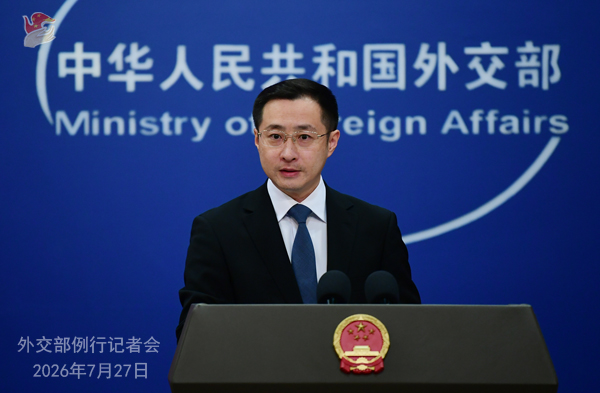
The High-level Meeting on the Global Development Initiative will be held in Beijing on July 28. Member of the Political Bureau of the CPC Central Committee and Minister of Foreign Affairs Wang Yi will attend the meeting and deliver remarks.
The meeting will be themed on “The Global Development Initiative at Five Years: Joining Hands for A Brighter Future of Sustainable Development.” UN senior officials, diplomatic envoys of member states of the Group of Friends of the GDI in China, representatives from China offices of the UN development system, renowned experts and scholars, and other Chinese and foreign guests will attend the meeting to have in-depth exchanges of views on the implementation of the GDI, cooperation priorities and the initiative’s contribution to the world.
China News Service: During the 48th session of the World Heritage Committee, the United Nations Educational, Scientific and Cultural Organization (UNESCO) added China’s Jingdezhen Handicraft Porcelain Industry Sites to the World Heritage List. What’s your comment?
Lin Jian: On July 25, a resolution was adopted by consensus at the 48th session of the World Heritage Committee held in Busan, the ROK, which inscribed the Jingdezhen Handicraft Porcelain Industry Sites on the UNESCO World Heritage List, bringing the total number of World Heritage sites in China to 61.
Jingdezhen Handicraft Porcelain Industry Sites are a group of heritage sites representing the handicraft porcelain industry system that developed in Jingdezhen from the 10th to the 19th century. The property exhibits the innovative development of China’s handicraft porcelain making technology, porcelain art and porcelain industry, and evidences the profound impact of China’s handicraft porcelain industry on the development of the world’s ceramic industry and the exchanges and mutual learning among civilizations. The committee spoke highly of the authenticity and integrity of the heritage sites and commended the policies and efforts made by the Chinese government in the preservation and management of the heritage sites.
In 2023, during the inspection trip in Jingdezhen, President Xi Jinping noted that ceramics are a Chinese treasure and an important calling card of Chinese civilization. He called for more efforts to make the millennium-old porcelain capital shine even brighter. The inscription of the Jingdezhen Handicraft Porcelain Industry Sites on the World Heritage List is a vivid example of how the Xi Jinping Thought on Culture and the Xi Jinping Thought on Diplomacy are implemented, and how China puts into practice its people-centered development philosophy. It also demonstrates the strong recognition from the international community on China’s efforts on world heritage preservation and development.
The inscription on the World Heritage List is not the purpose of heritage preservation, but a new starting point to strengthen the inheritance and development of cultural heritage. China will work with the international community to earnestly act on the Global Civilization Initiative, observe the Convention Concerning the Protection of the World Cultural and Natural Heritage, actively participate in the global governance on world heritage, and contribute China’s wisdom and strength to the exchanges and mutual learning among civilizations.
Reuters: Regarding the sunken Vietnamese cargo ship in South China Sea, are there continuing efforts between Viet Nam and China to look for the remaining missing people? As this incident takes place around the Spratly Islands, does China view the Viet Nam vessel as having passed through Chinese territorial waters? Has there been any tension raised over this incident?
Lin Jian: On July 25, a Chinese rescue vessel Nanhai Jiu 115 spotted and rescued 29 crew members of a distressed Vietnamese ship in waters near Nansha Qundao. The Chinese side immediately sent out several vessels and a helicopter to continue search and rescue operations. Until now, China has rescued 47 Vietnamese crew members. After giving medical treatment to those who are injured, the Chinese side transferred all rescued personnel to the Vietnamese side. The Vietnamese side has expressed thanks to the Chinese side. We have learned that the Vietnamese vessel was carrying 62 crew members when it sank on the night of July 24. The search for those who remain missing is still ongoing.
On your second question, the Chinese side immediately started rescue operations upon learning of the Vietnamese vessel in distress. The Vietnamese side has expressed thanks to the Chinese side.
Polish Press Agency: According to an announcement of the Commerce Ministry on July 24, China put restrictions on a company and a polytechnic university of Poland. China always opposes politicizing technology, education and trade exchanges. Isn’t the above-mentioned announcement politicizing academic and trade exchanges and exerting maximum pressure?
Lin Jian: On specifics about export controls, I’d refer you to competent authorities. Let me stress that China’s measures are a response to the EU’s erroneous move of listing and sanctioning Chinese companies. The measures do not target any specific country.
Belteleradio Company: In Kyrgyzstan, the foreign ministers of Belarus and China signed a Consultation Plan between their ministries and also held talks. How does China today view the regularity of its contacts with Belarus?
Lin Jian: Under the strategic guidance of President Xi Jinping and President Aleksandr Lukashenko, the China-Belarus all-weather comprehensive strategic partnership has achieved profound development, and the two sides maintain close exchanges at various levels. China stands ready to work with Belarus, under the fundamental guidance of the important common understandings between the two presidents, to further advance the robust bilateral relations.
The Paper: China-Africa trade has seen impressive growth in the first half of 2026. Zero-tariff for all African countries having diplomatic ties with China has yielded remarkable outcomes. What’s your comment?
Lin Jian: China-Africa trade in the first half of this year can be defined by several highlights: First, total trade volume has grown at a faster pace. To date, China-Africa two-way trade totaled RMB 1.41 trillion, a record high for the first half of the year. The total trade is expected to reach a new high by the end of this year. Second, trade structure has been improved. According to statistics, capital goods and intermediate goods account for 75 percent of China’s exports to Africa, which are production inputs needed for Africa’s industrialization and agricultural modernization, rather than for consumption only. Third, the potential of Africa’s export to China keeps unlocking. In May and June following the implementation of zero-tariff treatment for all African countries having diplomatic ties with China, China’s imports from Africa reached RMB 193.8 billion, up by 23.5 percent year on year. To date, African dried chilies, coffee beans, cashews and wild aquatic products have enjoyed unified regional market access.
International trade is a two-way street. There’s no forced trade. “Trade imbalance” narratives are nothing but traps set by those with ulterior motives in an attempt to disrupt friendly cooperation between China and Africa. As the world grapples with the spillover of regional hotspot issues and a resurgence of unilateralism and protectionism, China remains firmly committed to expanding high-standard opening up through its zero-tariff policy, demonstrating its sense of responsibility as a major country. This has been widely welcomed by African countries and commended by the international community. Going forward, we will further enhance trade facilitation between China and Africa and take concrete steps to open the Chinese market to more quality African products, injecting fresh impetus into building an all-weather China-Africa community with a shared future for the new era.
NHK: Chinese media reported that during his visit to Manila, Chinese Foreign Minister Wang Yi had neither meetings nor conversations with the Japanese side. However, Japanese foreign minister Motegi told reporters that he had exchanged greetings with Foreign Minister Wang Yi in Manila and discussed China-Japan relations. Could you clarify this discrepancy and was there any contact or exchange of words between the two foreign ministers?
Lin Jian: I answered this question last week. To put the record straight, I repeat, Foreign Minister Wang Yi did not meet with the Japanese side in Manila and never scheduled such a meeting. No contact or exchange of words ever took place there.