People’s Republic of China


CCTV: It’s reported that the Tokyo District Public Prosecutors Office indicted the Self-Defense Forces officer who broke into the Chinese embassy in Japan with a knife after a psychiatric evaluation confirmed that he is mentally fit to be held criminally responsible for his actions. What’s China’s comment?
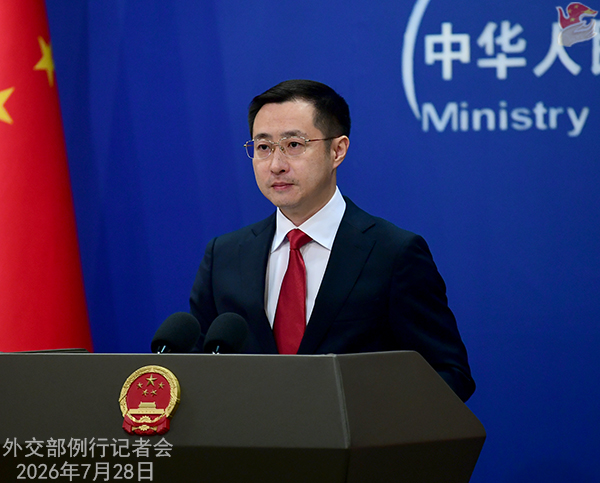
Lin Jian: It has been four months since Kodai Murata, a sitting officer of Japan’s Self-Defense Forces, illegally entered the Chinese embassy in Japan with a knife. Despite China’s stern protests, the Japanese side repeatedly prolonged investigation and handling of the case with so-called “psychiatric evaluation” or other pretexts, and delayed justice. China strongly deplores this.
For some time, vicious incidents threatening the security of Chinese diplomatic missions in Japan continue to occur. Many with insights in Japan and beyond highlighted the deep-seated problems in Japan revealed by a series of dangerous trends—the worsening right-wing impact and the suppression of rational voices, the serious lack of education on true history, the ongoing push for a more offensive and expansionist defense policy and failure in supervising the SDF and maintaining discipline inside the forces. Any attempt by Japan to downplay the case only greenlights more of the same and leads to immense harm on Japan itself and the region at large. The international community must remain highly vigilant. We once again urge the Japanese side to thoroughly probe the incident and its root cause, repent for and correct its policy and behavior, and fully account for the incident.
Beijing Daily: Recent data published by competent authorities shows that 77.7 percent of foreign tourists to China in the first half of this year benefited from the visa-free policy. There have been an influx of European tourists to China this summer to experience the “China Cool.” According to The Economist, growing interest on international social media in Chinese culture, Chinese products, and travel experiences is increasingly translating into concrete consumer demand and tourism interest. Do you have any comment?
Lin Jian: A growing number of foreign friends are choosing to travel to China and experience the Chinese lifestyle like the locals. Trendy spots such as NEV showrooms, China-chic pop-up stores, and sci-tech innovation parks are becoming new must-see destinations, along with scenic spots and historical sites. “China shopping” continues to gain momentum, enabling the world to share the quality and ingenuity of “Designed in China” and “Made in China.”
What’s underpinning the appeal of “China travel” and “China shopping” is China’s firm commitment to empowering the world through high-quality development and connecting the globe through high-standard opening up. I have noted several international surveys in recent media reports, which indicate that a China dedicated to peaceful development and brimming with innovative dynamism and culture charm is gaining ever more trust and recognition worldwide. We welcome more foreign friends to travel to China to feel its vibrancy this summer.
A Tarde: Yesterday, President Xi and Brazilian President Lula held a phone conversation. Can you provide more details about the topics they spoke? Brazil was recently targeted by tariffs from the U.S. Was this a topic during the talks between Lula and Xi?
Lin Jian: On the morning of July 27, President Xi Jinping took a phone call from Brazilian President Luiz Inácio Lula da Silva. We’ve put out a readout which you may refer to. Let me stress that China and Brazil are committed to building a community with a shared future for a more just world and a more sustainable planet. Given the current circumstances, deeper and all-round bilateral cooperation will contribute to our two countries’ development and revitalization and the people’s welfare, and play a vital role in forging greater solidarity and strength among Global South countries and upholding international fairness and justice.

The New York Times: The State Department is reportedly planning to spend hundreds of millions of dollars to counter China’s rising influence in the Americas and in Africa and Asia. What is China’s response?
Lin Jian: State-to-state relations and normal cooperation should not target any third party. China opposes forming exclusive groupings. China’s cooperation with relevant countries and regions, especially with fellow developing countries, is not about wooing anyone or rivaling anyone, but for global peace, prosperity, international order and a community with a shared future for humanity.
The New York Times: The United States is reportedly concerned about China’s involvement in building undersea fiber-optic cables in the Americas and across the Pacific to the Americas. Is China committed to building more of these cables?
Lin Jian: International submarine cables, as important infrastructure for international civilian use, bear on global network connectivity and the welfare of people of all countries. Politicizing this issue and turning it into a security one will only disrupt normal international market rules, threaten global digital connectivity and cybersecurity, and serve no one’s interest. China always supports international cooperation on submarine cables under the principles of fairness, justice, equality and inclusiveness, and stands ready to work actively with the rest of the world to promote the building and protection of submarine cables and other global information infrastructure.
Antara: Last week, around 28 Chinese companies participated in the Indonesia-China Business Delegation Meeting in Jakarta and met with Indonesia’s Coordinating Minister for Economic Affairs, Airlangga Hartarto. Does the ministry believe that this engagement helps address concerns that Indonesia may be becoming less welcoming toward Chinese investors, particularly following recent remarks alleging that some foreign investors have exploited or “robbed” Indonesia of its natural resources?
Lin Jian: We have responded to the remarks you mentioned alleging that some foreign investors have exploited or “robbed” Indonesia of its natural resources. The remarks are not aimed at China.
In recent years, under the strategic guidance of the heads of state of the two sides, China-Indonesia trade and investment cooperation has been extremely fruitful and benefited both sides. China and Indonesia, both major developing countries, are friendly neighbors and each other’s important cooperation partners for development, with promising prospects of cooperation. The Indonesian side has expressed on multiple occasions readiness to deepen industrial and supply chain cooperation with China and welcomed Chinese companies to invest in the country. We believe that Indonesia will continue to protect the lawful rights and interests of Chinese companies and foster a favorable environment for their investment and operation there.