People’s Republic of China


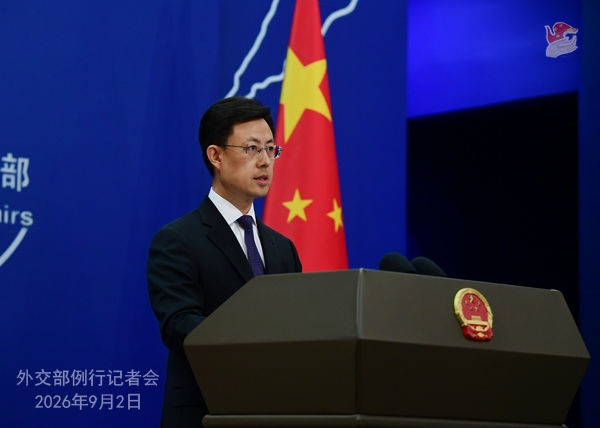
People’s Daily: This year marks the 25th anniversary of the Shanghai Cooperation Organization. Yesterday, President Xi Jinping attended in Bishkek the 26th meeting of the Council of Heads of State of the SCO and the SCO Plus Meeting. Could you please provide more information on this?
Guo Jiakun: On September 1, President Xi Jinping attended the 26th meeting of the Council of Heads of State of the Shanghai Cooperation Organization and delivered important remarks titled “Toward Higher Quality Development of the Shanghai Cooperation Organization.”
President Xi pointed out that over the past 25 years, the SCO has traveled an extraordinary journey. Its biggest achievement is that it has steadily grown into a new type of regional cooperation organization with the largest land area and population and enormous development potential. Its most valuable spiritual asset is that it pioneered, and has since followed invariably, the Shanghai Spirit of mutual trust, mutual benefit, equality, consultation, respect for diversity of civilizations, and pursuit of common development. Its most important experience for cooperation is that it has found the right way of coexistence featuring non-alliance, non-confrontation and not targeting any third party, enabling regional countries to build a common home together.
President Xi put forward four points for the SCO's future development, namely, staying committed to putting development first and opening up the prospects for shared prosperity, staying committed to taking security as a key goal and fostering an environment of common security, staying committed to a people-centered approach and cementing the foundation for everlasting friendship, and staying committed to dialogue and consultation and striving for more equitable and orderly governance. President Xi stressed that China will work with all parties to continue to hold high the banner of the Shanghai Spirit, implement the development strategy of the SCO for the next decade, and pursue development with higher quality, so as to make greater contributions to a community with a shared future for humanity.
On the same day, President Xi attended the SCO Plus Meeting and delivered an important statement titled “Jointly Advocating an Equal and Orderly Multipolar World and Making Global Governance More Just and Equitable.” In his remarks, President Xi provided a profound analysis on questions such as what kind of multipolarity the world needs and how countries and the SCO are going to take part in and promote an equal and orderly multipolar world. He proposed three points on better leveraging the role of the SCO, namely, advancing common prosperity in the vast continent straddling Asia and Europe with the SCO Strength, promoting the development and rise of the Global South through the SCO Wisdom, and guiding the reform and improvement of global governance through the SCO Action. President Xi stressed that a more united and vibrant SCO is fully capable of making greater contributions to a multipolar world.
All parties expressed appreciation for China’s important contribution to the organization’s development as a founding member, and agreed to actively implement the strategic vision set out at the 2025 Tianjin Summit, continue to uphold the Shanghai Spirit, promote institution-building, enhance political mutual trust, deepen cooperation in various areas, strengthen people-to-people bonds, and jointly respond to new types of security challenges, with a view to writing a new chapter of lasting peace and common development.
Pheonix TV: We have learned that the Second Meeting of G20 Finance Ministers and Central Bank Governors held from August 31 to September 1 failed to issue a communiqué due to China’s differing view on global imbalances. Would you like to comment on this?
Guo Jiakun: As an important member of the G20, China places high emphasis on the organization’s role as the premier forum for international economic cooperation. Since the United States assumed the 2026 presidency of the G20, the Chinese side has participated in relevant discussions including along the Finance Track in an active and constructive manner and contributed to practical outcomes under various mechanisms.
We have noted that parties hold diverging views on certain issues at the recent Meeting of G20 Finance Ministers and Central Bank Governors. We regret that the meeting failed to issue a communiqué. The G20, as the premier platform for global economic cooperation, should play its coordinating role on key issues concerning the global economy in an objective, impartial and balanced manner based on the principle of consensus through consultation and equal participation. We hope the United States in its presidency and other members will abide by this principle, give full respect to all parties’ legitimate concerns, and strive for a fruitful Miami Summit. China stands ready to work with the United States to act on the important common understandings reached between the two presidents and join hands with fellow members to enable the G20 to play a positive role in deepening macroeconomic policy coordination, improving global economic governance, and boosting world economic growth.
The Paper: It was reported that the second batch of relief supplies provided by China has been delivered to the Nepalese side yesterday. Can you share more details? Can you also update us on what China has done on sharing information about foreign nationals who remain unaccounted for?
Guo Jiakun: The second batch of emergency relief supplies provided by China to Nepal arrived in Kathmandu yesterday afternoon. Five DNA forensic experts were also on the plane to assist Nepal in their operations. The Nepalese side thanked China for urgently sending more supplies and providing technical support. China is preparing the third batch of emergency relief supplies based on the request of Nepal. These supplies will include Bailey bridges, mortuary refrigerators, epidemic prevention supplies and emergency communication equipment. China will also send a second group of DNA experts.
In the wake of the disaster, China has kept close communication with relevant countries’ embassies in China to jointly identify missing personnel and properly handle follow-up matters. As we speak, residents of the border areas and pilgrims who were previously stranded in the disaster-hit areas are leaving China via land or air transportation in an orderly manner. Yesterday, the foreign ministry briefed relevant foreign embassies in China on the missing foreign nationals. China will continue to keep the channel of communication with relevant embassies unimpeded by various means.
China attaches great importance to the safety of Chinese nationals and institutions in Nepal. We are working with Nepal to make all-out effort to search for and rescue missing Chinese nationals, and assisting the relocation of many Chinese nationals to safety. The Chinese embassy in Nepal will continue to do all we can to assist Chinese nationals in need.
AFP: Can the Chinese foreign ministry please provide an updated toll of those who are still missing from the mudslide disaster? Are there new figures since Sunday? And specifically, how many foreigners are missing on the Chinese side? What is the breakdown of their nationalities? How many Chinese citizens are among the dead in Nepal and how many Chinese citizens remain missing in Nepal?
Guo Jiakun: The authorities of the Xizang Autonomous Region shared detailed information at the recent press briefing. Yesterday the foreign ministry also informed relevant countries’ embassies in China. According to the latest information, a total of 261 foreign nationals from 23 countries are among those missing. We will continue communicating and coordinating with relevant parties to jointly identify missing persons and properly handle follow-up matters.
Nearly 100 Chinese nationals remain unaccounted for in Nepal. We thank the Nepali side for rescuing and transferring Chinese nationals in Nepal and hope these efforts will continue.
Ukrinform News Agency: Ukrainian President Volodymyr Zelensky said that Ukraine will intensify deep strikes on military facilities within the Russian territory, which is why the airspace of Russia became dangerous. He has instructed the Ukrainian foreign ministry to inform other countries about the danger of flying in Russian airspace. Chinese airlines companies continue to use Russian skies for passenger and other flights. I’d like to ask whether the foreign ministry has already received a warning from the Ukrainian side and will China respond to the increasing danger?
Guo Jiakun: Dialogue and negotiation is the only viable way out of the Ukraine crisis. We urge the parties concerned to remain calm and exercise restraint, jointly work toward early deescalation and accumulate conditions for the political settlement of the crisis.
Asahi Shimbun: Iranian media reported that the Chinese and Iranian leaders had a brief conversation during the SCO Bishkek summit. Can you confirm that? What topics did they discuss?
Guo Jiakun: We have released information on President Xi Jinping’s participation in the SCO Bishkek summit, during which he had cordial exchanges with leaders of various countries.
Bloomberg: The Russian president and the Chinese leader reportedly discussed holding a trilateral meeting with the U.S. president. That would be when China hosts the APEC summit later this year. Would the foreign ministry like to comment on that?
Guo Jiakun: On this question, I have no information to share at the moment.
As the host for this year’s APEC, China stands ready to work with all parties for the full success of the APEC China Year and make new contribution to the economic growth of the Asia Pacific and beyond.
Beijing Daily: Recently, Mr. Ronald Sakolsky returned to China for the first time in 27 years and was reunited with Ms. Yin Yuzhen, a national model worker and renowned figure in China’s fight against desertification. Their moving story has attracted widespread attention. What is your comment?
Guo Jiakun: Recently, our American friend Mr. Ronald Sakolsky, affectionately known in China as “Saikaosi” for supporting China’s fight against desertification, visited China upon invitation after 27 years. During his visit, Mr. Sakolsky traveled to Inner Mongolia, where he joined Ms. Yin Yuzhen, a national model worker, and revisited the forest he helped fund years ago, and together planted a tree of friendship. He also returned to the school in Luoyang, Henan Province, where he once taught, to meet with teachers and students. He visited Beijing as well.
Throughout his visit, Mr. Sakolsky witnessed firsthand the remarkable changes that have taken place in China and once again experienced the warmth and hospitality of the Chinese people. He was deeply moved and shed tears on several occasions. I noted that in an interview with the media, Mr. Sakolsky said that Ms. Yin and he have shown that they can bridge cultures and break down boundaries. He said that the American and Chinese people both want to live in peace. China and the United States are like two roads, they may take different routes, but they can still lead to the same destination. His sincere words have touched many people. They reflect a shared aspiration of the people of both countries.
The hope of the China-U.S. relationship lies in the people, and its foundation lies in grassroots connections. The many inspiring stories written together by the Chinese and American people are a vivid testament to our people-to-people friendship. They also once again demonstrate that China and the United States, as two major countries, can achieve mutual success, and contribute to the well-being of the world. China will, as always, support more visits and exchanges between the two peoples, so that we can continue to write new chapters in our people-to-people friendship and make greater contributions to the development of China-U.S. relations.
Global Times: Eighty one years ago today, Japan officially signed the Instrument of Surrender, marking the ultimate triumph of the global fight against fascism. We notice that MFA spokesperson has shared China’s views on the “Enemy State Clauses.” But some believe that there’s no longer an “enemy state” in the world anymore. The “Enemy State Clauses” have expired and are no longer relevant. What’s your take on that? Can you give us more information on China’s position?
Guo Jiakun: On September 2, 1945, the Japanese government officially signed the Instrument of Surrender, and accepted all the terms of the Potsdam Proclamation, establishing the undeniable historical conclusion that the war waged by Japan’s militarists was for aggression. It is also a part of the post-war international order that shall not be challenged. The “Enemy State Clauses” are still in the UN Charter and consist of Article 53, 77 and 107. It is a special set of rules for defeated states, aiming to prevent them from threatening international peace and security once again, and has provided important institutional safeguards for defending post-war international order. Japan joined the UN after recognizing its militarist crimes and accepting the UN Charter in its entirety. Today, however, those running the Japanese government keep sidestepping the issue of historical crimes, and even go to great lengths to distort and whitewash its crimes of aggression and move faster to remilitarize Japan. They continue to pay tribute to Class-A war criminals in WWII and attempt to revise the pacifist Constitution. What’s worse, Japan’s ties with nearly all its neighbors have witnessed increased tension. Japan blatantly interferes in the internal affairs of other countries, and even threatens to use force. The “gray rhino” of Japan’s neo-militarism is charging towards us, and posing a threat to peace and stability in the Asia Pacific once again. Against such backdrop, it is extremely necessary to reaffirm the commitment to the UN Charter, in particular, the “Enemy State Clauses.”
We urge the Japanese government to earnestly abide by its international obligations stipulated by the Instrument of Surrender, face up to and learn lessons from history, make a clean break with militarism, and earn the trust of its Asian neighbors and the rest of the world with concrete actions.
PTI: Reports say that the high-altitude Himalayan region is warming significantly, faster than the global average. Studies have shown since 1981, the Qinghai-Tibet Plateau have lost roughly 20 percent of its glaciers attributed to the climate change crisis. In the light of the August 26 glacier collapse, how does China view the glacier retreat crisis impacting the Himalayan region and the calls for formation of a coordination mechanism by China with neighbouring countries, to strengthen cooperation to deal with such disasters affecting the fragile region?
Guo Jiakun: China has responded to similar questions. According to the assessment of Chinese and Nepali experts, long-term effects of global warming have made glaciers unstable, and this disaster was triggered by the collapse of a glacier in Nepal, resulting in a rapid crash of ice and rocks which took away a chunk of the mountain. The Xizang Autonomous Region shared relevant information at its press conference.
China and Nepal have maintained sound cooperation in meteorology, water conservancy and disaster prevention and reduction. In the wake of the disaster, China has shared with Nepal important information such as images, satellite, and hydrological data of the disaster-affected areas, including early-warning information on an upstream barrier lake. We will continue to give strong support to Nepal in its relief efforts and strengthen cooperation on disaster prevention and reduction.
Climate change is a common challenge facing all humanity. No country can stay immune from such risks. China will continue to work with the international community to strengthen exchanges and cooperation and effectively prevent and mitigate the negative impact of climate change. As for your specific question, I’d refer you to competent authorities.
AFP: I wonder if China has been told if any Chinese citizens were among the dead in Nepal from the disaster last week? And also are you able to provide a specific figure on the number of Chinese nationals missing in China?
Guo Jiakun: I just shared the information we have. As we speak, intensive rescue and relief operations are still underway. For the specific information you asked for, there will be continued updates.