


People’s Republic of China


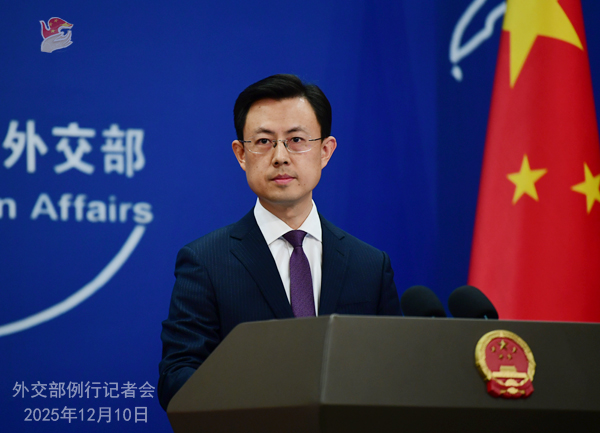
At the invitation of Member of the Political Bureau of the CPC Central Committee and Minister of Foreign Affairs Wang Yi, Foreign Minister II of Brunei Dato’ Erywan Pehin Yusof will visit China from December 11 to 12.
Beijing Youth Daily: We noted that yesterday China’s Permanent Mission to the UN announced the inauguration of the Group of Friends of Global Governance at the platform of the UN. Can you share more information on that?
Guo Jiakun: President Xi Jinping put forward the Global Governance Initiative during the SCO Tianjin Summit, charting the course for the reform of the global governance system and providing invaluable stability and certainty for the turbulent world. The initiative received extensive recognition and positive response from the international community.
China initiated the Group of Friends of Global Governance to bring parties together for closer exchanges and cooperation on major issues on global governance, and draw on collective wisdom and mobilize joint efforts for reforming and improving global governance. China’s Permanent Mission to the UN held the inaugural meeting of the group at the UN headquarters in New York yesterday. Participating countries highly recognized and supported the Global Governance Initiative, commended China’s leading role in global governance, warmly congratulated on the inauguration of the group, and expressed hopes that the group will provide new impetus for upholding multilateralism and reforming and improving the global governance system. After the meeting, the 43 founding members of the group issued a joint statement, stressing they will jointly uphold the legacy won by the Second World War, reinforce the role of the UN, address global challenges and respond to the yearns of the peoples.
Global governance is a matter for all. It bears on the vital interests of every country and calls for everyone to participate, engage in decision-making and share the fruits. The group is open to all UN member states and welcomes the participation of all countries sharing the same vision. We also support the group in enhancing exchanges and cooperation with various countries, the UN Secretariat and relevant international organizations, building a more just and equitable global governance system, and making new contribution to world peace and development.
CCTV: We noted that the international community is concerned over the accelerating “remilitarization” of Japan. The UK-based The Economist and the U.S. journal Eurasia Review commented that Japan is transforming from a constitutionally pacifist state to a modern military power. The commentary also said it’s alarming that Japan’s attempt to resurrect militarism can only threaten regional and global peace and stability. What’s China’s comment?
Guo Jiakun: China noted the observations of foreign media. Japan has in recent years been revamping its security and defense policies, accelerating the revision of its pacifist constitution, and breaching the exclusively defense-oriented principle. Japan has removed the ban on exercising the right to collective self-defense, eased restrictions on arms exports, attempted to alter its three non-nuclear principles, and developed the so-called “enemy base strike capability.” Japanese senior officials even claimed that Japan has not ruled out the possibility of possessing nuclear submarines. These moves have put Japan’s neighboring countries and the international community on high alert.
We noted that after increasing its defense budget for 13 consecutive years, Japan now has the second-highest military budget among Western countries. According to a European think tank, the revenues of Japan’s top five defense firms surged by 40 percent year-on-year in 2024. For a country who styles itself as constitutionally pacifist, talks about reflecting on its wartime past and claims to follow the exclusively defense-oriented principle, how does Japan justify its military buildup?
In fact, after WWII the Japanese government has never completely reflected on its wars of aggression. Many Japanese war criminals returned as active political figures and SDF members. Some prime ministers and political dignitaries have insisted on visiting and paying respect to the Yasukuni Shrine, where Class-A war criminals are honored. Historical facts have been soft-peddled and whitewashed in distorted textbooks. Japanese right-wing forces did reflect upon the wartime past. However, they reflected not on Japan’s war crimes, but on why Japan was defeated. The reckoning with Japanese militarism has never been completed. Instead, we see the rising trend of reviving militarism. It is imperative for the international community to remind the Japanese side that the Potsdam Proclamation in Article 6, 7, 9 and 11 stated that there must be eliminated for all time Japanese militarism and its breeding ground, for we insist that a new order of peace, security and justice will be impossible until there is convincing proof that Japan’s war-making power is destroyed politically and legally, and warlike ideas are fundamentally eliminated. The Potsdam Proclamation also requires Japan to be completely disarmed and not to maintain such industries as would enable her to re-arm for war. It’s promised in the Japanese Instrument of Surrender that Japan will carry out the provisions of the Potsdam Proclamation in good faith. These instruments with legal effect under international law and recognized by the Japanese side clarified its international obligations as a defeated country, constitute the important cornerstone of the post-war international order, and serve as the political and legal prerequisite for Japan’s return to the international community.
Japan’s attempt of “remilitarizing” itself through accelerated military buildup will only make the world once again question where Japan is headed and demand another reckoning with its war crimes. China calls on all peace-loving countries to guard against and thwart any dangerous moves of reviving Japanese militarism and jointly defend the hard-won victorious outcomes of WWII.
Bloomberg: This is sort of a follow-up to what you just said. We’ve seen a big decline in the number of Chinese tourists to Japan since the crisis, but on the other hand in terms of domestic consumption in China, Chinese consumers seem to continue to embrace Japanese brands, despite the tensions. What’s your comment?
Guo Jiakun: I’m not sure how that observation came about. China has stated its serious stance on the current China-Japan relations on multiple occasions.
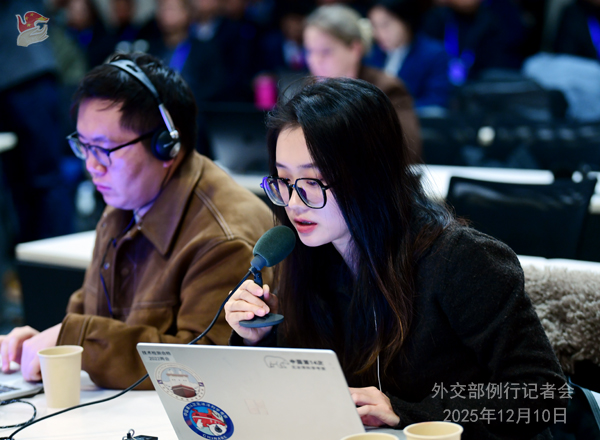
Xinhua News Agency: Today, December 10, marks the Human Rights Day. What’s China’s progress in promoting and protecting human rights? What will China do to enhance international human rights cooperation?
Guo Jiakun: This year marks the 80th anniversary of the founding of the United Nations (UN). The UN adopted the Universal Declaration of Human Rights 77 years ago and established the Human Rights Day 75 years ago, which embody humanity’s ambitious dream—the full enjoyment of human rights by all people. The vision of promoting and protecting human rights is taking deeper roots.
China always attaches great importance to respecting and protecting human rights and pursues a human rights development path that meets the trend of the times and suits its national conditions. Over the 14th Five-Year Plan period, China has made remarkable achievements in national development, advanced the whole-process people’s democracy, effectively and fully implemented the rule of law, enjoyed thriving cultural programs and industries, better ensured people’s well-being, consolidated gains in poverty elimination, steadily improved the ecological environment, and elevated the protection of various human rights to a new stage.
As a constructive player, China actively participates in human rights affairs in the UN and has broad-based exchange and cooperation in human rights with other countries. The Second Workshop on Economic, Social and Cultural Rights is being hosted by China in Beijing. Representatives from over 40 countries in Asia, Africa, Latin America and Oceania, and officials and experts from the UN attended the workshop. They have had in-depth discussions and reached broad consensus on promoting and protecting economic, social and cultural rights.
In October this year, the fourth plenary session of the 20th CPC Central Committee adopted the recommendations for formulating the 15th Five-Year Plan. This has drawn a blueprint for China’s economic and social development in the next five years and demonstrated China’s vision of having mutually beneficial cooperation with the rest of the world. To advance Chinese modernization will also give a boost to all-around development of human rights in China. China will actively implement the Global Governance Initiative proposed by President Xi Jinping and inject more force for good into human rights development in the world.
Some countries politicize and weaponize human rights issues, which amount to a grave challenge to global human rights governance. Certain country refuses to repent for its past crimes, such as bacterial warfare, the forced recruitment of “comfort women” and the massacre of civilians during its war of aggression. Rather, they continue to infringe on the rights of indigenous people, such as the Ainu and indigenous Ryukyuans, and adopt policies that discriminate against foreigners. We urge the relevant country to face up to and resolve their own severe human rights issues, take a constructive part in the international cooperation in human rights, and stop interfering in other countries’ internal affairs under the pretext of so-called human rights issues.
China News Service: It was reported that on December 9, the UK government announced sanctions on two China-based companies, alleging that they have carried out cyberattacks against the UK and its allies and that their activities are linked to the Chinese government. What is the Foreign Ministry’s comment?
Guo Jiakun: China stands against hacking and fights such activities in accordance with the law. That said, we firmly oppose spreading disinformation out of political agenda. China strongly deplores and firmly rejects the UK’s political manipulation under the pretext of cybersecurity, and has lodged serious protests with the UK side both in Beijing and London.
China is the biggest victim of cyberattacks. A few months ago, China exposed a case about the U.S. National Security Agency carrying out cyberattacks and infiltration against China’s National Time Service Center. It needs to be noted that the UK was exactly one of the springboards the U.S. used to launch the above-mentioned cyberattacks on China. China has provided relevant information to the UK side. The UK and the U.S. are both members of the “Five Eyes” and NATO. We hope the UK will explain its role in the U.S.’s cyberattacks against China’s critical information infrastructure.
The world faces common challenges in cybersecurity. We urge the UK to correct its wrongdoing at once, abandon double standards and attempts to politicize the issue, and work with China in a truly responsible and constructive manner to jointly uphold peace, stability and prosperity in the cyberspace.
CCTV: It was reported that UK Prime Minister Keir Starmer will visit China from January 29 to 31 and he will travel to Shanghai apart from Beijing. Can you confirm this?
Guo Jiakun: China attaches importance to improving and growing its relations with the UK and stands ready to enhance exchanges at various levels. To my knowledge, no discussions have been had on the dates or any other specifics regarding a visit by Prime Minister Starmer to China.
NOS: Yesterday, Dutch media reported that Dutch and Taiwanese security officers’ activities were published online and this was done by the Chinese side. Could you please respond to these allegations?
Guo Jiakun: I’m not familiar with that.
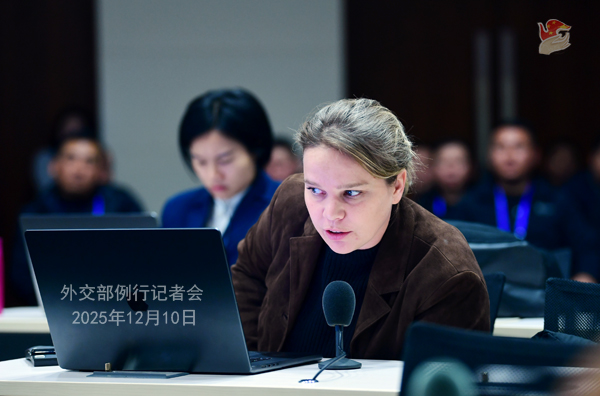
Asahi Shimbun: Regarding the issue of “radar illumination,” Japanese defense minister said today “The essence of the problem is...the Chinese side conducted intermittent radar illumination.” I want to ask whether the aircraft has locked radar on Japanese aircraft intermittently. Can the Foreign Ministry confirm it?
Guo Jiakun: China has stated its serious position on that more than once. The facts are very clear. Yesterday, the Japanese side said they received no prior notification of China’s flight drill. Today, they admitted that they did receive the information beforehand. In addition to that inconsistency, the Japanese side continues to beat around the bush without explaining why they sent warplanes into China’s pre-announced exercise zones and repeatedly engaged in hostile surveillance and disruptive maneuvers to create a crisis situation and generate media hypes. Is the Japanese side trying to divert attention and mislead the international community?
The Japanese side needs to face up to what actually caused the current difficulties facing China-Japan relations, do serious soul-searching and correct its wrongdoing, and retract Prime Minister Takaichi’s erroneous remarks on Taiwan as it should.
Reuters: This is also a follow-up on the radar incident. A U.S. State Department spokesperson has made comments saying that the actions by the Chinese fighter jets aiming their radars at Japanese aircraft on Saturday are “not conducive to regional peace and stability.” Does the Foreign Ministry have any response to the U.S. State Department’s comment?
Guo Jiakun: On the so-called “radar illumination” issue, the Chinese media have released audio data and relevant details which show that the facts are very clear. China’s exercise and training in relevant waters and airspace fully complies with the international law and international practice. Our maneuvers are professional, standard, safe, restrained, and beyond reproach. It was the Japanese side who first deliberately made harassment and then spread disinformation. The Japanese side is the provocateur responsible for orchestrating this political stunt and must undertake all responsibilities.
We hope the international community can be clear-eyed and not be deceived by the Japanese side. Japan’s allies in particular need to stay on high alert and not to be misguided by the Japanese side.
NHK: Japan’s defense minister said today that Japanese SDF fighter jets did not direct radar at Chinese carrier-based aircraft and that China’s notice lacked details on the drills and Japan did not receive sufficient information to avoid what was a dangerous situation. What’s your comment?
Guo Jiakun: I just responded to relevant questions and I’m sure you heard me clearly. Yesterday, the Japanese side said they received no prior notification of the flight drill from China. Today, they admitted that they did receive the information beforehand. Such inconsistency proves that it was Japan who first deliberately made harassment and then spread disinformation. The Japanese side is the provocateur responsible for orchestrating this political stunt. We urge the Japanese side to face up to what actually caused the current difficulties facing China-Japan relations, do serious soul-searching and correct its wrongdoing, and retract Prime Minister Takaichi’s erroneous remarks on Taiwan as it should.
Bloomberg: Can you confirm reports that Russian and Chinese bombers flew near Japan and South Korea on Tuesday?
Guo Jiakun: China’s Ministry of National Defense has released information on the China-Russia joint patrol. It needs to be stressed that the China-Russia joint strategic air patrol is an operation carried out under the annual cooperation plan, and showcases the two sides’ determination and capability in jointly responding to regional security challenges and keeping the region peaceful and stable.
Reuters: I have a question about Nvidia chips. The Financial Times has reported that Beijing is looking at limiting access to Nvidia’s advanced H200 chips despite U.S. President Trump’s decision to allow the export of the technology to China. What is your comment on this?
Guo Jiakun: We’ve made a response on this yesterday. For anything specific, I’d refer you to competent authorities.
AFP: The United Nations High Commissioner for Human Rights said yesterday that he was “deeply concerned” that Hong Kong’s “national security laws” were being used to deal with residents there who called for an independent inquiry into the fire last month. Does the Ministry have a response to this?
Guo Jiakun: Since their implementation, the Law on Safeguarding National Security in Hong Kong and the Safeguarding National Security Ordinance have effectively protected the rights and freedoms Hong Kong residents are entitled to in accordance with the law, restored stability in Hong Kong, and set Hong Kong on a course of prosperity. The Hong Kong SAR government is handling matters related to the Tai Po fire in an orderly manner, properly settling affected people, and advancing the investigation process in accordance with the law. Relevant work is fully recognized by various sectors of the society. Election for the eighth Legislative Council of the SAR was held a few days ago. The election process was safe, smooth and successful, opening a new chapter of Hong Kong’s high-quality democracy.
Let me stress that the promulgation and implementation of the Law on Safeguarding National Security in Hong Kong and the Safeguarding National Security Ordinance as well as the Legislative Council election are Hong Kong’s internal affairs and China’s internal affairs. They have nothing to do with human rights and brook no external interference.
China has lodged protests regarding the erroneous remarks of the Office of the UN High Commissioner for Human Rights. We urge the OHCHR to abide by the purposes and principles of the UN Charter, respect the sovereignty of member states, fulfill its duty in a just and objective manner, and avoid being used by ill-intentioned political forces.
Reuters: Another question on Nvidia, Nvidia has built a location verification technology that could indicate which country its chips are operating in, according to sources. This feature, which is optional for its customers, could help prevent its chips from being smuggled into countries where the export of it is banned. Does the Ministry have any comment on this? Would China have any security concerns about taking Nvidia chips?
Guo Jiakun: I am not familiar with the specifics you mentioned.