People’s Republic of China


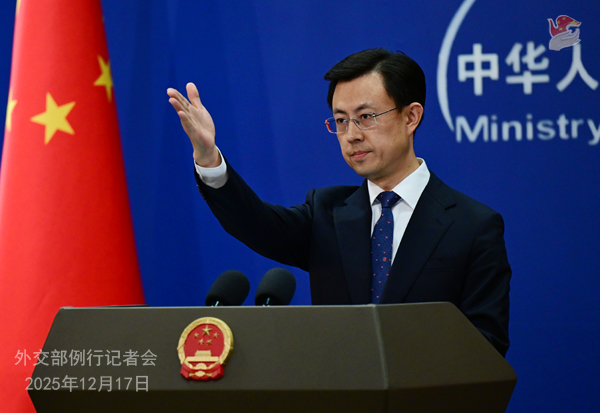
Phoenix TV: It’s reported that head of Japan’s National Security Secretariat Ichikawa Keiichi articulated Japan’s position on Prime Minister Sanae Takaichi’s remarks on Taiwan and refuted China’s statements during his recent conversations with officials from the UK, France, Germany and Canada. He said Takaichi’s remarks at the Diet didn’t change the Japanese side’s consistent position on Taiwan. Some in Japan claimed that Japan is a “peace-loving” country and China’s accusations are “inconsistent with facts.” What’s your response?
Guo Jiakun: What the Japanese side said and did is yet another example of how some in Japan knowingly distort facts, refuse to correct their wrongdoings, and attempt to feign innocence for sympathy in the international community.
It’s not the first time that the right-wing forces in Japan have concocted false narratives. They depicted Japan’s war of aggression against Asian neighbors as “the liberation of Asia,” downplayed the horrendous Nanjing Massacre as “the Nanjing incident,” whitewashed the infamous Unit 731 as a “public health research unit,” and dismissed forced labor and “comfort women” as “voluntary acts.” After the war, Japan has described itself as a “victim” of the war while avoiding mentioning that militarism is the source of the warfare. It claims to uphold the exclusively defense-oriented principle and the passive defense strategy, but has removed the ban on exercising the right to collective self-defense, kept relaxing restrictions on arms exports, and even attempted to revise its three non-nuclear principles.
Prime Minister Sanae Takaichi’s erroneous remarks on Taiwan have been met with the Chinese people’s indignation as well as opposition and criticism from Japan and some other countries. What the Japanese side should do is to listen to these calls and do soul-searching rather than make futile attempts to persuade other countries into believing their groundless explanations. We urge some in Japan to stop spreading false narratives, face up to the history, reflect on and correct the wrongdoings, retract the erroneous remarks, honor the commitments, and act responsibly to offer China and the international community a satisfactory answer.
Reuters: Wall Street Journal reported that China has increased its demands in deal talks involving two ports in the Panama Canal, pushing for state-owned ship operator COSCO to have a controlling stake. Is this true?
Guo Jiakun: I’m not familiar with that. On CK Hutchison’s sales of its assets overseas, the Chinese side has made responses to that more than once, which you may refer to.
Nippon TV: After Japanese Prime Minister’s remarks on Taiwan, the Chinese Ministry of Foreign Affairs held meetings with ambassadors from Southeast Asian countries and others based in Beijing to convey criticism on Japan and ask them to support China’s position. Could you share with us the purpose of this action?
Guo Jiakun: China’s Ministry of Foreign Affairs maintains normal working relations with embassies of all countries in Beijing.
The one-China principle is a universally recognized basic norm in international relations and a prevailing consensus of the international community including Southeast Asian countries. The erroneous remarks on Taiwan made by Japanese Prime Minister Sanae Takaichi seriously violate international law and basic norms governing international relations, and blatantly challenge the outcomes of WWII victory and international justice. The dangerous trend of reviving Japanese militarism has put regional countries and peoples on high alert. Defending the postwar international order, human conscience and justice serves the common interest of all sides and is a must choice. We noted that recently many regional countries have once again stressed their commitment to the one-China principle, opposition to “Taiwan independence,” support for China’s reunification, as well as their vigilance and resistance to the possible revival of militarism. The Japanese side needs to heed the calls, do soul-searching and correct its wrongdoings, instead of creating confusion and trouble.
China News Service: It’s reported that Thai troops seized Chinese-made anti-tank missiles and other equipment from Cambodian forces during the conflict. What’s China’s response?
Guo Jiakun: For anything specific, I’d refer you to competent authorities. Let me stress that China has had normal defense cooperation with both Thailand and Cambodia previously. Such cooperation does not target any third party and has nothing to do with the conflict between the two countries.
RIA Novosti: Russia’s Foreign Intelligence Service said in a report that the UK, France and Germany plan to build closer ties with China and use the ties as blackmail and bargaining chip against the U.S. regarding a peace deal on Ukraine. What is the comment of the Foreign Ministry?
Guo Jiakun: China’s position on the Ukraine crisis is consistent and clear. We support all effort conducive to the peaceful settlement of the crisis and hope parties will reach a fair, lasting and binding peace agreement through dialogue and negotiation at an early date.
China follows an independent foreign policy for peace. We develop relations and engage in cooperation with other countries on the basis of the Five Principles of Peaceful Coexistence, and at the same time firmly safeguard our sovereignty, security and development interests.
RIA Novosti: The European Commission hopes to call on EU countries to make a decision on the use of frozen Russian assets at the EU summit to be held on December 18 and 19. Will such a decision sap China’s confidence in the EU’s investment environment?
Guo Jiakun: China opposes unilateral sanctions that violate international law and lack the authorization of the UN Security Council. Parties need to foster a positive atmosphere and create favorable conditions for promoting talks for peace and a political settlement of the Ukraine crisis, rather than doing the opposite.