People’s Republic of China


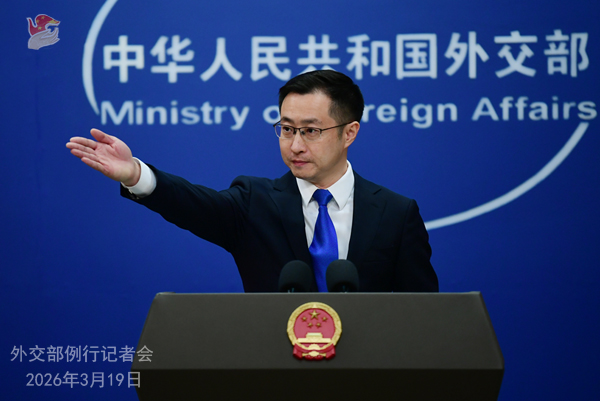
CCTV: It’s reported that Iranian Secretary of Supreme National Security Council Ali Larijani was killed in Israeli strikes. Israeli Defense Minister Israel Katz said Prime Minister Benjamin Netanyahu and he have authorized the Israel Defense Forces to kill any Iranian official without the need for additional authorization. What’s China’s comment?
Lin Jian: China is shocked by that remark. China is always against the use of force in international relations. The killing of Iranian leaders and attacks on civilian targets are by no means acceptable. As the conflict rages on in the Middle East and tensions continue to escalate and spill over, the international community is widely calling for an early ceasefire and end to hostilities. China calls on parties to the conflict to immediately stop military operations and prevent plunging the region into chaos.
Yonhap News Agency: In response to the ROK listing Taiwan as “China (Taiwan)” on its electronic arrival card system, the Taiwan authorities have said that they will change the designation of “Korea” to “South Korea” on some of its entry and exit documents. What is China’s comment on this?
Lin Jian: Taiwan is an inalienable part of China’s territory. The one-China principle is a basic norm in international relations and a prevailing international consensus. We believe the ROK will continue to adhere to the one-China principle, which is clearly stated in the China-ROK joint communiqué on the establishment of diplomatic relations, and will handle the Taiwan question accordingly.
EFE: According to reports, lately China has increased inspections of Panama-flagged vessels at several of its ports, a move believed to be linked to the Panamanian side’s decision to strip a Chinese company of its terminal concessions. What’s China’s comment?
Lin Jian: I’m not familiar with what you mentioned and would refer you to competent authorities.
Beijing Daily: On March 19, the House of Representatives elected Anutin Charnvirakul, the incumbent prime minister and Bhumjaithai Party leader, as the new prime minister of Thailand. What’s China’s comment on the result and expectation for the China-Thailand relations?
Lin Jian: China congratulates Prime Minister Anutin on his reelection. We believe that under his leadership, Thailand will make greater achievements in national development.
China and Thailand are close friends and neighbors and have formed a community with a shared future. Under the strategic guidance of the two heads of state, China-Thailand relations have maintained sound momentum, and practical cooperation has produced fruitful results in various fields. China stands ready to work with Thailand to earnestly implement the important common understandings reached between the leaders of the two countries, carry forward the traditional friendship and family-like relationship between the two countries, deepen and substantiate the building of the China-Thailand community with a shared future and deliver more tangibly for the two peoples.
Reuters: U.S. intelligence agencies in an annual report about global threats said China does not have plans currently to invade Taiwan next year in 2027, seeking instead to control the island without any use of force. What does China have to say about that report and this matter?
Lin Jian: The Taiwan question is China’s internal affair. Resolving the Taiwan question is a matter for the Chinese ourselves that brooks no external interference. The U.S. needs to abide by the one-China principle and the three China-U.S. joint communiqués and act all the more prudently on the Taiwan question. Relevant U.S. agencies and personnel need to discard ideological bias and Cold-War and zero-sum mentality, form a correct perception of China, and stop peddling the “China threat” narrative.
Xinhua News Agency: We noted that Zhai Jun, Special Envoy of the Chinese Government on the Middle East Issue, recently visited Middle East countries. Could you brief us on his visits?
Lin Jian: As we speak, the conflict is still raging in the Middle East and tensions continue to escalate and spill over. To help calm the situation and bring about peace, Special Envoy of the Chinese Government on the Middle East Issue Zhai Jun visited several countries in the region over the past few days. He met with the foreign ministers of Saudi Arabia, the United Arab Emirates, Bahrain, Kuwait and Egypt, as well as the Secretaries General of the Gulf Cooperation Council (GCC) and the League of Arab States, and had a phone conversation with Minister of State at the Ministry of Foreign Affairs of Qatar for in-depth exchanges of views on the regional situation.
During the visit, Special Envoy Zhai Jun elaborated on China’s position regarding the current situation, and stressed that a ceasefire and an end to the hostilities provide the fundamental solution, and urged parties to the conflict to immediately cease military operations and prevent the situation from becoming a complete chaos. He called for dialogue and negotiation and resolving differences through political and diplomatic means. He pointed out that the purposes and principles of the UN Charter should be upheld, the sovereignty, security and territorial integrity of GCC countries should be fully respected, non-military targets should not be attacked and the safety of shipping lanes should not be interrupted. All parties have commended China’s just position and efforts in promoting peace, and looked to China to play a bigger role.
Special Envoy Zhai Jun’s visit to the Middle East is part of China’s intensive diplomatic mediation effort. China is a responsible major country and a sincere friend of countries in the region. To work for reconciliation and peace in the region is a cornerstone of China’s Middle East policy. Our mediation effort will not cease as long as the conflict continues.
China Daily: As the conflict between Pakistan and Afghanistan entered its third week, it’s reported that following calls by Islamic countries—Saudi Arabia, Qatar and Türkiye—the two sides have agreed to a temporary ceasefire ahead of Eid al-Fitr and will halt hostilities from midnight March 18/19 to midnight March 23/24. What’s China’s comment?
Lin Jian: China welcomes the temporary ceasefire agreement between Pakistan and Afghanistan, and hopes the two countries will exercise calm and restraint, resume peace talks as soon as possible, realize a full and lasting ceasefire at an early date, properly address differences and disputes through dialogue and jointly keep the two countries and the region peaceful and stable. China commends the effort made by relevant Islamic countries, has been mediating between the two sides via its own channels, and stands ready to continue playing a constructive role on this issue.
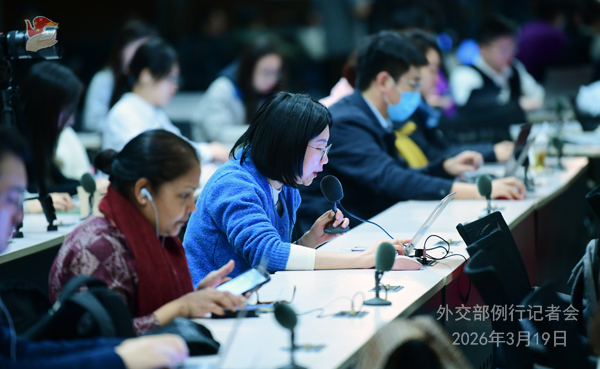
Reuters: Following the question I had earlier about the report from U.S. intelligence agencies, they said that Japan has shown a “significant shift” from its previous rhetoric on Taiwan, and this is referring to Prime Minister Takaichi’s remarks about a hypothetical Chinese attack on Taiwan. The Japanese government responded this morning, rejecting the U.S.’s assessment, and said that its position on how it determines an existential threat has not changed. Would China have a comment about this, on the report as well as Japan’s response?
Lin Jian: Prime Minister of Japan Sanae Takaichi’s erroneous remarks on Taiwan blatantly interfered in China’s internal affairs. The remarks signal Japan’s intention to attempt armed intervention on the Taiwan question, and constitute a threat of force against China. China has more than once made clear its serious position. The report you cited shows that the international community is increasingly aware of the egregious nature and impact of those remarks and remains vigilant against Japan’s dangerous provocations. Japan’s claim that it “has not changed its position” is hardly convincing. That kind of attitude will not possibly enable Japan to establish trust with its Asian neighbors and the international community. We urge Japan to reflect on its behavior and change course, act on the four political documents between China and Japan and Japan’s own commitments and abide by the pacifist clause of the Japanese Constitution. Time for Japan to stop going further down the wrong path.
Reuters: This is about the Philippines. We read the news that the Philippine agriculture secretary said yesterday that China has assured the Philippines that it will not restrict fertilizer exports to the country. We also see news that Chinese ambassador in Manila has also met with the Philippine energy minister to talk about energy security. Could you share with us what was discussed? Was Manila interested in increasing its energy security through China’s help? Was oil supply discussed? Would China be able to offer the same kind of reassurance about energy supply the way it did for fertilizers?
Lin Jian: The situation in the Middle East dealt a heavy blow to global energy security. Relevant countries need to stop military operations at once and prevent regional turmoil from further impacting global growth. China stands ready to strengthen coordination and collaboration with Southeast Asian countries and jointly address energy security issues.
On your question about fertilizers, China is a major producer and consumer of fertilizers and a key participant in global fertilizers trade. While ensuring that domestic demand is met, China exports some of its fertilizers to international markets. For anything specific, I’d refer you to competent authorities.
Reuters: Another following question on the related topic. On the related topic, we would also like to know if there have been similar discussions with other Southeast Asian countries? Have any Southeast Asian countries individually reached out to China to request for help with their energy security?
Lin Jian: As I just said, China stands ready to strengthen coordination and collaboration with Southeast Asian countries and jointly address energy security issues.