


People’s Republic of China


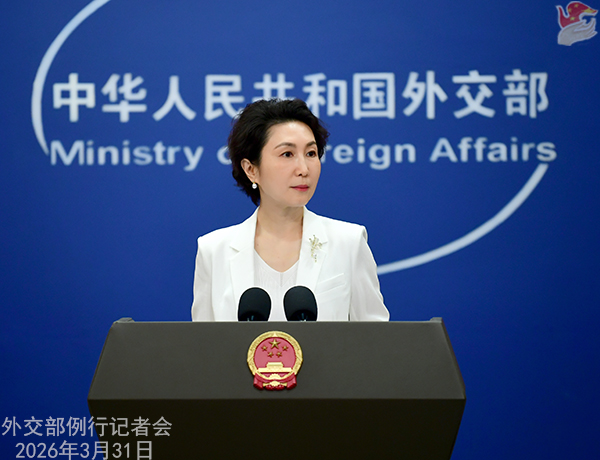
The Paper: To follow up on the announcement that Pakistani Deputy Prime Minister and Foreign Minister Ishaq Dar is coming to China today for the second time in three months. Is the trip related to the recent situation in Iran?
Mao Ning: China and Pakistan are all-weather strategic cooperative partners of mutual trust and mutual support. The two countries share similar position and maintain close communication on major international and regional issues. It’s believed that the two foreign ministers will step up strategic communication and coordination on the situation in Iran and other international and regional issues of mutual interest, jointly call for peace and a just position, and make new effort to help end the conflict and bring about peace and stability in the region.
Anadolu Agency: Your Ministry of Foreign Affairs announced that Pakistan’s Foreign Minister Ishaq Dar will visit China today. The visit comes after a meeting of top diplomats from Pakistan, Türkiye, Egypt and Saudi Arabia in Islamabad on the weekend to promote talks between the U.S. and Iran to end the ongoing conflict in the Middle East and possible role for Pakistan to mediate between sides. Can you share information about the relevant visit and talks with Foreign Minister Wang Yi? What will be the focus of discussion here?
Mao Ning: Pakistani Deputy Prime Minister and Foreign Minister Mohammad Ishaq Dar will arrive in China today. I shared relevant information just now. It’s believed that the two foreign ministers will exchange views on the situation in Iran and other international and regional issues of mutual interest. We will release more details in due course. Please check back for updates.
CCTV: It was reported that the Self-Defense Forces officer who broke into the Chinese embassy in Japan with a knife has been sent to prosecutors by the Japanese police. What is China’s comment?
Mao Ning: This incident shows how toxic and dangerous the right-wing ideology and distorted view of history could be in Japan. The National Defense Academy in Japan reportedly has an annual practice of paying group visits to the Yasukuni war shrine. In 2024, a former senior officer of the Maritime Self-Defense Forces became the shrine’s chief priest, marking the first time ever that a retired admiral assumed the shrine’s top position. The SDF has over the years invited radical far-rightist personnel who harbor hatred towards China to participate in teaching, and their textbooks are filled with contents distorting and whitewashing Japan’s history of aggression during WWII.
The parents of the SDF officer who broke into the Chinese embassy said they saw no radical behavior while he was growing up and receiving education in his hometown, and they had no idea at all why he acted like this. But at the SDF, he received nine months of training for reserve officers. So the question is, during those nine months, what kind of views was he indoctrinated by the SDF and what kind of training did he receive? These questions deserve more attention, probe and deep pondering. The international community needs to stay on high alert against the rightward turn of the SDF and the trend of remilitarization in Japan. China once again urges the Japanese side to have a thorough investigation into the incident and get rid of the root cause for such incidents once and for all.
Islamic Republic of Iran Broadcasting: According to a report by Iran’s Ministry of Cultural Heritage, Tourism, and Handicrafts, since the beginning of the war on February 28, the Israeli regime and the United States have attacked more than 130 historical sites and monuments—many of which are also listed by UNESCO—causing extensive damage. Given the importance of historical heritage to the ancient civilizations of Iran and China, and the contradiction of these actions with the Global Civilization Initiative proposed by China, what is China’s position regarding these attacks?
Mao Ning: World cultural heritage is precious treasure for all humanity. It is truly sad and regrettable to see how the war is damaging Iran’s cultural relics and historical sites. China urges all parties to the conflict, especially the U.S. and Israel, to immediately and completely stop military operations, start dialogue and negotiations as quickly as possible, and bring an early end to the war that should not have happened.
Beijing Daily: It is reported that recent military operations by the United States and Israel have struck Iran’s Arak heavy water production plant, Khondab heavy water reactor, Ardakan yellowcake production plant and Bushehr nuclear power plant. The U.S. military is also conducting drills to seize and transfer Iran’s enriched uranium stockpile by force. In addition, Iran has submitted a working paper on prohibiting attacks on peaceful nuclear facilities and scientists to the upcoming Eleventh Review Conference of the Parties to the Treaty on the Non-Proliferation of Nuclear Weapons (NPT), emphasizing that armed attacks on nuclear facilities violate multiple international legal instruments. What is China’s comment?
Mao Ning: Armed attacks against peaceful nuclear facilities under the safeguards and monitoring of the International Atomic Energy Agency (IAEA) violate the purposes of the UN Charter, international law and the Statute of the IAEA. The attacks deal a heavy blow to the authority of the NPT, undermine the international efforts to uphold the international nuclear non-proliferation regime, and could bring serious consequences to regional peace, security and stability. China firmly opposes such attacks and advocates the peaceful settlement of the Iranian nuclear issue through political and diplomatic means, calls on all parties to remain calm and exercise restraint and avoid further escalation of tensions.
The Eleventh Review Conference of the Parties to the NPT is to be held soon. China is concerned about the negative impact of the military strikes by the U.S. and Israel. China stands ready to work with all sides to continue to uphold an objective and impartial position in promoting talks, support the settlement of the Iranian nuclear issue through dialogue and negotiation, earnestly safeguard the international nuclear non-proliferation regime, and promote peace and stability in the Middle East.
Antara: Two Indonesian peacekeepers were killed on Monday, and two others were injured in separate attacks over two consecutive days targeting personnel serving with the UN Interim Force in Lebanon. Given China’s significant role in UN peacekeeping operations, does this incident raise serious concerns about the safety of peacekeepers, and what measures can be taken to better ensure their protection?
Mao Ning: We express deep condolences over the death of the Indonesian peacekeepers. Any deliberate attack on UN peacekeepers is a serious violation of international humanitarian law and UNSC Resolution 1701. Such attacks are absolutely unacceptable. Parties to the conflict should stop fighting as soon as possible and take concrete steps to ensure the safety of UN peacekeepers. China stands ready to play a constructive role in facilitating deescalation and maintaining peace and stability in the Middle East.
AFP: Tracking data from a monitoring group has shown two container vessels belonging to COSCO have successfully passed through the Strait of Hormuz as they have already exited the Gulf. Has the foreign ministry received any further assurance from Iran guaranteeing ship safety or the status of traffic through the Strait of Hormuz?
Mao Ning: After coordination with relevant parties, three Chinese ships recently transited the Strait of Hormuz. We express appreciation for the assistance of relevant parties. The Strait of Hormuz and waters nearby are an important route for international goods and energy trade. China calls for an immediate end to hostilities to restore peace and stability in the Gulf.
Bloomberg: We understand a group of European Union lawmakers have announced they are traveling to Beijing and Shanghai from March 31 to April 2. This is the first such delegation to China in eight years. Does the foreign ministry have any comment on the visit?
Mao Ning: Exchanges between legislative bodies are an important part of China-EU relations. To our knowledge, the delegation from the European Parliament’s Committee on the Internal Market and Consumer Protection begins its visit to China today at the invitation of the Legislative Affairs Commission of the Standing Committee of the National People’s Congress. We believe this visit will enhance exchange and cooperation between the two legislatures, deepen the European Parliament’s knowledge and understanding of China, and facilitate the sound and steady development of China-EU ties.