


People’s Republic of China


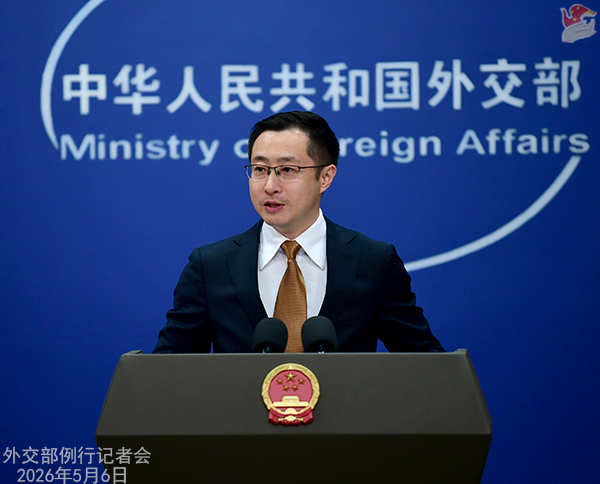
At the invitation of President of the Republic of Djibouti Ismaïl Omar Guelleh and President of the Republic of Uganda Yoweri Kaguta Museveni, President Xi Jinping’s Special Envoy and Vice Chairman of the Standing Committee of the National People’s Congress Luosang Jiangcun will travel to Djibouti City for the inauguration of President Guelleh on May 9 and to Kampala for the inauguration of President Museveni on May 12.
At the invitation of Costa Rica, President Xi Jinping’s Special Envoy and Chairman of the China International Development Cooperation Agency Chen Xiaodong will attend the presidential handover ceremony in Costa Rica’s capital San José from May 7 to 8.
China-Arab TV: According to reports, Japan’s Type 88 missiles were fired for the first time in a Balikatan exercise today, and this is also the first time that Japan fired offensive missiles overseas. Do you have any comment on that?
Lin Jian: Japan once invaded and imposed colonial rule over the Philippines and other Southeast Asian countries, and thus shoulder grave historical responsibilities. As the world marks 80 years of the opening of the Tokyo Trials, not only has Japan, the aggressor, failed to deeply reflect on its historical crimes, it has even sent military forces overseas and fired offensive missiles under the pretext of security cooperation. This is yet another example of the Japanese right-wing forces’ push for accelerated remilitarization of Japan. They have repeatedly breached Japan’s exclusively defense-oriented policy and relevant rules in international and domestic laws. Some of their policies and moves have gone far beyond the scope of self-defense. The serious lack of education on true history, the fundamentally wrong historical views, compounded by strategies for military rearmament and preparation for war, have led to the malevolent emergence of neo-militarism in Japan and put regional peace and stability under threat. We urge the Japanese side to deeply reflect on its history of militarist aggression, and honor its commitments and stay prudent in military and security areas.
China Daily: Lai Ching-te sneaked into Eswatini on its plane. While in Eswatini, he spoke about “diplomatic independence.” Yet the international community and people in Taiwan described his action as “thief-like” and an “international joke.” What is your response?
Lin Jian: Even though there was widespread opposition, Lai Ching-te sneaked onto a foreign plane and cheated himself into Eswatini by concealing passenger information with the country. On his return flight, after use of airspace was rejected by relevant countries, Lai again slipped onto the plane and forced his way through these countries’ skies. The whole thing showed the world how little Lai respects relevant countries’ airspace and sovereignty and cares for the opinion of the world. What he did was extremely dangerous and outrageous. The fact that he would smuggle himself in and out of the country shows exactly “Taiwan independence” separatism is just shady business and unacceptable to the international community. His act was nothing but a scandalous stunt.
Some politicians in Eswatini who are kept in Taiwan’s pay have been wrongly providing space for “Taiwan independence.” China strongly condemns it. In recent years, we’ve heard people from various sectors in so-called Taiwan’s “diplomatic allies” strongly call on their countries to grow ties with China. Which is the right thing to do? To see where the arc of history bends and follow their people’s will, or to continue serving as a political prop and keeping up the appearances for Lai Ching-te and his kind? The politicians in these countries need to come to the wise decision and stop going further down the doomed path.
There’s but one China in the world and Taiwan is an inalienable part of China’s territory. The one-China principle is an international consensus that has solid support and is simply unshakable. The pursuit of “Taiwan independence” is a dead end and its days are numbered. Any new attempt Lai Ching-te makes to advance his separatist agenda will only box himself further in. We urge those separatists to turn back from the wrong path and mend their ways sooner rather than later.
AFP: In the talks between Foreign Minister Wang Yi and Iran’s Foreign Minister in Beijing today, what issues were discussed? Did Minister Wang Yi push Iran to resume allowing the safe passage of ships through the Strait of Hormuz? I wonder if the Chinese foreign ministry can introduce anything about the talks today?
Lin Jian: Member of the Political Bureau of the CPC Central Committee and Minister of Foreign Affairs Wang Yi held talks with visiting Iranian Foreign Minister Abbas Araghchi today. They exchanged views on bilateral relations and international and regional issues of mutual interest. More information on this will be released soon. Please stay tuned.
BRTV: According to the latest statistics, during this year’s May Day holiday, it is estimated that over 1.5 billion cross-regional trips were made in China, a daily average of more than 300 million, up by 4 percent from last year. Hotel group purchase sales increased by 86 percent year-on-year. Box office exceeded 750 million yuan. In particular, inbound tourism recorded phenomenal growth, as China becomes a destination of choice for more and more foreign tourists. Many see such robust holiday performance as an indicator of the strong pulse of China’s economy. How would you comment on this?
Lin Jian: Perhaps many of our journalist friends here had a first-hand experience of the May Day holiday boom in various destinations across China. The data you just mentioned demonstrate the strong resilience of China’s economic growth and the huge potential of the Chinese market. We have also noted that more foreign tourists came to China during the holiday to experience the strong sense of safety and the sweet moments of everyday life unique to this country. This also attests to the appeal of China’s policies and measures towards facilitating cross-border travel guided by its commitment to high-standard opening-up. China will open its door wider to the world. Cross-border travel brings prosperity both in and beyond China. It will surely inject more vitality and positive expectations into the world economy.
RT TV: Two questions. Donald Trump recently called Xi Jinping very respectful, adding that Washington hasn’t been challenged by Beijing. The U.S. president also said he had offered China the option to send the ships to the United States, essentially suggesting that China buy American oil instead of Iranian oil. How does Beijing respond to these remarks? Would China ever consider such an offer? The second question is U.S. Treasury Secretary Scott Bessent recently lectured China, demanding that Beijing support the U.S.-led military operation in the Strait of Hormuz and also accusing China of obstructing UN initiatives. Given Washington’s long history of unilateral military interventions and bypassing the UN when convenient, how does the ministry respond to this call from Washington?
Lin Jian: On your first question, China and the U.S. are in communication on President Trump’s visit to China. On the Iran situation, China has made clear its position more than once. As for specifics about China’s energy policy, I’d refer you to competent authorities. On your second question, China’s position on the situation regarding the Strait of Hormuz is clear. We hope relevant parties will act prudently, avoid further escalation, resolve disputes through dialogue, and restore peace and tranquility in the Strait soon. China will continue working for deescalation of the situation there and making utmost effort to protect the safety and security of Chinese ships and crew.
Hubei Media Group: According to reports, results of the recent general election in Antigua and Barbuda have been released. The Antigua and Barbuda Labour Party won 15 of the 17 seats in the House of Representatives. Leader of the party, incumbent Prime Minister Gaston Browne has secured another term in office. Does China have any comment?
Lin Jian: China congratulates Prime Minister Gaston Browne on his reelection. We stand ready to work together with Antigua and Barbuda, a good friend and partner in the Caribbean, to continue deepening practical cooperation in various areas, bring our friendly relations to a new level, and deliver more benefits for both peoples.
Associated Press: It’s a follow-up question about the Iran situation. The U.S. government has also been asking China to put more pressure on Iran to not only end the war but open the Strait of Hormuz. What would you say about that?
Lin Jian: The situation in the Strait of Hormuz remains tense. Only through early and full ceasefire can there be necessary conditions for a deescalation. The sovereignty, security and territorial integrity of the coastal countries should be respected, the reasonable concerns of regional countries should be taken seriously, and the legitimate interests of the international community should be protected.
Bloomberg: You said China and the U.S. are in communication on Trump’s visit. Do you have any details on that visit, such as when it might happen?
Lin Jian: Please stay tuned.
The New York Times: Did China coordinate with the United States the American decision overnight to pause escorts of vessels through the Strait of Hormuz, so as to give today’s talks between China and Iran a chance of making progress?
Lin Jian: I just shared China’s position. Our position on the situation regarding the Strait of Hormuz is clear. We hope relevant parties will act prudently, avoid further escalation, resolve disputes through dialogue, and restore peace and tranquility in the Strait soon. China will continue working for deescalation of the situation there.
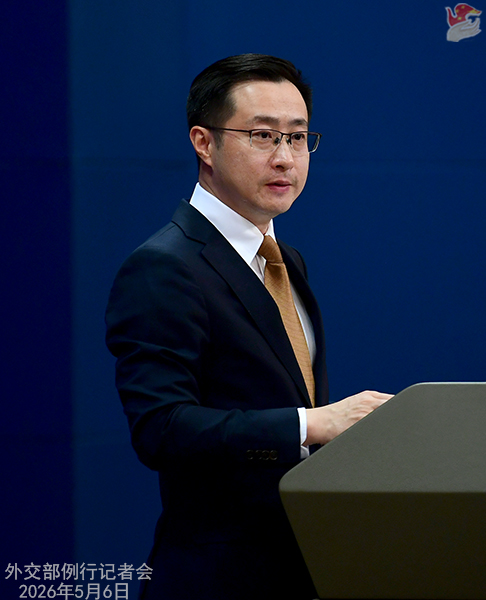
Reuters: I have two questions. The first one is a follow-up to Taiwan leader Lai Ching-te’s return flight from Eswatini. Based on the flight route that we’ve seen, he has taken a rather long flight path back to Taiwan. So we wanted to know if China has spoken or made any requests to countries such as Madagascar and Mauritius about letting his flight through their airspace? Also, we noted that on his way back, he did fly over Indonesia, Malaysia, the Philippines, Brunei and Australia. Has China reached out to these countries? Were there any engagement pre or after the travel back for Lai and whether China has summoned any ambassadors to talk about this?
Lin Jian: Whether to open a country’s airspace falls within the country’s sovereignty. Relevant countries, in upholding the one-China principle, have refused to issue flight permits for Lai Ching-te’s visit. This just act is fully consistent with international law and basic norms in international relations, and fully proves that the one-China principle is where the arc of history bends and that “Taiwan independence” separatist moves have no support.
AFP: The 48th summit of the Association of Southeast Asian Nations will be held in the Philippines this week. Is China sending a delegation? If so, who will represent China?
Lin Jian: As is always the case, the ASEAN Summit is attended by leaders of ASEAN member states. Dialogue partners are not included.
Ukrinform News Agency: I have two questions. The President of Ukraine Volodymyr Zelensky has said that Ukraine is declaring a ceasefire starting May 6 and expects reciprocal actions from Russia. According to him, Ukraine considers human life to be of far greater value than any anniversary celebration. Would the ministry like to comment on this new ceasefire proposition? The second question is about two Chinese citizens who fought against Ukraine on the Russia side and were captured last spring. They have been in captivity for a year. Ukraine can hand them over only to Russia, but Moscow is not interested in them. I’d like to ask whether the Chinese government is taking measures to free them from Ukrainian captivity?
Lin Jian: On your first question, China’s position on the Ukraine crisis is very clear. We support all efforts for peace, and hope relevant parties will continue to resolve the crisis through dialogue and negotiations.
On your second question, China asks the Ukrainian side to follow relevant provisions of international law, protect the legitimate rights and interests of Chinese nationals, and ensure their humane treatment.
We’ve issued multiple security alerts to ask Chinese nationals to stay away from areas of armed conflict, avoid any form of involvement in armed conflict, and in particular avoid participation in any party’s military operations.
The New York Times: Has China asked Iran to stop attacking ships carrying the exports of other Persian Gulf nations?
Lin Jian: As I just said, only through early and full ceasefire can there be necessary conditions for a deescalation in the Strait of Hormuz. Our position is clear. The sovereignty, security and territorial integrity of the coastal countries should be respected, the reasonable concerns of regional countries should be taken seriously, and the legitimate interests of the international community should be protected.
Bloomberg: The foreign ministry statement on Wang Yi’s meeting with the Iranian foreign minister says that China seeks a bigger role in restoring Middle Eastern peace. Can you give us any details on what that bigger role would look like?
Lin Jian: In the talks with Iranian Foreign Minister Araghchi, Foreign Minister Wang Yi stressed that since the fighting began, China has been actively promoting talks for peace. President Xi Jinping solemnly made the four propositions on safeguarding and promoting peace and stability in the Middle East which has been positively echoed by the international community. The current regional situation is at a critical stage of whether the conflict could end or not. China believes that bringing about a full stop of hostilities is of utmost urgency, a relapse in fighting must be avoided and sticking to negotiations is highly important. China supports Iran in safeguarding its national sovereignty and security and commends Iran’s willingness of seeking political settlement through diplomatic means. On issues regarding the Strait, resuming normal and safe passage at the Strait is a shared concern of the international community. China hopes that parties concerned will respond to the strong call of the international community as soon as possible. China advocates that the Gulf and Middle East countries need to take their fate into their own hands. We encourage Iran to have dialogue with more Gulf states to realize good-neighborliness and friendship, and support a regional architecture for peace and security established by regional countries with common participation for common interests and common development.
Foreign Minister Wang Yi also noted that China stands ready to uphold the spirit of President Xi Jinping’s four propositions, support countries in the Middle East to work for building a common home of good-neighborliness, development, security and cooperation, stay committed to deescalation and ending the conflict, assist the resumption of peace talks and play a bigger role in restoring peace and tranquility to the Middle East. For more about the talks, please refer to the readout.
China-Arab TV: The UK government announced yesterday new sanctions against some individuals and entities for supplying drone components and other military goods to Russia, including two entities based in China. What is China’s response?
Lin Jian: China opposes unilateral sanctions that have no basis in international law or the authorization of the UN Security Council. China strongly deplores the UK’s move and has lodged serious protests with the UK side. On the Ukraine crisis, China has been committed to promoting talks for peace and strictly controlled the export of dual-use items. Normal exchanges and cooperation between China and Russia should not be disrupted or affected. China will do what is necessary to firmly protect its legitimate and lawful rights and interests.
RIA Novosti: U.S. Secretary of State Marco Rubio commented on China’s Ministry of Commerce order to block U.S. sanctions against five Chinese refiners over alleged Iran oil ties yesterday, and I quote: “If you don’t comply with sanctions, you will face secondary sanctions.” What’s China’s reaction on these remarks?
Lin Jian: China’s competent authorities have stated their position. I want to stress that Chinese government opposes illicit unilateral sanctions that have no basis in international law or authorization of the UN Security Council. Relevant measures are concrete steps to implement the Rules on Counteracting Unjustified Extra-territorial Application of Foreign Legislation and Other Measures in line with the law. China will keep a close eye on the unjustified extra-territorial application of foreign legislation and measures by relevant countries, and China will firmly safeguard the legitimate rights and interests of Chinese citizens and companies in accordance with the law.