People’s Republic of China


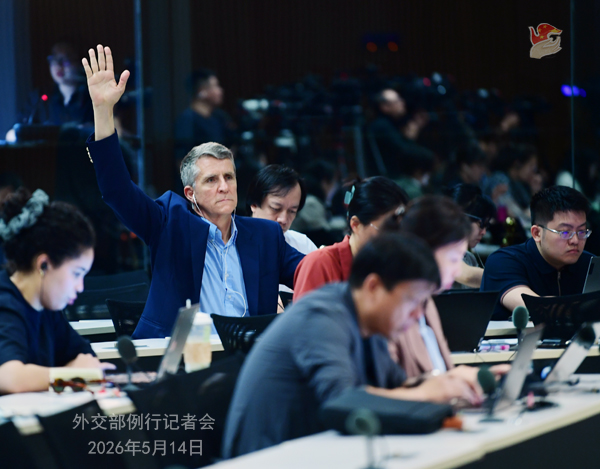
Asharq News: Regarding the situation in the Middle East, did the leaders discuss it? Has there been any specific progress on the conflict in Iran or on the reopening of the Strait of Hormuz? (Similar question from The New York Times)
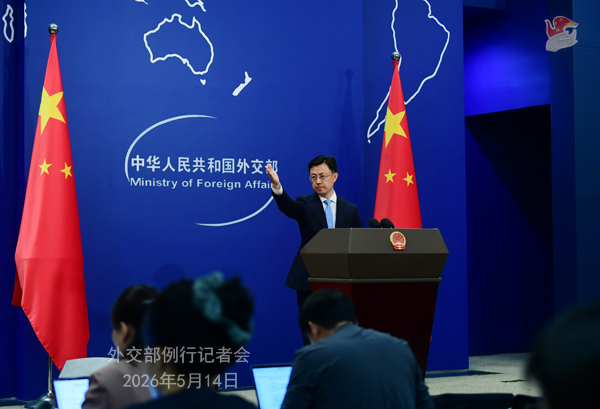
Guo Jiakun: President Xi Jinping held talks with President Trump this morning. The two heads of state exchanged views on the Middle East situation and other major international and regional issues. You may refer to the readout released by the Chinese side. On the Strait of Hormuz, China’s position is consistent and clear.
The New York Times: Regarding U.S. beef exports to China, are any actual purchases agreed to?
Guo Jiakun: During his talks with President Trump this morning, President Xi Jinping noted that the two countries should expand exchanges and cooperation in areas such as the economy and trade and agriculture. China has released a readout, which you may refer to.
The Paper: The second APEC Senior Officials’ Meeting will be held in Shanghai from May 18 to 19. Can you brief us on the preparations for the meeting? What does China hope to achieve through the meeting?
Guo Jiakun: APEC senior officials’ meetings, held four to five times every year, are the main channel for preparing outcomes for the leaders’ meeting. As the host of APEC in 2026, China will hold the second APEC Senior Officials’ Meeting in Shanghai from May 18 to 19. Through the meeting, the participants will review the APEC cooperation in the first half of this year, gather early harvests, and make preparations for the outcomes of the leaders’ meeting and other events throughout the rest of the year.
In addition, prior to the senior officials’ meeting, various committees and working groups are scheduled to hold a total of nearly 40 meetings from May 11 to 17, covering trade and investment, economic and technological cooperation, women, telecommunication, food security and other areas. More than 1,000 representatives from member economies of APEC, the APEC Secretariat and the APEC observers are expected to participate in the meetings.
The host city Shanghai is China’s largest economic center and an important global economic hub, ranking among the world’s top five cities by economic output, and topping the world in terms of port trade volume and container throughput in TEUs. We welcome all journalists to report on the second APEC Senior Officials’ Meeting and continue following and supporting the APEC “China Year.”
Reuters: Two questions going back to President Xi’s meeting with Trump. President Xi talked about a new positioning in ties with the U.S. and also he said both leaders agree that building a constructive and strategically stable relation will guide ties in the next three years and beyond. Could you elaborate on that as well? My second question is, President Xi also said if Taiwan issue was handled poorly, then bilateral relations with the U.S. could be pushed into an extremely dangerous situation. Is that a warning to the U.S. about a potential war?
Guo Jiakun: On your first question, President Xi Jinping and President Trump held talks this morning. Both sides agreed on a new vision of building a constructive China-U.S. relationship of strategic stability. This will provide strategic guidance for China-U.S. relations over the next three years and beyond. “Constructive strategic stability” means positive stability with cooperation as the mainstay, healthy stability with competition within proper limits, constant stability with manageable differences, and lasting stability with expectable peace. China stands ready to work with the U.S. to translate the new vision into actions in the same direction and jointly work for a steady, sound and sustainable development of China-U.S. relations.
On your second question, as President Xi Jinping noted during the talks with President Trump, the Taiwan question is the most important issue in China-U.S. relations. If it is handled properly, the bilateral relationship will enjoy overall stability. Otherwise, the two countries will have clashes and even conflicts, putting the entire relationship in great jeopardy. “Taiwan independence” and cross-Strait peace are as irreconcilable as fire and water. Safeguarding peace and stability across the Taiwan Strait is the biggest common denominator between China and the U.S. The U.S. side must exercise extra caution in handling the Taiwan question.
The New York Times: Did the two leaders specifically discuss American arms sales to Taiwan?
Guo Jiakun: China’s opposition to U.S. arms sales to China’s Taiwan region is consistent and clear.
RIA Novosti: Russia announced a few days ago the successful test launch of its Sarmat missile, which is “designed to penetrate both current and future missile defence systems”, according to President Putin. Do you have any comment on this?
Guo Jiakun: We have noted relevant media reports.
AFP: U.S. Secretary of State Marco Rubio has traveled to China with President Donald Trump. And this morning Secretary Rubio also met Chinese President Xi Jinping. But Secretary Rubio was sanctioned by China in 2020 over his remarks then as a senator criticizing China’s human rights record. Have those sanctions against Marco Rubio been removed? How does China view Secretary Rubio’s visit to Beijing along with President Donald Trump?
Guo Jiakun: The sanctions are aimed at Mr. Rubio’s actions and rhetoric on China when he served as a U.S. senator.
O Globo: I have a question about the foreign ministers’ meeting of the BRICS in Delhi, which is struggling to reach a final statement. First, I wanted to know what for China is the preferable outcome from this meeting? And secondly, why has China not sent a high-level representative from Beijing to this meeting? Iran’s foreign minister is present as well. So does China have any expectations in terms of the role that BRICS might be able to play in dealing with the current crisis? (Similar question from The Hindu)
Guo Jiakun: Chinese Ambassador to India Xu Feihong is attending the meeting on behalf of Foreign Minister Wang Yi due to scheduling reason.
BRICS is an important platform for cooperation among emerging markets and developing countries. China attaches great importance to and actively participates in BRICS cooperation. We are always committed to deepening BRICS strategic partnership and consolidating the positive momentum of BRICS solidarity and cooperation. We stand ready to work with other members of the BRICS family to support this year’s chair India in making the Foreign Ministers’ Meeting a full success, and advance the high-quality development of greater BRICS cooperation.
The New York Times: What role is Eric Trump playing in these talks?
Guo Jiakun: China has released a readout on the talks between President Xi and President Trump. I’d refer you to the U.S. side for anything about the delegation traveling with the U.S. president.