


People’s Republic of China


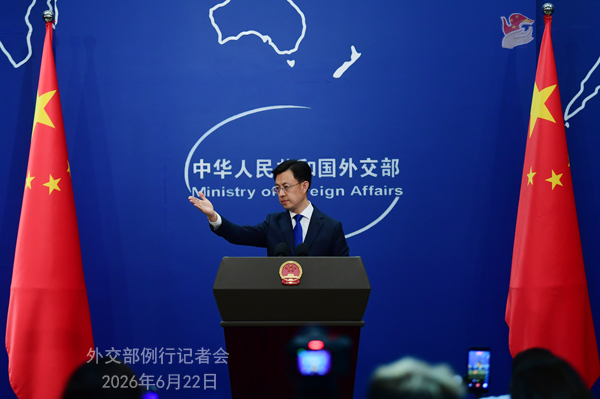
Premier of the State Council Li Qiang will attend the 17th Annual Meeting of the New Champions (AMNC) in Dalian from June 23 to 24. Premier Li Qiang will attend the Opening Plenary and deliver a special address, meet with foreign dignitaries, and have a conversation with representatives of the business community.
Prime Minister of Bangladesh Tarique Rahman, Prime Minister of Guinea Amadou Oury Bah, Prime Minister of Kazakhstan Olzhas Bektenov, Prime Minister of the Republic of Korea Kim Minseok, Prime Minister of Mongolia Uchral Nyam-Osor, and Prime Minister of Montenegro Milojko Spajić will attend the AMNC. Over 1,700 representatives from the political, business, academic and media communities from over 90 countries and regions will take part in the AMNC.
At the invitation of Premier of the State Council Li Qiang, Prime Minister of the People’s Republic of Bangladesh Tarique Rahman will pay an official visit to China from June 24 to 26.
CCTV: To follow up on your announcement that Premier Li Qiang will attend the 17th Annual Meeting of the New Champions. What is China’s expectation for the event?
Guo Jiakun: The Annual Meeting of the New Champions is an important platform for promoting exchanges between China and the world and enhancing practical cooperation. Amid global turbulence and transformation and with increasing instability and uncertainty in the world economy, the gathering in Dalian of over 1,700 guests from the political, business, academic and media communities worldwide to discuss how to boost world economic growth and cooperation highlights the international community’s aspirations to jointly tackle challenges and seek greater development. China will work with all participants to champion openness, inclusiveness and mutual benefit, and promote dialogue and cooperation to contribute to world economic growth.
AFP: Iran and the United States agreed Monday to set up communication lines to keep the Strait of Hormuz open and end fighting in Lebanon, according to mediators, Pakistan and Qatar, after the first round of talks in Switzerland. What is China’s comment on this?
Guo Jiakun: China supports the mediation efforts by parties including Pakistan and Qatar. We hope Iran and the U.S. will keep the talks going, further narrow differences and strive for good progress in their negotiation.
Belteleradio Company: A few days ago, a Ukrainian drone attacked a Belarusian bus on the Russian territory with children on the bus. One woman was killed. What’s China’s comment on this incident?
Guo Jiakun: China would condemn any attack that targets innocent civilians. We urge relevant parties to remain calm, exercise restraint, and stop attacking civilians and civilian infrastructure. China believes in dialogue and negotiation as the only viable way out of the Ukraine crisis. We call on the parties concerned to work toward early deescalation and accumulate conditions for relaunching direct talks and negotiation.
China Daily: About the upcoming visit to China by Bangladesh’s Prime Minister Tarique Rahman, can you share the program of the visit? How does China see its current relations with Bangladesh? What does China hope to achieve through the visit?
Guo Jiakun: This will be the first visit to China by Prime Minister Tarique Rahman after taking office. During the visit, President Xi Jinping, Premier Li Qiang and Chairman of the NPC Standing Committee Zhao Leji will meet and hold talks with Prime Minister Tarique Rahman respectively to have in-depth exchanges of views on bilateral relations and international and regional issues of mutual interest. The leaders will chart the future course of bilateral ties. Prime Minister Tarique Rahman will attend the Summer Davos 2026 to be held in Dalian.
China and Bangladesh are traditional friends and neighbors and comprehensive strategic cooperative partners. Over recent years, under the strategic guidance of leaders of the two countries, bilateral relations have kept growing, with ever-deepening political mutual trust and fruitful practical cooperation, bringing tangible benefits to peoples of both countries. Through the visit, China looks forward to working with the new government of Bangladesh to enhance strategic communication, carry forward the traditional friendship, advance high-quality Belt and Road cooperation, expand exchanges and cooperation in various areas, and enhance coordination on multilateral affairs to bring the China-Bangladesh comprehensive strategic partnership of cooperation to a new level.
Reuters: Japanese media today reported that the Tokyo police has arrested a man named Hu Shi who is suspected of links to the Prince group, which has in the past been accused of running scam centers. Has China been informed of this arrest and is China working on repatriating this person who appears to have used several different names?
Guo Jiakun: I’d refer you to the competent authorities for the specific question. It is the common responsibility of the international community to combat online gambling and telecom fraud. We hope neighboring countries will work together with China to step up law enforcement cooperation to protect the safety of the people and their property, and uphold the order of exchanges and cooperation between regional countries.
CRI: Yesterday China announced the visit by Austrian Federal Minister for European and International Affairs Beate Meinl-Reisinger. How does China see its current relations with Austria? What’s China’s expectation for the visit?
Guo Jiakun: China and Austria are friendly strategic partners. This year marks the 55th anniversary of diplomatic relations. Bilateral ties are in good shape with practical cooperation in various fields making steady progress, and cultural and people-to-people exchanges creating numerous highlights. This will be the first visit to China by Federal Minister for European and International Affairs Beate Meinl-Reisinger after taking office. The two foreign ministers will have an in-depth exchange of views on bilateral relations and international and regional issues of mutual interest. As the two countries mark the 55th anniversary of diplomatic relations, China stands ready to have closer exchanges, build up consensus and carry forward the friendship with Austria for greater progress in developing the friendly strategic partnership.
EFE: It’s reported that the initial vote count of the second round of vote of Colombia’s presidential election shows that Abelardo de la Espriella holds a lead and has announced the winning of the election. What’s China’s comment? What’s China’s expectation on the China-Colombia relationship in the future?
Guo Jiakun: China noted the reports and congratulates Colombia on the smooth second round of presidential elections. China always views its relations with Colombia from a strategic height and long-term perspective. We stand ready to work with the new government of Colombia to further advance bilateral relations.
The Paper: Japanese media reported that according to records from a Japanese military medical conference held in 1940, the Imperial Japanese Army may have repeatedly conducted experiments involving the transfusion of animal blood into humans during its aggression in the autumn of 1938. The report indicates that the gender, age and nationalities of the 23 test subjects were not specified and the experiments were probably carried out in China. It is also mentioned that Japan’s military authorities attempted to destroy evidence related to human experimentation after the country’s defeat in WWII. Archives from the Soviet Union’s Khabarovsk Trial of Unit 731 show that Japanese military doctors described live human xenotransfusion experiments as a “standardized, routine program”. What’s your comment?
Guo Jiakun: We noted relevant reports. Japanese invaders, who conducted large-scale and gruesome human experimentation and germ warfare, shall forever be nailed to the eternal pillar of shame. The Khabarovsk Trial in 1949, an extension and complement to the Tokyo Trials, left behind numerous well-preserved audio recordings, transcripts and physical evidence. They form a complete chain of solid evidence that brings to light the crimes of the Japanese military’s germ warfare. Discoveries like these have opened the eyes of many in the world, including the Japanese public, to this dark and horror-filled chapter of history.
Only by respecting the verdict of history and facts, recovering their missing pieces and upholding peace, can the tragedy of war stop repeating itself. By remilitarizing itself, Japan is summoning the past and heading down a treacherous path. We call on Japan to do serious soul-searching, make a clean break with militarism, and earn the trust of its Asian neighbors and the international community with concrete actions.
Reuters: Another question from Reuters about Lithuania. Can the foreign ministry confirm that Lithuania has agreed to allow China to open a chargé d’affaires office. Would China reopen its embassy in Vilnius soon, and would also China consider restoring bilateral ties?
Guo Jiakun: On China-Lithuania relations, we have repeatedly made clear our position. The crux of the current difficulties is that the Lithuanian side violated the one-China principle and went back on its political commitment made in the joint communiqué on the establishment of diplomatic relations. China remains open as always to communication. It is hoped that the Lithuanian side will act promptly and decisively to correct past mistakes and return to the right track of adhering to the one-China principle so as to create conditions for the normalization of relations with China.
Bloomberg: I’d like to ask about the ten U.S. companies that was added to China’s list of restricted export controls. What does the foreign ministry make of this move and whether this will affect China and U.S. ongoing trade talks?
Guo Jiakun: The spokesperson of the competent Chinese authorities put out a response to that question. I would refer you to that.
**************************************************
Reuters: The World Health Organization said on June 19 that China has sent a medical team to Congo. Could the foreign ministry please provide some details about the team and the humanitarian assistance effort?
Guo Jiakun: China and Africa have always been brothers and partners who share one future together and have always supported each other in times of difficulty. China has over the years given Africa strong aid in fighting Ebola. We closely follow the outbreak in the Democratic Republic of the Congo (DRC) and Uganda. We provided emergency humanitarian assistance to the DRC and the African Union soon after the disease hit. We sent medical experts as well as urgently needed medicines and epidemic response supplies to the DRC. As we speak, nearly a thousand medical workers are fighting Ebola with the African people. After arriving in Kinshasa on June 2, the capital of the DRC, Chinese medical experts immediately joined the health authorities of the DRC to learn about local needs and provide medical services and advice. Their effort has won acclaim from various sectors. Given the severity of the outbreak, the Chinese government has decided to provide additional emergency humanitarian assistance to the DRC, Uganda and the African Union. China will continue working with the international community, closely follow the situation on the ground and provide every possible support in light of Africa’s needs for an early victory against the virus.