People’s Republic of China


Hubei Media Group: It is reported that Taiwan’s so-called “deputy foreign minister” said that the Taiwan authorities are in dialogue and consultation with political figures and social communities in Honduras regarding the restoration of “diplomatic ties” between China’s Taiwan region and Honduras. However, not long ago, the Foreign Ministry of Honduras clarifies on social media that Honduras is not engaged in any official talks or official contacts with Taiwan authorities aimed at “restoring diplomatic relations.” The country’s foreign policy is conducted in accordance with its existing diplomatic commitments. What’s your comment?
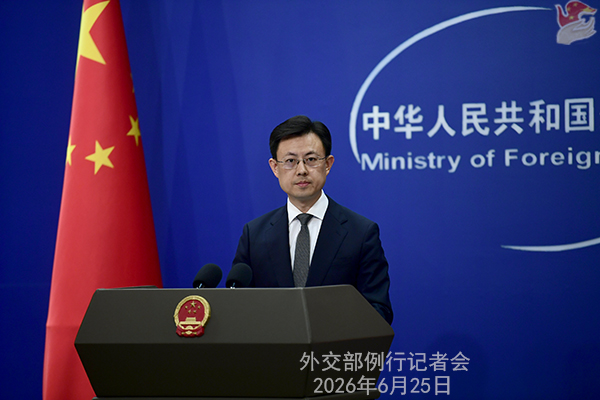
Guo Jiakun: We note that the government of Honduras has made clarifications on the DPP authorities’ lies. Apparently, upholding the one-China principle is recognized internationally as the right thing to do. It is where the arc of history bends and public opinion trends. The “Taiwan independence” forces and the DPP authorities’ unjust pursuit have little support and will end up in failure.
Since the two countries established diplomatic ties, China-Honduras ties which were built on the basis of the one-China principle have grown rapidly, and the economic and social development of Honduras has benefited from the practical cooperation it has had with China in various fields. It is quite clear that China-Honduras diplomatic ties serve the fundamental and long-term interests of both countries and peoples. China is committed to further advancing ties with Honduras on the basis of the one-China principle.
Telesur: A double-earthquake of magnitude above seven has struck Venezuela, including the capital of Caracas, causing widespread impact across the region, with significant damage to infrastructure and building collapses. Rescue operations are currently underway, and several countries have already offered assistance. How is China following this situation?
Guo Jiakun: China noted the reports about the earthquakes and offers its sympathies to the Venezuelan government and the affected population. We believe that under the leadership of the Venezuelan government, its people will recover and rebuild soon. We stand ready to see what we can do to help in suitable ways in light of Venezuela’s need.
Reuters: A follow-up question on the earthquake in Venezuela. Are there any confirmed Chinese nationals who were injured or killed in the earthquake? And as far as the assistance, what kind of assistance will China be able to provide Venezuela?
Guo Jiakun: China is closely following the severity of the earthquakes in Venezuela. We are in close communication with our embassy in Caracas. As of this moment, there has been no report of Chinese nationals injured or killed.
China is ready to do what it can to assist in light of Venezuela’s need.
Global Times: According to reports, the U.S. State Department announced on June 23 that it is sanctioning five entities and one individual for generating revenue for the Cuban government. Cuban Foreign Minister Bruno Rodríguez responded on X that the government of the U.S., led by its Secretary of State, continues the steps to tighten the noose around the economy of Cuba, as the latter proves stronger, more capable, and more effective than he expected in the face of ruthless aggression and collective punishment. Do you have any comment on that?
Guo Jiakun: China opposes illicit unilateral sanctions that have no basis in international law. We urge the U.S. to stop at once its blockade and all forms of coercion and pressuring against Cuba, which violate the Cuban people’s right to survival and development. We firmly support Cuba in exploring the socialist development path suited to its national conditions, and firmly support Cuba in safeguarding national sovereignty and security and opposing external interference.
CGTN: It is reported that at the opening ceremony of the 56th annual meeting of the Organization of American States, Panama’s President José Mulino claimed that Panama has registered unusual increase over recent months in inspections and detentions of Panama-flagged vessels in ports of China without any verifiable technical or maritime safety reasons; and that the international maritime law, the right of free passage and the right of innocent passage should not become any country’s tool to exert political pressure. Panama’s foreign minister recently said that China and Panama were to have technical talks at an early date to discuss the inspection of Panama-flagged vessels in China’s ports and advance the negotiation for China-Panama Maritime Transport Agreement. What is China’s comment on this?
Guo Jiakun: We have made clear China’s position several times. China is a major shipping country and places high importance on maritime transport and personal safety. Since 2026, Panama-flagged vessels have been involved in multiple collisions of merchant or fishing vessel in a row in Chinese waters, resulting in deaths and people being missing. To exercise responsibility for maritime transport safety, particularly people’s safety, China’s competent authorities have conducted port state control inspections on incoming vessels in accordance with laws and regulations. This is fully in compliance with international conventions and does not target any particular country or ship flag. For specifics, I would refer you to competent authorities.
CNR: According to reports, the National Election Board of Ethiopia recently announced the final results of the country’s seventh general elections. In a landslide victory, the ruling Prosperity Party won 438 of the 501 seats of the House of Peoples’ Representatives, maintaining its dominance in the national political landscape, which began with its founding in 2019. What’s China’s comment?
Guo Jiakun: China congratulates the Prosperity Party led by Prime Minister Abiy Ahmed on once again winning the parliamentary elections. As Ethiopia’s all-weather strategic partner, China supports the country in following a path suited to its national conditions and believes it will achieve even greater progress in national development. China deeply values its relations with Ethiopia and stands ready to work with the Ethiopian side to deliver on the important common understandings of the leaders of the two countries and the outcomes of the Beijing Summit of the Forum on China-Africa Cooperation, deepen practical cooperation across the board, bring more benefits to both peoples, and contribute to greater solidarity and cooperation between China and Africa and among the Global South.
Reuters: Chinese embassies and consulates in the United States have reportedly contacted U.S. local government offices and private firms to discourage engagement with Taiwan, while mischaracterizing U.S. policy. This is according to letters sent by U.S. government departments to governors’ offices and business leaders in the U.S. How does the ministry respond to these allegations?
Guo Jiakun: China firmly opposes official interactions of any form between China’s Taiwan region and the U.S., including its federal and state governments. To only maintain unofficial relations with Taiwan is a commitment made by the U.S. side in the Joint Communiqué on the Establishment of Diplomatic Relations. China urges the U.S. to earnestly abide by the one-China principle and the three China-U.S. joint communiqués, stick to the statements and commitments President Trump has made to China, prudently handle the Taiwan question, and not to have any official interactions with the Taiwan region under any pretext or send any wrong signal to “Taiwan independence” separatist forces.
Reuters: The United States, Britain, France, and Germany have expressed concern that recent Chinese activities off Taiwan’s east coast, where China has deployed Coast Guard patrols, threaten regional stability, freedom of navigation, and the safety of international shipping. How does the ministry view these concerns?
Guo Jiakun: According to China’s domestic law and international law including UNCLOS, China has exclusive economic zone and continental shelf in waters east of China’s Taiwan island. Chinese authorities’ law enforcement and patrol activities in these waters are legitimate actions to exercise China’s jurisdiction, safeguard regional stability and uphold order at sea in accordance with the law. These actions are also a necessary response to Japan and the Philippines’ manipulation of their delimitation agenda and violation of China’s maritime rights and interests. Relevant countries need to respect China’s sovereignty, territorial integrity and maritime rights and interests, and stop mischaracterizing facts and truth. Relevant institutions should not make statements unsuited to their identity.
The DPP authorities are playing deaf to the infringement of Japan and the Philippines and even joining with external forces to vilify the Central Government’s effort to safeguard rights, and peddle their separatist narratives. It once again exposes the DPP authorities’ separatist nature and betrayal of the overriding interest of the Chinese nation. What awaits them is contempt from the people on both sides of the Taiwan Strait and the judgment of history.