People’s Republic of China


Global Times: President of the European Commission Ursula von der Leyen said recently that EU’s dialogue with China has to deliver on trade imbalances. The EU had to be “very clear” in its talks, raising issues including “overcapacity of goods coming to our market.” Meanwhile, due to recent heat waves, China’s cooling products such as air conditioners, fans, and multifunctional sun umbrellas have become increasingly popular in Europe, with some air conditioners completely sold out. What’s your comment?
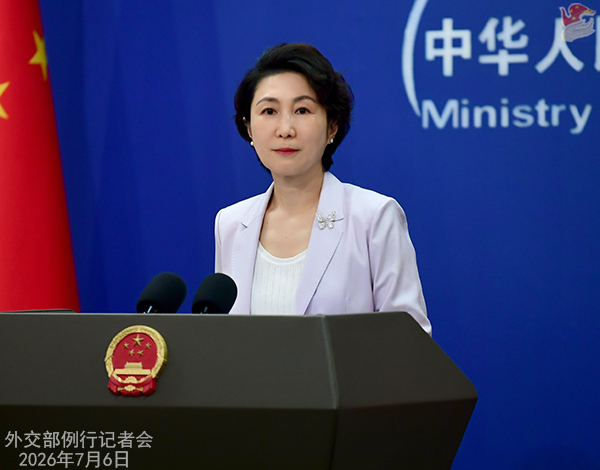
Mao Ning: Are Chinese goods “overcapacity” or undersupply? The consumers can decide for themselves. Quality products that are in demand and fair-priced naturally find a ready market. China-EU trade is driven by market demand and shaped by economic complementarity. China-EU trade has benefited consumers and profited dealers. It is not something that can be forced, but a result of mutual choice that benefits both sides. Hope the EU will put things into perspective, ditch the zero-sum mentality and work with China to make the pie of win-win cooperation bigger.
CCTV: Did Chinese President Xi Jinping send congratulatory message to the U.S. President over the 250th anniversary of American independence?
Mao Ning: This year marks the 250th anniversary of American independence. President Xi Jinping, on behalf of the Chinese government and people, has sent a message of congratulations to U.S. President Donald Trump.
NHK: Chinese military test-fired a missile from a nuclear submarine into the Pacific on Monday. Could you explain the purpose of the test and clarify where the missile landed?
Mao Ning: The Chinese side has released information on this. For more specifics I would refer you to the competent authorities. It is a routine arrangement in China’s annual military training program. It is consistent with international law and customary international practice and is not directed at any specific country or target.
China News Service: Cuban President Miguel Díaz-Canel recently warned that the U.S. embargo against Cuba has brought pressure to an “unsustainable” level and amounted to “genocide,” and the Cuban side requested a special session of the UN General Assembly on July 7. What is China’s comment?
Mao Ning: The U.S. 60 plus years of full blockade and illicit sanctions have brought profound sufferings to the Cuban people. Recently the U.S. once again upgraded blockade and sanction measures, hitting hard at the basic livelihood of the Cuban people and raising concern from the international community. China, as always, opposes illicit unilateral sanctions that have no basis in international law. We urge the U.S. to stop its blockade, coercion and pressuring against Cuba at once, and stop violating the Cuban people’s rights to survival and development. China firmly supports Cuba in defending national sovereignty and standing against external interference. We stand ready to work with the rest of the world to uphold international fairness and justice.
AFP: To follow up on the test missile question. This has been criticized by several countries, including Japan, Australia and New Zealand. Japanese authorities said that they had strongly urged China to reconsider the test launch before it happened. Does the foreign ministry have any comments on the test launch or response to the related criticism today?
Mao Ning: It is a routine military training activity that is not directed at any specific country or target. The countries concerned were informed prior to the launch. It is consistent with international law and customary international practice. The whole process was safe, standard and professional. We hope relevant countries will not read too much into it.
NOS: Tomorrow the Dutch minister of foreign trade Mr. Sjoerdsma will arrive in China for his meeting with the Chinese commerce minister. In 2021 Mr. Sjoerdsma was put on a sanction list by China. Does his upcoming visit mean that China has lifted the sanctions on Mr. Sjoerdsma? The second question would be, what’s China’s hope for the visit?
Mao Ning: For specifics about the visit, I’d refer you to competent authorities. China and the Netherlands are important cooperation partners. Advancing dialogue and cooperation in an open and practical spirit serves the common interests of both countries. We welcome closer dialogue and communication and deeper cooperation between the commerce departments of the two countries on the basis of mutual respect.
Bloomberg: Australia and Fiji signed a mutual defense treaty and a new agreement to develop ties. This is part of Canberra’s campaign to shore up its influence in the South Pacific and to limit China’s influence. Would the foreign ministry like to respond?
Mao Ning: China always upholds the principles of mutual respect, equality, mutual benefit, openness and inclusiveness in carrying out cooperation with Pacific island nations. We do not engage in geopolitical rivalry or seek selfish political gains. It is hoped that the country concerned will truly respect the independence of Pacific island nations, focus on their sustainable socioeconomic development, and avoid targeting any third party or harming the interests of any third party.
DPA: Last Thursday Germany’s foreign ministry requested urgent talks with the Chinese ambassador over reports of Russian soldiers receiving training in China, according to German foreign ministry. Does the Chinese foreign ministry have any comment on this? How will the talks affect China-Germany relations?
Mao Ning: The Chinese ambassador to Germany recently met with officials of the German foreign ministry upon request to exchange views on bilateral relations and issues of common interest.
As to the so-called reports that the German side is following with concern, we have made clear that they are pure slander with no factual basis. On the Ukraine crisis, China always maintains an objective and just position and stays committed to facilitating a political settlement and promoting peace talks in its own way. The German side should view China’s position and role in an objective and rational light.