People’s Republic of China


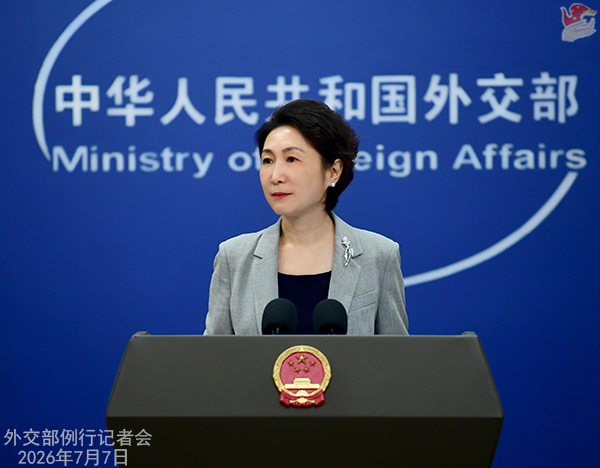
Telesur: China has been one of the leading supporters of Venezuela’s relief efforts following the recent earthquakes. Yesterday, a Chinese government humanitarian aid flight arrived in Venezuela carrying essential equipment and emergency supplies. Could the Ministry provide an overview of China’s humanitarian response so far, including government aid and contributions from Chinese-funded companies and the Chinese community in Venezuela? What additional support or humanitarian shipments are planned to assist the country’s recovery and reconstruction?
Mao Ning: China is closely following the severity of the earthquakes in Venezuela. President Xi Jinping sent a message of sympathies to acting President Delcy Rodríguez over the disaster. In addition to the cash assistance that China has provided to Venezuela, the Chinese government has decided to provide emergency supplies worth RMB100 million as donations. The Red Cross Society of China has provided the Red Cross Society of Venezuela with US$300,000 as emergency cash assistance. Yesterday, the first batch of 80-tonne assistance supplies from the Chinese government, including generators, water purifiers, tents and blankets, arrived in Venezuela via charter flight. China also provided satellite imagery to the quake zones. Chinese companies and associations of overseas Chinese in Venezuela provided a large number of urgently needed machinery and food. China stands ready to offer more support and assistance as the disaster response progresses.
CCTV: As Foreign Minister Wang Yi is about to conclude his visit to Denmark, Sweden, Finland and Norway, can you brief us on the trip?
Mao Ning: Foreign Minister Wang Yi visited Denmark, Sweden, Finland and Norway from July 2 to 7. During the trip, Foreign Minister Wang Yi held talks with foreign ministers of the four countries and had friendly exchanges with King Frederik X of Denmark, Swedish Prime Minister Ulf Kristersson, Finnish President Alexander Stubb and Norwegian Prime Minister Jonas Gahr Støre. They had candid, in-depth and constructive exchanges of views and reached positive common understandings and results on promoting the sound, steady and sustainable development of bilateral ties between China and the four countries in the new era and on international and regional issues of mutual interest.
The visit carries forward friendship. These four nations visited by Foreign Minister Wang Yi are among the first European countries to recognize and establish diplomatic relations with the People’s Republic of China (PRC). China has a long history of exchanges with these countries and together we’ve set many records along the way. Denmark is the first country to launch a green transition cooperation mechanism with China and is now China’s comprehensive strategic partner. Sweden is the first Western nation to establish diplomatic ties with the PRC, and today stands as China’s top trading partner in Northern Europe. Finland is the first Western country to sign an intergovernmental trade agreement with China, and the two sides now enjoy a future-oriented new-type cooperative partnership. Norway was among the first countries to recognize China’s market economy status. The valuable experience over the past decades is that the two sides always treat each other with respect and equality, and accommodate each other’s core interests and major concerns. The four countries made clear their commitment to the one-China policy for a stronger political foundation of the bilateral ties. The two sides agreed to further implement the important common understandings reached between President Xi Jinping and leaders of the four countries, carry forward traditional friendship, maintain high-level exchanges, step up strategic communication, expand comprehensive cooperation, and strive for new development in bilateral ties.
The visit deepens mutual trust. The four countries are important nations in Europe. Both sides agreed that China and Europe should foster a correct perception of each other, maintain dialogue and cooperation as the mainstream, and make sure that differences are appropriately placed in bilateral relations. China believes that China-Europe economic and trade cooperation has been fruitful over the decades and the current economic and trade ties need to be viewed in a more comprehensive, objective, and positive light. The two sides need to maintain and expand two-way opening up, and do more for upward balance. The European side recognizes the need to enhance its own competitiveness. Foreign Minister Wang Yi welcomed businesses from the four countries to walk into the “fitness club” of the Chinese market to build their strength and share in the opportunities offered by China’s mega market, complete industrial chains, and diversified application scenarios. The four countries welcomed more constructive economic and trade dialogues between China and Europe, and supported the effort of properly handling economic and trade frictions, seeking win-win solutions, and achieving substantive outcomes. The four countries welcome greater people-to-people exchanges with China and the effort of deepening exchanges in various fields, including education, culture, tourism, language, scientific research, think tanks, youth, and local governments, so as to further consolidate public support for bilateral ties.
The visit expands cooperation. Green and low-carbon development is a shared pursuit of China and the four countries. The concept of “Green is gold” put forth by President Xi Jinping was highly recognized and commended by the four countries. Green has become an important defining feature of the bilateral cooperation in the new era. The two sides agreed to take green cooperation as a leading area, forge synergy in policy coordination, complementary industries, multilateral governance and other areas, and jointly inject strong impetus into the global green transition. The four countries are a powerhouse for scientific and technological innovation. China welcomes businesses from both sides to leverage their respective advantages and pool strength for coordination so as to deliver more for our people with innovation outcomes. Both China and the four countries pay high attention to the development and governance of AI. The two sides agreed to strengthen dialogue on global AI governance and explore rules on collective governance, and appreciated the principles put forward by China, namely people-centered approach, AI for good, universal benefit, inclusiveness and collaborative governance.
The visit builds consensus. Both China and the four countries uphold multilateralism, champion international rule of law and advocate the central role of the UN in international affairs. The four countries agreed to work with China to strengthen multilateral communication and collaboration, safeguard the authority and the role of the UN, and work for a more just and equitable global governance system. The two sides had in-depth exchanges of views on international and regional issues of mutual interest. Foreign Minister Wang Yi reaffirmed the principled position on Ukraine and emphasized that China has always followed the fundamental guidance of the four points about what must be done put forth by President Xi Jinping and has been actively promoting the political settlement of the Ukraine crisis. China’s position is objective, just and consistent. It takes into full consideration the legitimate concerns of all parties, including those of Europe, and supports all efforts conducive to peaceful settlement of the crisis.
A broad consensus during the visit is that, facing the chaotic and turbulent international situation, we should focus on consolidating and developing the bilateral relations well to address the uncertainty of the world with the stability of the bilateral relations, and meanwhile, keep pace with the times, break new ground, jointly respond to the real challenges, grasp the historical opportunities, and respectively contribute more to North-South and South-South cooperation.
Beijing Youth Daily: It was reported that the Japan Coast Guard claimed on July 3 that at around 11 am, it detected a Chinese maritime survey vessel entering the exclusive economic zone near Okinawa’s Kume Island, southwestern Japan, and extending a wire into the sea. A Japanese patrol ship immediately radioed the Chinese vessel to demand a complete halt to the operation. What’s your comment?
Mao Ning: Diaoyu Dao and its affiliated islands have always been part of China’s territory. It is fully within China’s sovereign rights to have Chinese research vessels carrying out activities in the adjacent waters of Diaoyu Dao, which is legitimate, lawful and beyond reproach. China firmly opposes Japan’s disruption of the legitimate activities of Chinese research vessels and has lodged serious protests with the Japanese side.
Shenzhen TV: This year marks the 30th anniversary of China’s ratification of the United Nations Convention on the Law of the Sea. How does China see the Convention’s role? What was China’s contribution to it?
Mao Ning: The United Nations Convention on the Law of the Sea (UNCLOS) is a key outcome of the third United Nations Conference on the Law of the Sea held between 1973 and 1982. The Convention, along with other international treaties and customary international law, constitutes the basic legal framework of modern international maritime law. Its entry into force and implementation is conducive to maintaining a fair and just international maritime order and fostering a more just and equitable global governance system.
The UNCLOS negotiations were the first major international legislative process China took part in after the restoration of its lawful seat at the United Nations. China participated in the entire process of the third United Nations Conference on the Law of the Sea and contributed along with fellow developing countries to the birth of the Convention. China was one of the first countries that signed UNCLOS and became a State Party on July 7, 1996.
Over the past 30 years, China has exercised its rights and fulfilled its obligations under the Convention in good faith. It has been a strong advocate for the spirit of multilateralism embodied by the Convention and has supported the effective operation of the three international institutions established in accordance with UNCLOS. It has also worked together with various parties to safeguard maritime peace and security, promote sustainable development of the ocean, strengthen marine scientific research and environmental protection, and facilitate exchange and cooperation in maritime affairs. Through these efforts, China has played its part in improving global maritime governance and advancing the welfare of all humanity.
AFP: Several foreign governments have criticized China’s missile test launch yesterday. They include some countries in the South Pacific, like the Solomon Islands and also New Zealand, who have said that they don’t want to see missiles tested in the South Pacific near them. I wonder if you have a response to those countries who are worried about tests close to their territory?
Mao Ning: The test launch is a routine training activity of China’s military. It is not directed at any specific country or target. The Chinese side had notified relevant countries beforehand, as is consistent with international law and customary international practice. I would also like to stress that China is committed to the path of peaceful development and follows a defensive nuclear strategy. There is no need for any country to overinterpret the test launch.
Telesur: Venezuela’s earthquake has posed a double challenge for the country. While the authorities are working to save lives and assist those affected, difficulties persist in financing humanitarian operations, carrying out international financial transfers, and importing essential supplies. The United States announced a temporary easing of some sanctions to facilitate humanitarian assistance, but other restrictions and the freezing of Venezuelan assets remain in place. How does Beijing assess the impact of these measures on relief efforts and reconstruction, particularly in a country that just a few months ago experienced a U.S. military operation involving large-scale bombings and the abduction of its president Nicolás Maduro?
Mao Ning: China always opposes illicit unilateral sanctions that have no basis in international law. We call on the U.S. to fully lift its illicit unilateral sanctions against Venezuela as soon as possible and create favorable conditions for Venezuela’s reconstruction.