


People’s Republic of China


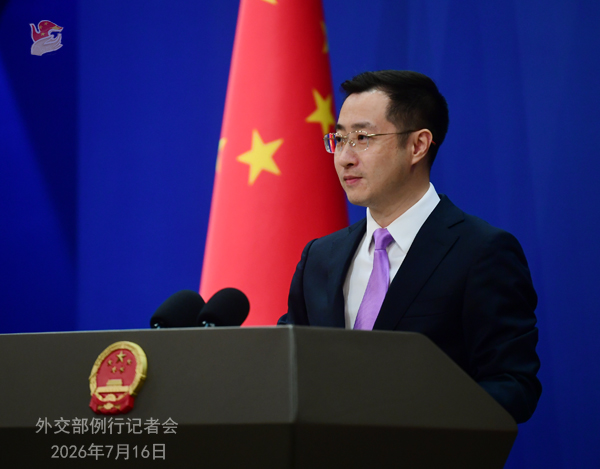
CCTV: The 2026 World AI Conference & High-Level Meeting on Global AI Governance to be held in Shanghai has received extensive media attention globally. It is widely believed that the Conference will focus on cutting-edge AI technology and showcase China’s efforts in global AI rule-making. However, some assert that China intends to use the Conference to seek support from the Global South and gain dominance in major-country competition in the area of AI. The Economist even claims that China’s open-source AI is a trap and that embracing China is risky. What’s China’s comment on the above views?
Lin Jian: The development of AI bears on the well-being of all humanity. All parties should work to narrow the digital and smart technology gap, hold on to the bottom line of security, improve global governance, and jointly develop AI as an open and inclusive technology for good and for all. China opposes drawing lines along ideological difference and conducting technological blockade. China stays committed to coordinating both development and security and is ready to share experiences with all to elevate the level of AI innovation worldwide.
Tomorrow, the 2026 World AI Conference & High-Level Meeting on Global AI Governance will kick off in Shanghai. China will use the occasion to have candid exchanges with all parties, build consensus and ensure that developing countries have greater access to the dividend of the intelligence age and that technological advancement can truly lead to progress and prosperity of human society.
RT TV: Today carries significance to Russia-China relations as it marks the 25th anniversary of the signing of the China-Russia Treaty of Good-Neighborliness and Friendly Cooperation. How does China view the development of the bilateral ties under this framework as well as its future?
Lin Jian: This year marks the 25th anniversary of the signing of the China-Russia Treaty of Good-Neighborliness and Friendly Cooperation. In May, President Xi Jinping and President Putin had a successful meeting in Beijing, where they agreed to extend the treaty and jointly steer the China-Russia relationship into a new stage of greater achievements and faster development. Under the strategic guidance of the two presidents, both sides will continue following the purposes and principles of the treaty and expanding mutually beneficial cooperation in various fields so as to bring more benefits to our two peoples and provide more certainty and development confidence for the world.
CCTV: On July 15, the National Endowment for Democracy held a press conference to introduce its report titled “Testing the Limits: China and Russia’s Authoritarian Influence at Scale in a New Period of Impunity.” Does China have any comment?
Lin Jian: The National Endowment for Democracy’s so-called report is riddled with lies, fallacies and disinformation deliberately aimed to spread the false narrative of “authoritarian expansion,” smear China’s foreign exchanges and international cooperation and propagate the false “China threat.” It is ill-intended and malignant. China firmly opposes it.
For years and years, the National Endowment for Democracy has been interfering in other countries’ internal affairs, committing subversion, stoking division and confrontation, manipulating and misleading public opinion, and conducting ideological infiltration under the pretext of promoting democracy. It has brought profound damage, grown utterly discredited and notorious, and long been a disgrace in the international community.
China stays committed to developing friendly cooperation with all countries on the basis of the Five Principles of Peaceful Coexistence to share development opportunities, and uphold international fairness and justice. It is regarded as a builder of world peace, contributor to global development, and defender of international order. We urge relevant U.S. institutions and individuals to form a right perception of China, abandon prejudice and arrogance, stop political manipulation and care more about the affairs of its own country.
Beijing Daily: It’s reported that yesterday the government of Papua New Guinea announced the closure of the “Taipei Economic Office in Papua New Guinea.” Would you like to comment on this?
Lin Jian: The government of Papua New Guinea decides to close the “Taipei Economic Office in Papua New Guinea.” China highly commends the decision and it demonstrates once again that upholding the one-China principle is where international public opinion trends and the arc of history bends. China stands ready to continue working together with Papua New Guinea to support each other on issues concerning respective core interests and advance our comprehensive strategic partnership.
Global Times: We have seen commentaries on China’s foreign policy from Western media and scholars that introduce the concept of “tribute system,” saying that “we are in the very early stage of a shift to a tribute-system-type order in the Asia region.” China is reshaping countries’ expectations by economic and technological powers to “subdue the enemy without fighting.” Some also believe that it’s nothing but another distorted conclusion from the West based on traditional geopolitical mentality, and another made-up label for “China threat” narratives. What’s your comment?
Lin Jian: The so-called “tribute system” is a false image projected by the Western hegemonic logic onto Chinese diplomacy. The narrative fails to see the values of harmony and diversity that have defined and shaped the Chinese civilization for thousands of years, and misrepresents the principle of equality which is at the core of China’s diplomacy since 1949. The narrative is a serious departure from the basic norms of international relations and the opposite of the reality of China’s interaction and cooperation with Asia and the rest of the world.
China never subscribes to the logic that a great power is bound to seek supremacy. China never pursues hegemony that aims to deter, but a world that lives in harmony and solidarity. All countries, regardless of their size, are equal. And the right approach to get along with each other is mutual success, not one-way dependence. China’s diplomacy is anchored in mutual respect, fairness and justice, and win-win cooperation. We work to defend true multilateralism and build a community with a shared future for humanity. We are committed to an amicable, secure and prosperous neighborhood and sharing a region of amity, sincerity, mutual benefit and inclusiveness with our neighbors. All these commitments enable China to be the anchor of security in the region and the engine of prosperity. China will work with the rest of the world to continue injecting more certainty to a peaceful, stable and prosperous Asia and world.
PTI: India earlier this week has announced its bid for the non-permanent seat for 2028-2029 of the UN Security Council. India’s External Affairs Minister Dr. S. Jaishankar has delivered a speech in this regard to the UN diplomats. How does China view India’s candidature and will Beijing back India’s bid for this?
Lin Jian: We have taken note of relevant reports.
Xinhua News Agency: It’s reported that senior Pentagon officials in recent weeks examined a range of options for possible military action against Cuba, including an assault involving thousands of U.S. soldiers, but it’s not an indication that President Trump has decided to carry out an operation. What’s China’s comment?
Lin Jian: We noted relevant reports. The use or threat of force in international relations seriously violates the UN Charter and endangers global and regional peace and security. China firmly opposes it. The UN General Assembly’s overwhelming vote to proceed with the debate on “the necessity of ending the economic, commercial and financial embargo imposed by the United States against Cuba” reflects the extensive international support to Cuba and the just call for ending the blockade. The U.S. needs to immediately stop its military threat and any form of blockade against Cuba. China will continue its firm support to Cuba in safeguarding national sovereignty and opposing external interference.
***********************************************************************
The following question was raised after the press conference: It’s reported that Indonesian leader recently said that “uninvited” foreign investors are “robbing” natural resources from the country. Some media outlets said that the remarks are probably aimed at China. What’s China’s comment?
Lin Jian: China noted relevant reports. The interpretation of individual media outlets has been proved to be not factual at all. China and Indonesia are friendly neighbors and each other’s important cooperation partners for development. Trade and investment cooperation between the two sides are mutually beneficial in nature. Indonesia on multiple occasions expressed readiness to deepen cooperation with China on industrial and supply chains and welcome Chinese companies to invest in the country. We believe that China and Indonesia, as two major developing countries, enjoy promising prospects of cooperation and that Indonesia will continue to protect the lawful rights and interests of Chinese companies and foster a sound environment for their investment and operation there.