People’s Republic of China


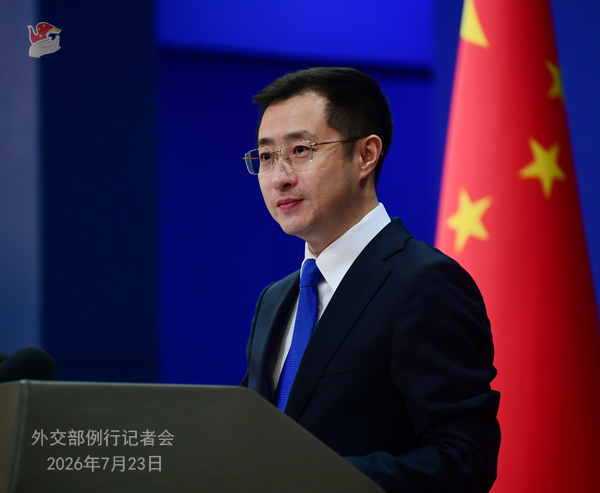
Xinhua News Agency: Yesterday Foreign Minister Wang Yi attended the China-ASEAN Foreign Ministers’ Meeting and met with many counterparts in the Philippines. Could you share more information? Against the current regional landscape, how does China see the prospects of China-ASEAN relations?
Lin Jian: On July 22, Foreign Minister Wang Yi attended in Manila the China-ASEAN Foreign Ministers’ Meeting alongside the foreign ministers of ASEAN nations and the Secretary-General of ASEAN. While in Manila, he also met with the foreign ministers of more than ten countries and the Secretary-General of ASEAN who were attending the ASEAN Plus Foreign Ministers’ Meetings there.
Foreign Minister Wang Yi introduced the cooperation achievements of the China-ASEAN Comprehensive Strategic Partnership over the past five years. He noted that under the joint strategic guidance of the leaders of both sides, China-ASEAN cooperation yielded fruitful results, benefiting over two billion people. The building of a community with a shared future with neighboring countries has steadily gained traction, as China has reached important common understandings with eight ASEAN member states on forming a community with a shared future bilaterally. The China-ASEAN Free Trade Area 3.0 Upgrade Protocol was formally signed. Trade volume between China and ASEAN has increased steadily over the years, making China and ASEAN each other’s largest trading partners for six years running. In the face of hardships, China and ASEAN have also demonstrated solidarity. Right after earthquakes hit Myanmar and Mindanao, the Philippines, China sent swift emergency relief to the two sides, demonstrating the fine tradition of mutual assistance. China and ASEAN also have seen warmer people-to-people interactions, marked by more convenient mutual travel and closer people-to-people ties.
Foreign Minister Wang Yi put forward four proposals. First, to safeguard the regional environment for peace and development and champion the Asian values of peace, cooperation, openness and inclusiveness. Second, to bolster the resilience of regional development, stay committed to open cooperation, and deepen development integration. Third, to advance green and innovation-driven development, expand cooperation in emerging areas, and step up collaboration in climate response, clean energy, green agriculture, and the blue economy. Fourth, to remain people-centered and promote inclusive and universally beneficial development to ensure that the outcomes of China-ASEAN cooperation are tangible and accessible and deliver greater benefits to the people of all countries.
Foreign Minister Wang Yi noted that the South China Sea is the common home of regional countries, and the South China Sea issue should not become an obstacle in China-ASEAN relations. China and ASEAN nations have the wisdom and capability to continue properly handling this issue to turn peace, stability, cooperation and friendship into the main narrative in the South China Sea, and keep the initiative over upholding peace and stability in the South China Sea firmly in the hands of our regional countries. China is ready to work with ASEAN countries to remove disruptions and accelerate consultations on the Code of Conduct in the South China Sea.
Foreign ministers of ASEAN nations and the Secretary-General of ASEAN spoke highly of the fruitful ASEAN-China cooperation and concurred that China is one of ASEAN’s most important friendly neighbors and dialogue partners. They commended ASEAN-China ties as the most dynamic relationship with real results delivering tangible benefits for the people. They expressed the hope to have closer strategic coordination and deepen exchanges and cooperation in various fields with China. They also expressed the hope of reaching a Code of Conduct in the South China Sea as early as possible this year, in a joint effort to uphold peace and stability in the South China Sea. They stand ready to work with China to turn ASEAN-China relations into a stabilizing force for regional peace and development and a model dialogue partnership.

China-Arab TV: Lately the U.S. has been deploying additional aircraft carrier, fighter jets and other military assets to the Middle East. A renewed full-scale conflict with Iran could erupt in the coming days. Multiple countries have issued travel advisories urging caution for travel to the region. What’s China’s comment on the escalating tensions in the Middle East? Is China in contact with parties in the region?
Lin Jian: China is deeply concerned over the latest round of escalation in the Middle East and Gulf region. The negotiation outcomes did not come easy, more fighting serves no one’s interests, and the sovereignty, security and territorial integrity of regional countries should be respected and upheld. Parties concerned need to remain calm, exercise restraint, stop hostilities, resume contact and dialogue, resolve disputes through political and diplomatic means, and strive for a full and lasting ceasefire at an early date. China stands ready to continue acting in the spirit of the four propositions put forward by President Xi Jinping, make further efforts to facilitate the end of fighting, and work relentlessly to cool down the situation and restore peace to the region.
Kyodo News: Did the Chinese and Japanese foreign ministers have contact and communication in Manila? If so, what did the Chinese side say to the Japanese side? What is China’s comment on the contact? What significance does it have for China-Japan relations going forward? (Similar question from NHK)
Lin Jian: As I’ve learned, a meeting with the Japanese side in Manila is not on Foreign Minister Wang Yi’s agenda.
Reuters: Wang Yi’s meetings in Manila sound very successful. But he did not attend the ASEAN Plus Three and the ASEAN Regional Forum meetings this morning. Was there a reason for this? (Similar question from NHK)
Lin Jian: Due to scheduling reasons, Foreign Minister Wang Yi can’t participate in the entire process of the China-ASEAN foreign ministers’ meetings. Chinese senior officials will attend the ASEAN Plus Three Foreign Ministers’ Meeting, the East Asia Summit and the ASEAN Regional Forum Foreign Ministers’ Meeting on behalf of him.
AFP: A top White House official accused Chinese AI start-up Moonshot AI of covertly copying the most advanced model of an American company. I wonder if the foreign ministry has a comment on this?
Lin Jian: The development of AI in China comes from greater self-reliance and strength in science and technology, and is fueled by China’s vision of extensive consultation and joint contribution for shared benefit. All countries should take a people-centered approach and develop AI for the positive and for good to ensure the open and inclusive development of AI for good and for all so as to better contribute to social progress and the common welfare of the international community. China opposes politicizing and instrumentalizing trade and tech issues. Such actions will only stifle global AI advances and serve no one’s interests.
Reuters: Are there plans for Foreign Minister Wang Yi to meet Russian foreign minister Sergey Lavrov for a bilateral on the sidelines of the SCO Foreign Ministers’ Meeting in Bishkek?
Lin Jian: Relevant information on Foreign Minister Wang Yi’s participation in the Meeting of the Council of the Ministers of Foreign Affairs of the SCO Member States will be released in due course. Please stay tuned.
Reuters: A follow-up of the ASEAN issue. Why did China decide to conduct live drills in the Taiwan Strait just a day after U.S. Secretary of State Marco Rubio and Foreign Minister Wang Yi met in the Philippines. During their meeting, they discussed many issues including Taiwan. Could the timing of the live drills be interpreted as carrying a message for the U.S.?
Lin Jian: On the military drill you mentioned, Chinese competent authorities have released relevant information.