People’s Republic of China


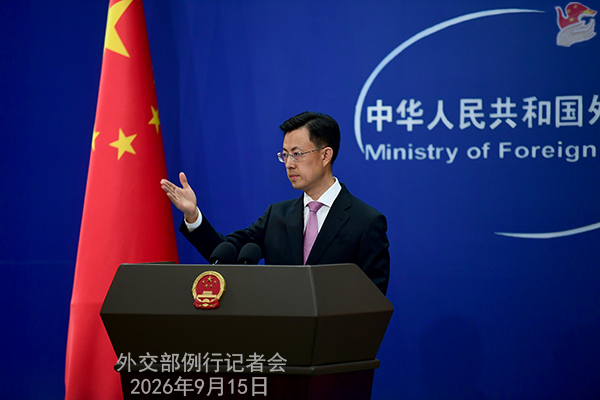
Special Advisor to the President of Brazil Celso Amorim will visit China from September 16 to 17. Member of the Political Bureau of the CPC Central Committee and Director of the Office of the Central Commission for Foreign Affairs Wang Yi will meet with him.
CCTV: The 2026 China International Fair for Trade in Services (CIFTIS) closed in Beijing two days ago. It attracted nearly 100 countries and international organizations to exhibit and hold events. A host of new products and services made their debut, drawing widespread attention. Some say CIFTIS has become a window into China’s continued opening up. What is your comment?
Guo Jiakun: “China Services” is a new calling card of China’s high-standard opening up. This year’s CIFTIS attracted over 1,830 offline exhibitors and over 5,300 online, reaching over 1,200 outcomes. A series of new technologies, new solutions and new achievements were exhibited in such areas as IT, financial technologies, digital health care, smart education and energy conservation and environmental protection, creating new opportunities for cooperation. China will continue to connect with the international market with premium services, promote outcome sharing through mutually beneficial cooperation, and bring “China Services” to more countries, delivering greater benefit to the world.
Kyodo News: The cross-party Japan-China Friendship Parliamentarians’ Union had a meeting with Assistant Foreign Minister Liu Bin yesterday. Can you share more details and how does China view the significance of this talk?
Guo Jiakun: On September 14, Assistant Foreign Minister Liu Bin met with the delegation of young Japanese lawmakers from the Japan-China Friendship Parliamentarians’ Union, who was on a visit to China. China stressed that the crux of the serious difficulties in China-Japan relations lies in Prime Minister of Japan Sanae Takaichi’s erroneous words and deeds on Taiwan. The Japanese side should honor the spirit of the four political documents, learn the lesson of history, and earn trust from its Asian neighbors and the rest of the world with concrete actions. We hope that the Japan-China Friendship Parliamentarians’ Union will carry forward its tradition of goodwill toward China, step up to its responsibility, and create conditions and a sound environment for bringing the bilateral relations back to the right track.
Global Times: It is reported that in a statement issued on September 11, the Philippines’ Department of Foreign Affairs reaffirms the Philippines’ sovereign rights and jurisdiction over Meiji Jiao and Zhubi Jiao as low-tide elevations (LTE) within the Philippines’ exclusive economic zone and continental shelf. Later, it changed the narrative, reaffirming its sovereignty over Zhubi Jiao as an LTE within the territorial sea of Zhongye Dao. The statement claims that China’s island-building on the above-mentioned features violates the Philippine Maritime Zones Act, UNCLOS and the 2016 Arbitral Award. Does China have any comment on that?
Guo Jiakun: Nansha Qundao, including Meiji Jiao, Zhubi Jiao and Zhongye Dao, are China’s inherent territory. It is totally legitimate and lawful for China to conduct construction and other activities on its own territory, a matter within China’s sovereignty.
The territorial scope of the Philippines has already been defined by a series of international treaties. Nansha Qundao has never been part of the Philippine territory. According to the “land dominates the sea” principle in international law, the Philippines’ claim of so-called maritime jurisdiction over China’s territory is illegal. The Philippine side at one point claimed that Zhubi Jiao is within its EEZ and continental shelf, but later claimed that it lies within the territorial sea of the island it illegally occupies. This only exposes how absurd and random its claim is, making it totally untenable.
The “South China Sea arbitration” is completely a political manipulation by the Philippines to grab unlawful gains. The so-called “award” is illegal, null and void, and has no binding force. The Philippines’ so-called “Maritime Zones Act” illegally includes China’s Huangyan Dao and most of the islands and reefs in Nansha Qundao and relevant waters into the Philippines’ maritime zone. This is a grave violation of China’s territorial sovereignty and maritime rights and interests in the South China Sea, and is illegal and null and void. China firmly opposes it and will never accept it.
Let me stress once again: China will continue to take resolute measures to safeguard its territorial sovereignty and maritime rights and interests, and firmly oppose any infringement. The Philippines should immediately stop infringing upon China’s rights, and stop the provocations and publicity stunts.
AFP: An official from the U.S. military said yesterday that the U.S. is facing a shortfall in ammunition as a result of its war in Iran. Does China have any comment on this?
Guo Jiakun: China is following the situation in the Middle East and Gulf region. We hope that relevant parties will resolve disputes through political and diplomatic means.
AFP: The U.S. Space Force said yesterday that the United States has weapons deployed in space. What is China’s reaction? Does China also have weapons deployed in space?
Guo Jiakun: China stands for peaceful use of outer space and keeping it safe, and opposes any arms race in outer space or any attempt to weaponize it and turn it into a warzone. We urge the U.S. to stop expanding military build-up in outer space, and uphold global strategic stability with concrete actions.
China News Service: According to reports, on September 14, the China National Space Administration, the Permanent Mission of China to the United Nations and Other International Organizations in Vienna, and the United Nations Office for Outer Space Affairs held a ceremony at the UN Headquarters in Vienna where China formally gifted the United Nations with the world’s first soil sample collected from the far side of the moon by the Chang’e‑6 mission. Ms. Monica Juma, Director‑General of the United Nations Office at Vienna, said that the permanent display of the lunar sample at the United Nations Office in Vienna is of great significance, adding that it demonstrates China’s support for the United Nations in galvanizing efforts in the international community to address common challenges. Would you like to comment on this? Is China trying to share its vision for space exploration through this gift?
Guo Jiakun: By donating to the United Nations a soil sample collected from the far side of the moon by the Chang’e‑6 mission, China is delivering on the four major global initiatives put forward by President Xi Jinping. The move demonstrates China’s firm support for the United Nations and multilateralism as well as its sense of responsibility as a major country on the peaceful use of outer space and improving global space governance. China looks forward to working with all countries to uphold relevant international law with the Outer Space Treaty as the cornerstone, abide by the paramount principle of exploring and using outer space for peaceful purposes, firmly oppose attempts to weaponize space or turn it into a battlefield, make sure progress in science and technology will bring greater benefits to all humanity, and ensure that space will truly become a platform for win‑win cooperation.
**************************************************
The following question was raised by Bloomberg after the press conference: Can the foreign ministry clarify and elaborate on your response yesterday regarding calls from U.S. tech leaders for a slowing down AI development. How does China assess the risks posed by AI including the possibility of AI being used for the production of biological weapons?
Guo Jiakun: We noted recent remarks by some in the U.S. AI industry. As AI develops at an incredible speed, it’s all the more important to stay committed to developing AI for the positive, for good, and for the benefits of the people, to calibrate regulation and governance on AI, and to promptly strengthen safeguards to prevent it from getting out of control.
China puts equal emphasis on development and security in terms of AI. We take seriously the inherent and secondary risks of AI. We are committed to holding on to the bottom line of security, and we have been making continued efforts to improve laws and regulations, policies, application norms, and ethical rules to prevent the abuse and misuse of AI, and ensure that AI is safe, reliable and controllable. Yesterday, Chinese relevant authorities released AI Safety Governance Framework 3.0, in which the classification of AI safety risks was reviewed and updated, and recommendations on optimizing technological countermeasures and comprehensive governance measures were outlined.
AI is the collective wisdom and precious asset shared by all humanity. AI development and governance require the practice of true multilateralism, with all countries working together to build a global governance framework on broad-based consensus. No single country or enterprise can develop effective solutions on its own. China always supports the UN’s role as the main channel in global AI governance, and participates in the multilateral governance of AI in a responsible attitude. China stands ready to join hands with all countries to build a just and equitable system for global AI governance, and develop AI for good and for all.