People’s Republic of China


Vice President Han Zheng will attend the general debate of the 81st session of the United Nations General Assembly (UNGA) in New York from September 24 to 26. On the sidelines of the general debate, Vice President Han will attend the High-Level Dialogue on the Fifth Anniversary of the Global Development Initiative hosted by China, and meet with UN Secretary-General, President of the 81st UNGA session, and leaders of relevant countries.
The 48th WorldSkills Competition will be held in Shanghai from September 22 to 27. The fifth Global Digital Trade Expo will be held in Hangzhou, Zhejiang Province from September 23 to 27. At China’s invitation, Prime Minister of Malaysia Anwar Ibrahim will attend the opening ceremony of the WorldSkills Competition and the launching ceremony of the Global Digital Trade Expo, and Chairman of the Cabinet of Ministers of Kyrgyzstan Adylbek Aleshovich Kasymaliev will attend the launching ceremony of the Global Digital Trade Expo.
CCTV: You just announced that Vice President Han Zheng will attend the general debate of the 81st session of the UN General Assembly. What is China’s expectation for his trip?
Guo Jiakun: Across the world, changes unseen in a century are accelerating. The international landscape is volatile and fraught with risks and challenges. The United Nations is the core platform for global governance, and the general debate of UNGA is a vital opportunity for countries to build political consensus and coordinate multilateral actions. This year marks the 55th anniversary of the restoration of the People’s Republic of China’s lawful seat in the UN. At the general debate, Vice President Han Zheng will present China’s views and propositions on the current international landscape, major international and regional issues, and the work of the UN. He will outline China’s strong actions to advance true multilateralism and promote world peace and development, and call on the international community to revitalize the authority and role of the UN, build greater synergy for reforming and improving global governance, and work together in the right direction of building a community with a shared future for humanity.
The Paper: Malaysian Prime Minister Anwar Ibrahim will attend two major events hosted by China. What’s China’s comment on the current relations with Malaysia? What is your expectation for the prime minister’s visit?
Guo Jiakun: China and Malaysia are good neighbors, good friends and good partners connected by sea. Over the past 50 plus years of diplomatic relations, bilateral ties have maintained sound momentum of growth with good progress in cooperation across the board. The two countries are jointly building a high-level strategic community with a shared future.
Prime Minister Anwar Ibrahim’s attendance at events of the WorldSkills Competition and the Global Digital Trade Expo demonstrates the two countries’ close and warm ties and sound cooperation in relevant areas. China looks forward to working with Malaysia to further synergize development strategies, promote high-quality Belt and Road cooperation, have close communication and coordination on international and regional issues, and strive for more outcomes in building the high-level strategic China-Malaysia community with a shared future.
AFP: U.S. Treasury Secretary Scott Bessent warned on Monday that Iranian airlines will have trouble functioning globally under the weight of American sanctions. He said in an interview that tomorrow, all the Iranian airlines will be shut down around the world, and that countries that provide these airlines with landing services or fuel would be knocked out of the dollar system. Can the foreign ministry comment on this since there seems to be Iranian airlines flights landing in Guangzhou and Shanghai tomorrow morning? Will China accommodate these Iranian flights?
Guo Jiakun: China opposes illicit unilateral sanctions that have no basis in international law and lack UN Security Council mandate.
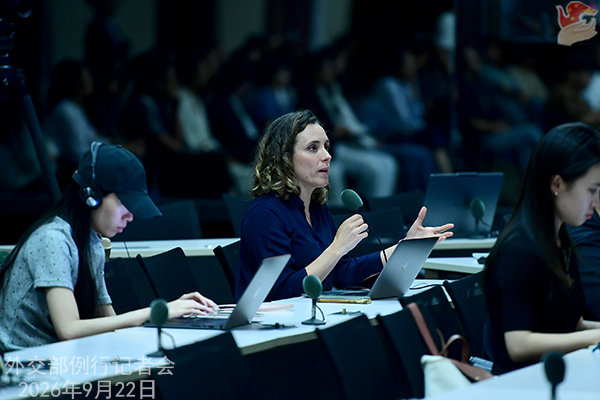
Sky News: At the weekend, He Lifeng was meeting with a delegation from the U.S. and afterwards Scott Bessent told the press that the two negotiating teams had discussed establishing an AI dialogue. There were also reports about a possible notification mechanism of AI incidents between the U.S. and China. Can we expect specific measures on AI to be announced at the leaders’ summit that we expect to happen this week? Does China believe that these overtures from the U.S. are being made in good faith, or is there a belief that there is a desire from the U.S. to curtail China’s AI rise?
Guo Jiakun: The Chinese side has released a readout regarding the China-U.S. consultations on economic and trade issues. I’d refer you to competent authorities for the specific questions.
CGTN: Yesterday, the 23rd China-ASEAN Expo concluded successfully, yielding fruitful outcomes. Last week, the Pinglu Canal officially opened to navigation, which received extensive public attention both in China and abroad. Some call the China-ASEAN Expo a “Golden Platform” and the Pinglu Canal a “Golden Waterway,” and believe that they will open a new chapter of China-ASEAN cooperation. What’s your comment?
Guo Jiakun: The China-ASEAN Expo is a shining brand of China-ASEAN cooperation. Over the past 23 years, the Expo witnessed China-ASEAN cooperation leaping through the “Golden Decade” to the “Diamond Decade” and the upgrade to the China-ASEAN Free Trade Area 3.0 (CAFTA 3.0). This year, for the very first time, the Expo designated an area tailored to ASEAN countries’ demand and released an ASEAN countries’ demand list aimed at precision matchmaking between what ASEAN needs and what China can provide. The Expo also designated a Pinglu Canal exhibition area. The Canal’s opening to navigation will significantly reduce the maritime shipping distance from Southwest China to ASEAN countries, opening up a new route for bilateral trade. China is ready to work with ASEAN countries to implement CAFTA 3.0 and build an even closer China-ASEAN community with a shared future.
NHK: The Foreign Ministry Spokesperson’s Office today posted a video titled “Constructive Strategic Stability” on its social media account. What is China’s consideration and purpose of posting the video? As President Xi Jinping is set to pay a state visit to the United States, what message does China hope to convey to the U.S. and the international community through the video?
Guo Jiakun: We appreciate your interest in the Foreign Ministry’s social media account. China is ready to work with the U.S. to enrich the China-U.S. constructive relationship of strategic stability, enhance dialogue and cooperation, and properly manage differences to contribute to the well-being of both peoples and to a peaceful, stable and prosperous world.
Sky News: Returning to the issue of AI governance, which is gonna be such an important topic probably between President Xi and President Trump this week. I wonder if China has any further comments in response to a lot of the commentary we’ve seen over the weekend about how important this issue of working together on governance is and any intentions going into that summit.
Guo Jiakun: China has made clear on multiple occasions its position on issues related to AI. Parties need to work together for the open and inclusive development of AI for all and for good.