People’s Republic of China


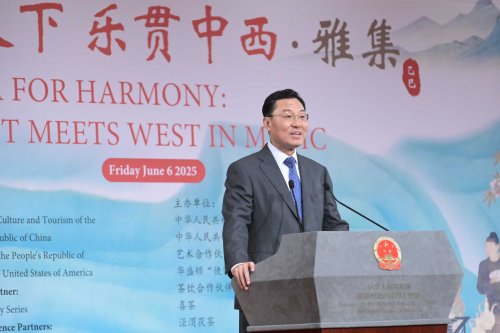
Distinguished guests,
Ladies and gentlemen,
Dear friends,
Good evening!
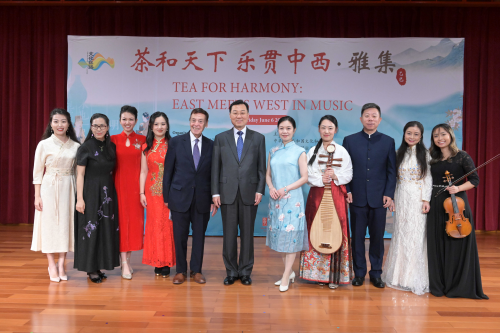
It is a great delight to celebrate the International Tea Day with so many tea lovers, and together explore the charm of tea alongside classical Eastern and Western melodies. For the Chinese, tea is not just a drink, but a way of life and a refined art over the past thousands of years. Today, it is both a healthy drink popular around the world, and a symbol of Chinese culture. Through the “magical oriental leaves”, you can have a glimpse into China’s natural and cultural treasures.
Tea connects history with reality, and embodies China’s principles of modesty and respect for others. Born in China, tea is an epitome of its time-honored civilization, which has spanned over 5,000 years. We welcome guests with a cup of tea, and offer tea to teachers at school ceremonies and parents at weddings. Through the ritual, you can see how much the Chinese value humility, harmony, etiquette and respect for others.
Today, Chinese tea is evolving with the times. Sitting around a stove to brew tea is becoming a trendy way to connect with friends. The market size for new Chinese-style tea drinks has reached nearly 50 billion US dollars. Around the world, many have taken to bubble tea as a sweet comfort, and brands like Heytea, Gong Cha and Chagee are catching on among young people.
In a tea ceremony, it is important to ensure everyone tastes the same tea and every cup is served in a respectful manner. The brewing process itself is an art of balance too. Underlying this is our belief that only with equality and respect can we achieve peaceful coexistence, and harmony brings prosperity to all.
Tea connects man with nature, and illustrates China’s philosophy of observing the laws of nature. 茶, the Chinese character for tea, is structured as an individual between trees and grasses. “Good mountains and waters make good teas.” The Chinese deeply value harmony between man and nature. In the videos of the Chinese vlogger Li Ziqi, you can see how we flow with the rhythm of the seasons: in late spring, she dried up tea leaves plucked during the grain rain solar term, which is believed to be the best time for tea. In winter, she made ginger rice tea, which keeps one warm the whole day.
Green is gold. The tea industry has not only boosted China’s economy but also benefited the whole world. From Malipo County in Yunnan Province to Anxi County in Fujian, tea has become the “golden leaves” that lift people out of poverty and lead them to prosper. Currently, global tea production amounts to over 18 billion US dollars annually, while the value of total tea trade is estimated at around 9.8 billion. Tens of millions of farmers around the globe are living a better life thanks to the industry. As a major tea producer and consumer, China is committed to promoting the sustainable development of the global tea industry so that more people will benefit from it.
Tea also connects China with the world, and reflects China’s value of harmony in diversity. As early as over 2,000 years ago, Chinese tea started to spread to other parts of the world along the ancient Silk Road and the Tea Horse Road, bringing fragrance rather than conflict wherever it went, and building bridges of exchanges and friendship. Now, tea is produced in over 60 countries and regions, and consumed by nearly 3 billion people in more than 160 countries and regions, becoming a daily necessity for many.
Every land nurtures its own tea. Today, we will get to savor Oolong tea and Lapsang Souchong black tea, both from Fujian Province but each with its unique magic. Likewise, coffee and tea are not incompatible with each other. Both can perk you up and leave a sweet aftertaste. And guess what: the United States is now the world’s third largest tea importer, while China has nearly 400 million coffee drinkers. This has again proven that it is entirely possible for different civilizations to draw on each other and flourish together.
Dear friends,
Over 240 years ago, the American merchant ship “Empress of China” returned to the U.S. laden with Chinese tea, marking the start of trade between our two countries. Around 50 years ago, Chairman Mao Zedong gave President Richard Nixon the famous Da Hong Pao Oolong tea from the Wuyi Mountains as a welcome gift during the latter’s visit to China. A bond between Eastern and Western civilizations, tea offers China’s wisdom to solve the world’s problems through a peaceful path, and bears witness to the history of China and the U.S. ending estrangement and seeking win-win cooperation.
Both history and reality have demonstrated that when China and the U.S. pursue mutual respect, peaceful coexistence and win-win cooperation, it will benefit not only our two countries, but also world peace and development. Neither a cold war nor a tariff war should be fought or could be won. Neither economic decoupling nor attempts to cut off people-to-people ties would find any support or ever succeed. Different countries and cultures need to pursue common development through mutual respect and seek common ground despite differences, so as to flourish together.
During the phone call with President Donald Trump yesterday, President Xi Jinping pointed out that recalibrating the direction of the giant ship of China-U.S. relations requires us to take the helm and set the right course. It is particularly important to steer clear of the various disturbances and disruptions. President Trump said that the U.S. and China working together can get a lot of great things done. The U.S. will honor the one-China policy, and it loves to have Chinese students coming to study in America. The two Presidents agreed that their teams should continue implementing the Geneva agreement and hold another round of meeting as soon as possible.
The China-U.S. relationship is now at a critical juncture. It is our hope that the U.S. side will work with China in the same direction, follow through on the important consensus reached between the two Presidents during their phone calls, roll back erroneous moves taken against China, and create the necessary conditions for bringing the relationship back to the right track. I would also like to encourage every one of you and other friends with vision from both countries to speak up for reason, build more bridges of exchanges and cooperation, and play a positive role in promoting the steady, sound and sustainable development of China-U.S. relations.
Let us together enjoy this feast of tea and music, continue the dialogue between Eastern and Western civilizations, and find a right way for us to get along with each other in the new era.
Thank you.