People’s Republic of China


Ms. Janna Fritz,
Mr. Jim Sutter,
Mr. Jason Hafemeister,
Mr. Cao Derong,
Ladies and gentlemen,
Dear friends,
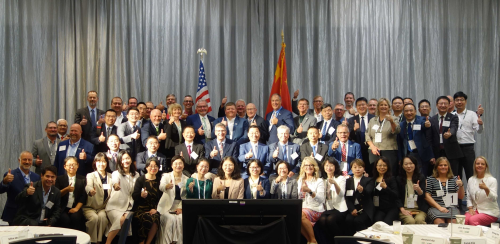
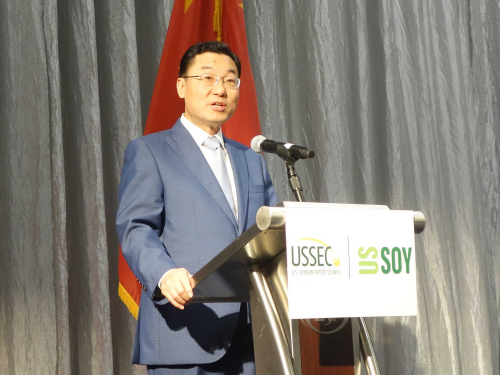
Good morning. It is a great honor to attend the reception today, which brings together the U.S. Soybean Export Council (USSEC) and the Chinese agricultural delegation.
Agriculture is one of the first areas of cooperation between China and the U.S., and also one of the most fruitful, with the greatest potential. It has always served as a pillar of China-U.S. relations. So let me first pay tribute to all friends who have long been promoting China-U.S. agricultural exchanges and cooperation! I hope that through candid discussions, our agricultural leaders will build consensus and gather more momentum for future cooperation.
People are the foundation of a nation, and food is of paramount importance to the people. From healthy and delicious soy products, to high-quality animal feed, and to environmentally friendly biofuel, the tiny soybean plays a big role in our production and daily life. Traveling from the vast farmland in the U.S. to freighters in the Pacific and to the dinner tables of Chinese families, soybeans are an epitome of the deeply interconnected industrial and supply chains of our two countries, and are also witness to the close bond between our two peoples.
In soybeans, we can see the shared commitment of China and the US to agriculture. China has a time-honored agricultural civilization.As an ancient Chinese saying goes, “Agriculture is the foundation of a country. Nothing is more important than it.” Through arduous efforts, China has managed to feed nearly one-fifth of the world’s population with only 9% of the world’s arable land and 6% of the freshwater resources. Seven decades ago, the 400 million Chinese people could barely have enough to eat; now, our 1.4 billion people are eating well. We have not only answered the question “Who can feed China?”, but also unleashed huge consumption potential for high-quality agricultural products.
Today, China is building a unified national market at a faster pace. Every day, goods worth nearly 4.8 billion US dollars are traded online, and products worth about 16.8 billion US dollars are imported and exported. As the world’s most important agricultural producers and consumers, China and the U.S. together produce nearly 40% of global food and consume one-fourth of the total. China has comparative advantage in labor-intensive agricultural products, while the U.S. specializes in land-intensive agricultural commodities through mechanized, large-scale production. We each have our own strengths and can well complement each other.
In soybeans, we can see the mutually beneficial nature of the China-U.S. economic and trade relationship. Forty years ago, during his first visit to the state of Iowa, President Xi Jinping focused on learning about agriculture and animal husbandry. The seeds of friendship and cooperation sown back then have now yielded fruitful outcomes. As the world’s largest importer and exporter of agricultural products respectively, China and the U.S. are natural partners. For years, China remained the top destination for American agricultural products, and half of American soybeans exported were sold to China. From 2001 to 2018, before trade frictions started, our trade in agricultural products grew by 15% yearly on average. In 2023, U.S. agricultural exports to China reached 29.1 billion US dollars, taking up nearly one-fifth of the total. In other words, every American farmer exported nearly 9,000 US dollars worth of farm goods to China. USSEC and Henan Province jointly launched the China-U.S. Soy Value Chain Innovation Center. Our agricultural enterprises such as COFCO, Cargill and ADM have set up processing plants, research centers and logistics bases in each other’s country.
Agricultural exchanges and cooperation have not only offered more choices for consumers in both our countries, but also put more money in the pockets of American farmers. They have provided impetus for agricultural transformation and upgrading in China and the U.S., and opened up a new path for securing global food security. Such cooperation has benefited both our two countries and the entire world. We need more of it, not less.
In soybeans, we can see the fact that China and the U.S. stand to gain from cooperation and lose from confrontation. As a Chinese proverb goes, “Plant melons and you will get melons; plant beans and you will get beans.” The rising protectionism has undoubtedly cast a shadow over our agricultural cooperation. In the first half of this year, U.S. agricultural exports to China dropped 53% year-over-year, and the number for soybeans dropped 51%. After confusion and chaos in the plowing season, our farmer friends may soon have to face new uncertainties in the harvest season.
Just like their Chinese peers, American farmers are hard-working and kind-hearted people. They toil rain or shine, in the hope that they will reap a good harvest, get a good price, and live a better life. Agriculture should not be politicized, and farmers should not pay the cost of trade war.
The U.S. farmland held by Chinese investors accounts for less than 0.03% of the total. How can it pose a threat to U.S. food security as some have claimed? Restricting Chinese citizens and businesses from buying farmland is purely a move of political manipulation on the pretext of national security. It is completely unfounded, and is aimed to hijack China-U.S. agricultural cooperation for a few individuals’ own agenda.
Under the strategic guidance of the two Presidents, our economic and trade teams recently held a new round of talks in Stockholm and issued a joint statement. China is ready to work with the U.S. side to implement the important common understandings of the two leaders, make good use of the economic and trade consultation mechanism, build consensus, clear up misunderstandings and strengthen cooperation, so as to jointly share the dividends of development and return to the right track of win-win cooperation.
Dear friends,
When the weather fails, good farmers work even harder. Industry associations and enterprises in both countries serve as a bridge and shoulder a special mission, and need to continue playing a constructive role. I hope more friends will join in, and let’s together be “farmers” who work hard to grow a steady, sound and sustainable China-U.S. relationship. We need to keep the “pests” away from bilateral agricultural cooperation, say a loud no to any attempt to politicize trade and economic issues in the name of national security, and tear down tariffs and other kinds of barriers to agricultural trade, so as to create an enabling environment. We also need to sow more “seeds”, work closely on trade, industry, business and research, and strive to achieve more results in restoring dialogue and cooperation mechanisms in the agricultural area, deepening the integrated development of industrial chains, promoting mutually beneficial cooperation among businesses, forming greater synergy between states and provinces, building platforms for innovation and research, and strengthening exchanges and cooperation in education. From precision agriculture to biotech, and from water-saving irrigation to smart farming, we have vast room for collaboration. Let’s together explore more areas of opportunity and seek win-win outcomes, so that our agricultural cooperation will keep flourishing and grow healthily.
In closing, I wish Soy Connext 2025 a great success, and I hope all of you will take away a lot of food for thought and abundant hope for the future.
Thank you.