


People’s Republic of China


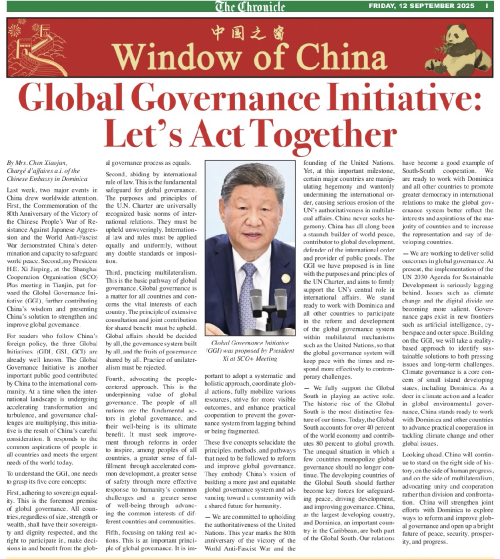
On September 12, Mrs. Chen Xiaojun, Chargé d’Affaires ad interim of the Chinese Embassy in Dominica, published a signed article titled Global Governance Initiative: Let's Act Together in Dominica's mainstream newspaper The Chronicle. In the article, Chen elaborated on the five core concepts of the Global Governance Initiative and shared insights into the bright prospects of China and Dominica working hand in hand to advance the reform and improvement of global governance.
Full Text:
Last week, two major events in China drew worldwide attention. First, the Commemoration of the 80th Anniversary of the Victory of the Chinese People’s War of Resistance Against Japanese Aggression and the World Anti-Fascist War demonstrated China’s determination and capacity to safeguard world peace. Second, my President H.E. Xi Jinping, at the Shanghai Cooperation Organization (SCO) Plus meeting in Tianjin, put forward the Global Governance Initiative (GGI), further contributing China’s wisdom and presenting China’s solution to strengthen and improve global governance.
For readers who follow China’s foreign policy, the three Global Initiatives (GDI, GSI, GCI) are already well known. The Global Governance Initiative is another important public good contributed by China to the international community. At a time when the international landscape is undergoing accelerating transformation and turbulence, and governance challenges are multiplying, this initiative is the result of China’s careful consideration. It responds to the common aspirations of people in all countries and meets the urgent needs of the world today.
To understand the GGI, one needs to grasp its five core concepts:
First, adhering to sovereign equality. This is the foremost premise of global governance. All countries, regardless of size, strength or wealth, shall have their sovereignty and dignity respected, and the right to participate in, make decisions in and benefit from the global governance process as equals.
Second, abiding by international rule of law. This is the fundamental safeguard for global governance. The purposes and principles of the U.N. Charter are universally recognized basic norms of international relations. They must be upheld unwaveringly. International law and rules must be applied equally and uniformly, without any double standards or imposition.
Third, practicing multilateralism. This is the basic pathway of global governance. Global governance is a matter for all countries and concerns the vital interests of each country. The principle of extensive consultation and joint contribution for shared benefit must be upheld. Global affairs should be decided by all, the governance system built by all, and the fruits of governance shared by all. Practice of unilateralism must be rejected.
Fourth, advocating the people-centered approach. This is the underpinning value of global governance. The people of all nations are the fundamental actors in global governance, and their well-being is its ultimate benefit. It must seek improvement through reforms in order to inspire, among peoples of all countries, a greater sense of fulfillment through accelerated common development, a greater sense of safety through more effective response to humanity’s common challenges and a greater sense of well-being through advancing the common interests of different countries and communities.
Fifth, focusing on taking real actions. This is an important principle of global governance. It is important to adopt a systematic and holistic approach, coordinate global actions, fully mobilize various resources, strive for more visible outcomes, and enhance practical cooperation to prevent the governance system from lagging behind or being fragmented.
These five concepts selucidate the principles, methods, and pathways that need to be followed to reform and improve global governance. They embody China’s vision of building a more just and equitable global governance system and advancing toward a community with a shared future for humanity.
— We are committed to upholding the authoritativeness of the United Nations. This year marks the 80th anniversary of the victory of the World Anti-Fascist War and the founding of the United Nations. Yet, at this important milestone, certain major countries are manipulating hegemony and wantonly undermining the international order, causing serious erosion of the UN’s authoritativeness in multilateral affairs. China never seeks hegemony. China has all along been a staunch builder of world peace, contributor to global development, defender of the international order and provider of public goods. The GGI we have proposed is in line with the purposes and principles of the UN Charter, and aims to firmly support the UN’s central role in international affairs. We stand ready to work with Dominica and all other countries to participate in the reform and development of the global governance system within multilateral mechanisms such as the United Nations, so that the global governance system will keep pace with the times and respond more effectively to contemporary challenges.
— We fully support the Global South in playing an active role. The historic rise of the Global South is the most distinctive feature of our times. Today, the Global South accounts for over 40 percent of the world economy and contributes 80 percent to global growth. The unequal situation in which a few countries monopolize global governance should no longer continue. The developing countries of the Global South should further become key forces for safeguarding peace, driving development, and improving governance. China, as the largest developing country, and Dominica, an important country in the Caribbean, are both part of the Global South. Our relations have become a good example of South-South cooperation. We are ready to work with Dominica and all other countries to promote greater democracy in international relations to make the global governance system better reflect the interests and aspirations of the majority of countries and to increase the representation and say of developing countries.
— We are working to deliver solid outcomes in global governance. At present, the implementation of the UN 2030 Agenda for Sustainable Development is seriously lagging behind. Issues such as climate change and the digital divide are becoming more salient. Governance gaps exist in new frontiers such as artificial intelligence, cyberspace and outer space. Building on the GGI, we will take a reality-based approach to identify sustainable solutions to both pressing issues and long-term challenges. Climate governance is a core concern of small island developing states, including Dominica. As a doer in climate action and a leader in global environmental governance, China stands ready to work with Dominica and other countries to advance practical cooperation in tackling climate change and other global issues.
Looking ahead, China will continue to stand on the right side of history, on the side of human progress, and on the side of multilateralism, advocating unity and cooperation rather than division and confrontation. China will strengthen joint efforts with Dominica to explore ways to reform and improve global governance and open up a bright future of peace, security, prosperity, and progress.