


People’s Republic of China


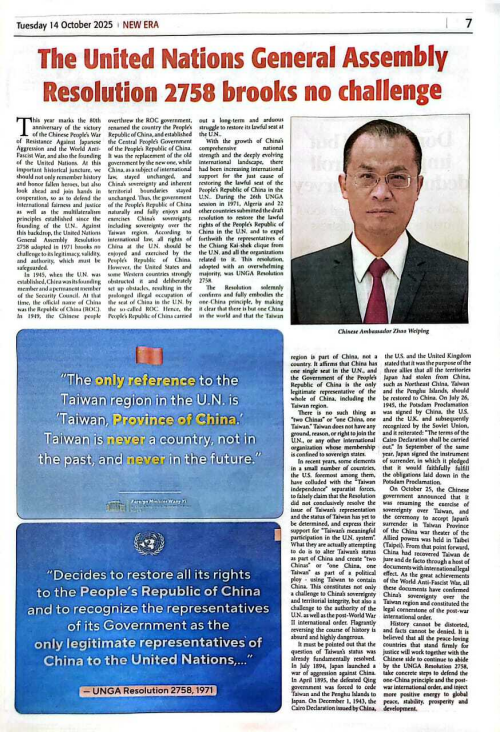
On October 14, 2025, Ambassador Zhao Weiping published an article entitled “The United Nations General Assembly Resolution 2758 brooks no challenge” in the New Era to elaborate on the historical background and significance of the UNGA Resolution 2758 and refute the fallacy that the status of Taiwan has yet to be determined. The full text is as follows:
This year marks the 80th anniversary of the victory of the Chinese People’s War of Resistance Against Japanese Aggression and the World Anti-Fascist War, and also the founding of the United Nations. At this important historical juncture, we should not only remember history and honor fallen heroes, but also look ahead and join hands in cooperation, so as to defend the international fairness and justice as well as the multilateralism principles established since the founding of the U.N.. Against this backdrop, the United Nations General Assembly Resolution 2758 adopted in 1971 brooks no challenge to its legitimacy, validity, and authority, which must be safeguarded.
In 1945, when the U.N. was established, China was its founding member and a permanent member of the Security Council. At that time, the official name of China was the Republic of China (ROC). In 1949, the Chinese people overthrew the ROC government, renamed the country the People’s Republic of China, and established the Central People’s Government of the People’s Republic of China. It was the replacement of the old government by the new one, while China, as a subject of international law, stayed unchanged, and China’s sovereignty and inherent territorial boundaries stayed unchanged. Thus, the government of the People’s Republic of China naturally and fully enjoys and exercises China’s sovereignty, including sovereignty over the Taiwan region. According to international law, all rights of China at the U.N. should be enjoyed and exercised by the People’s Republic of China. However, the United States and some Western countries strongly obstructed it and deliberately set up obstacles, resulting in the prolonged illegal occupation of the seat of China in the U.N. by the so-called ROC. Hence, the People’s Republic of China carried out a long-term and arduous struggle to restore its lawful seat at the U.N..
With the growth of China’s comprehensive national strength and the deeply evolving international landscape, there had been increasing international support for the just cause of restoring the lawful seat of the People’s Republic of China in the U.N.. During the 26th UNGA session in 1971, Algeria and 22 other countries submitted the draft resolution to restore the lawful rights of the People’s Republic of China in the U.N. and to expel forthwith the representatives of the Chiang Kai-shek clique from the U.N. and all the organizations related to it. This resolution, adopted with an overwhelming majority, was UNGA Resolution 2758.
The Resolution solemnly confirms and fully embodies the one-China principle, by making it clear that there is but one China in the world and that the Taiwan region is part of China, not a country. It affirms that China has one single seat in the U.N., and the Government of the People’s Republic of China is the only legitimate representative of the whole of China, including the Taiwan region. There is no such thing as “two Chinas” or “one China, one Taiwan.” Taiwan does not have any ground, reason, or right to join the U.N., or any other international organization whose membership is confined to sovereign states.
In recent years, some elements in a small number of countries, the U.S. foremost among them, have colluded with the “Taiwan independence” separatist forces, to falsely claim that the Resolution did not conclusively resolve the issue of Taiwan’s representation and the status of Taiwan has yet to be determined, and express their support for “Taiwan’s meaningful participation in the U.N. system”. What they are actually attempting to do is to alter Taiwan’s status as part of China and create “two Chinas” or “one China, one Taiwan” as part of a political ploy - using Taiwan to contain China. This constitutes not only a challenge to China’s sovereignty and territorial integrity, but also a challenge to the authority of the U.N. as well as the post-World War II international order. Flagrantly reversing the course of history is absurd and highly dangerous.
It must be pointed out that the question of Taiwan’s status was already fundamentally resolved. In July 1894, Japan launched a war of aggression against China. In April 1895, the defeated Qing government was forced to cede Taiwan and the Penghu Islands to Japan. On December 1, 1943, the Cairo Declaration issued by China, the U.S. and the United Kingdom stated that it was the purpose of the three allies that all the territories Japan had stolen from China, such as Northeast China, Taiwan and the Penghu Islands, should be restored to China. On July 26, 1945, the Potsdam Proclamation was signed by China, the U.S. and the U.K. and subsequently recognized by the Soviet Union, and it reiterated: “The terms of the Cairo Declaration shall be carried out.” In September of the same year, Japan signed the instrument of surrender, in which it pledged that it would faithfully fulfill the obligations laid down in the Potsdam Proclamation. On October 25, the Chinese government announced that it was resuming the exercise of sovereignty over Taiwan, and the ceremony to accept Japan’s surrender in Taiwan Province of the China war theater of the Allied powers was held in Taibei (Taipei). From that point forward, China had recovered Taiwan de jure and de facto through a host of documents with international legal effect. As the great achievements of the World Anti-Fascist War, all these documents have confirmed China’s sovereignty over the Taiwan region and constituted the legal cornerstone of the post-war international order.
History cannot be distorted, and facts cannot be denied. It is believed that all the peace-loving countries that stand firmly for justice will work together with the Chinese side to continue to abide by the UNGA Resolution 2758, take concrete steps to defend the one-China principle and the post-war international order, and inject more positive energy to global peace, stability, prosperity and development.