


People’s Republic of China


On October 17, Ambassador Yang Xiaokun published a signed article titled “From Beijing to Beijing: Continue to Advance Women’s All-Round Development” on Public Eye and The Reporter. Here's the full text.
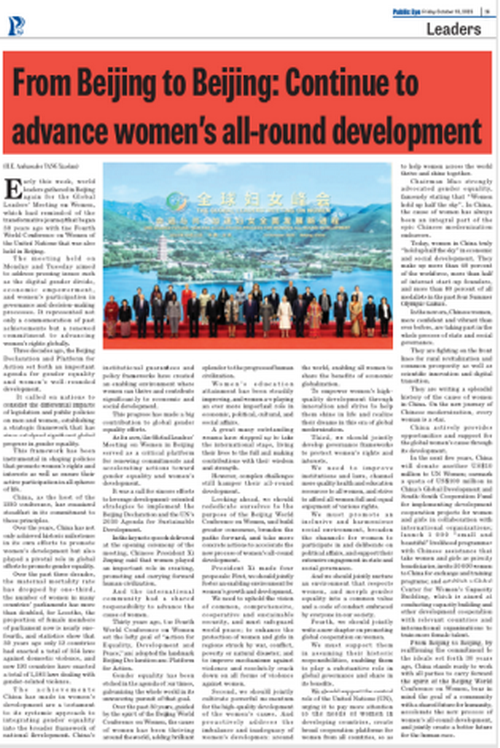
Early this week, world leaders gathered in Beijing again for the Global Leaders' Meeting on Women, which had reminded of the transformative journey that began 30 years ago with the Fourth World Conference on Women of the United Nations that was also held in Beijing.
The meeting held on Monday and Tuesday aimed to address pressing issues such as the digital gender divide, economic empowerment, and women's participation in governance and decision-making processes. It represented not only a commemoration of past achievements but a renewed commitment to advancing women's rights globally.
Three decades ago, the Beijing Declaration and Platform for Action set forth an important agenda for gender equality and women's well-rounded development. It called on nations to consider the differential impacts of legislation and public policies on men and women, establishing a strategic framework that has since catalyzed significant global progress in gender equality. This framework has been instrumental in shaping policies that promote women's rights and interests as well as ensure their active participation in all spheres of life.
China, as the host of the 1995 conference, has remained steadfast in its commitment to these principles. Over the years, China has not only achieved historic milestones in its own efforts to promote women's development but also played a pivotal role in global efforts to promote gender equality. Over the past three decades, the maternal mortality rate has dropped by one-third, the number of women in many countries' parliaments has more than doubled, for Lesotho, the proportion of female members of parliament now is nearly one-fourth, and statistics show that 30 years ago only 12 countries had enacted a total of 354 laws against domestic violence, and now 193 countries have enacted a total of 1,583 laws dealing with gender-related violence.
The achievements China has made in women's development are a testament to its systemic approach to integrating gender equality into the broader framework of national development. China's institutional guarantees and policy frameworks have created an enabling environment where women can thrive and contribute significantly to economic and social development. This progress has made a big contribution to global gender equality efforts.
As for now, the Global Leaders' Meeting on Women in Beijing served as a critical platform for renewing commitments and accelerating actions toward gender equality and women's development. It was a call for sincere efforts to leverage development-oriented strategies to implement the Beijing Declaration and the UN's 2030 Agenda for Sustainable Development.
In the keynote speech delivered at the opening ceremony of the meeting, Chinese President Xi Jinping said that women played an important role in creating, promoting and carrying forward human civilization. And the international community had a shared responsibility to advance the cause of women. Thirty years ago, the Fourth World Conference on Women set the lofty goal of “Action for Equality, Development and Peace,” and adopted the landmark Beijing Declaration and Platform for Action. Gender equality has been etched in the agenda of our times, galvanizing the whole world in its unwavering pursuit of that goal.
Over the past 30 years, guided by the spirit of the Beijing World Conference on Women, the cause of women has been thriving around the world, adding brilliant splendor to the progress of human civilization. Women's education attainment has been steadily improving, and women are playing an ever more important role in economic, political, cultural, and social affairs. A great many outstanding women have stepped up to take the international stage, living their lives to the full and making contributions with their wisdom and strength.
However, complex challenges still hamper their all-round development. Looking ahead, we should rededicate ourselves to the purpose of the Beijing World Conference on Women, and build greater consensus, broaden the paths forward, and take more concrete actions to accelerate the new process of women’s all-round development.
President Xi made four proposals: First, we should jointly foster an enabling environment for women’s growth and development. We need to uphold the vision of common, comprehensive, cooperative and sustainable security, and must safeguard world peace; to enhance the protection of women and girls in regions struck by war, conflict, poverty or natural disaster; and to improve mechanisms against violence and resolutely crack down on all forms of violence against women.
Second, we should jointly cultivate powerful momentum for the high-quality development of the women’s cause. And proactively address the imbalance and inadequacy of women’s development around the world, enabling all women to share the benefits of economic globalization. To empower women’s high-quality development through innovation and strive to help them shine in life and realize their dreams in this era of global modernization.
Third, we should jointly develop governance frameworks to protect women’s rights and interests. We need to improve institutions and laws, channel more quality health and education resources to all women, and strive to afford all women full and equal enjoyment of various rights. We must promote an inclusive and harmonious social environment, broaden the channels for women to participate in and deliberate on political affairs, and support their extensive engagement in state and social governance. And we should jointly nurture an environment that respects women, and morph gender equality into a common value and a code of conduct embraced by everyone in our society.
Fourth, we should jointly write a new chapter on promoting global cooperation on women. We must support them in assuming their historic responsibilities, enabling them to play a substantive role in global governance and share in its benefits. We should support the central role of the United Nations (U.N.), urging it to pay more attention to the needs of women in developing countries, create broad cooperation platforms for women from all countries, so as to help women across the world thrive and shine together.
Chairman Mao strongly advocated gender equality, famously stating that “Women hold up half the sky”. In China, the cause of women has always been an integral part of the epic Chinese modernization endeavors. Today, women in China truly “hold up half the sky” in economic and social development. They make up more than 40 percent of the workforce, more than half of internet start-up founders, and more than 60 percent of all medalists in the past four Summer Olympic Games. In the new era, Chinese women, more confident and vibrant than ever before, are taking part in the whole process of state and social governance. They are fighting on the front lines for rural revitalization and common prosperity as well as scientific innovation and digital transition. They are writing a splendid history of the cause of women in China. On the new journey of Chinese modernization, every woman is a star.
China actively provides opportunities and support for the global women’s cause through its development. In the next five years, China will donate another US$10 million to U.N. Women; earmark a quota of US$100 million in China’s Global Development and South-South Cooperation Fund for implementing development cooperation projects for women and girls in collaboration with international organizations; launch 1,000 “small and beautiful” livelihood programs with Chinese assistance that take women and girls as priority beneficiaries; invite 50,000 women to China for exchange and training programs; and establish a Global Center for Women’s Capacity Building, which is aimed at conducting capacity building and other development cooperation with relevant countries and international organizations to train more female talent.
From Beijing to Beijing, by reaffirming the commitment to the ideals set forth 30 years ago, China stands ready to work with all parties to carry forward the spirit of the Beijing World Conference on Women, bear in mind the goal of a community with a shared future for humanity, accelerate the new process of women’s all-round development, and jointly create a better future for the human race.