


People’s Republic of China


In November 2025, Ambassador Liu Yantao gave a written interview to the Gold Magazine, elaborating on, among others, China-Cyprus economic and trade relations, the Belt and Road Initiative, and China’s foreign policy.
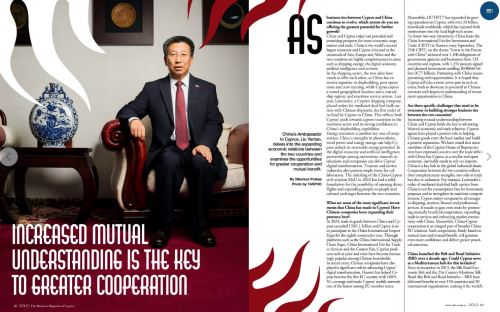
The full text of the interview is as follows:
1. Cyprus and China share evolving business ties. In which sectors do you see the greatest potential for growth?
China and Cyprus enjoy vast potential and promising prospects for economic cooperation and trade. China is the world’s second largest economy, and Cyprus is located at the crossroads of Asia, Europe and Africa. The two countries are highly complementary in areas such as shipping, energy, digital economy, artificial intelligence, and services.
Specifically, in the shipping sector, the two sides have much to offer each other, as China has extensive expertise in shipbuilding, port operations, and crew training, and Cyprus enjoys a sound geographical location and mature ship registry and maritime service system.
Last year, a Cypriot shipping company placed orders for methanol dual-fuel bulk carriers with Chinese shipyards, the first order of its kind by Cyprus in China. This reflects both Cyprus’ push for green transition in the maritime sector and its strong confidence in China’s shipbuilding capabilities.
Energy transition is another key area of cooperation. China’s strengths in photovoltaics, wind power, and energy storage can help Cyprus unlock its renewable energy potential. In digital economy and artificial intelligence, partnerships among universities, research institutions, and companies can drive Cyprus’ digital transformation.
Tourism and service industries also present ample room for collaboration. The initialing of China-Cyprus civil aviation MOU in 2024 has laid a solid foundation for the possibility of opening direct flights and expanding people-to-people and cultural exchanges between the two countries.
2. What are some of the most significant investments China has made in Cyprus, and which Chinese companies have been expanding their presence in the country?
In 2024, trade in goods between China and Cyprus exceeded USD 1.1 billion. Cyprus has participated in the China International Import Expo for eight consecutive years. Through platforms such as China International Supply Chain Expo, China International Fair for Trade in Services and Canton Fair, Cypriot products such as juice and wine have become increasingly popular among Chinese households.
In recent years, Chinese companies have also played a significant role in advancing Cyprus’ digital transformation. Huawei has helped Cyprus become the first EU country with 100% 5G coverage, and made Cyprus’ mobile network one of the fastest among EU member states. Meanwhile, OUTFIT7 has expanded its video game business in Cyprus, with over 24 billion downloads worldwide, which has injected fresh momentum into the high-tech sector in Cyprus.
To foster two-way investment, China hosts the China International Fair for Investment and Trade (CIFIT) in Xiamen every September. The 25th CIFIT, with the theme of “Invest in the Future with China”, was just concluded. It attracted over 1,100 delegations of government agencies and businesses from 123 countries and regions, with 1,154 projects signed and planned investments totaling RMB 644 billion (EUR 77 billion). Partnering with China means partnering with opportunities. It is hoped that Cyprus will take a more active part in such event, both to showcase its potential to Chinese investors, and deepen its understanding of investment opportunities in China.
3. Are there any challenges that need to be overcome in building stronger business ties between the two countries?
Increasing mutual understanding between China and Cyprus holds the key to advancing bilateral economic and trade relations. Cypriot agents have played a positive role in helping Chinese goods enter the local market and build a positive reputation. We have noted that some members of the Cypriot Parliament have expressed concern over the trade deficit with China. In fact, Cyprus, as a smaller and open economy, inevitably needs to rely on imports. China is a key link in the global industrial chain. Cooperation between the two countries reflects their complementary strengths not only in trade, but also in industries. For instance, Lemissoler’s order of methanol dual-fuel bulk carriers from China is not for consumption, but for investment purposes and to strengthen its maritime competitiveness.
Cyprus enjoys comparative advantages in shipping, tourism, finance, and professional services. It stands to gain even more by promoting mutually beneficial cooperation, expanding trade in services, and enhancing market connectivity with China. Meanwhile, China-Cyprus cooperation is an integral part of broader China-EU relations. Such cooperation, firmly based on mutual trust and mutual benefit, will generate even more confidence and deliver greater practical outcomes.
4. China has launched the Belt and Road Initiative (BRI) and has planned to expand its investment in over 100 countries globally. Could Cyprus serve as a hub in the Mediterranean for this initiative?
Since its inception in 2013, the Silk Road Economic Belt and the 21st Century Maritime Silk Road (the Belt and Road Initiative, or BRI) have delivered benefits to over 150 countries and 30 international organizations, making it the world’s most popular public goods and largest platform for global cooperation. China and Cyprus signed the MOU on BRI cooperation in 2019. Given the sound geographical location of Cyprus and its traditional friendship with China, there is huge potential for cooperation between the two countries. Cyprus is the 11th largest flag state in the world, and the third largest in the EU. It is also the largest ship management center in the EU. In this context, Cyprus enjoys multiple advantages as a fulcrum country for Belt and Road cooperation.
Going forward, under the BRI framework, China is ready to work with Cyprus to leverage the synergy in ports, shipping and trade and to increase air connectivity, so as to further unleash the cooperation momentum in the East Mediterranean, and advance high-quality Belt and Road cooperation.
5. China is one of the biggest investors in clean energy. Why is it important to invest in these technologies, and how can Cyprus improve its infrastructure?
China’s strategic investment in clean energy reflects its strong commitment to green development. It also forms a key part of its broader efforts to peak carbon emissions before 2030 and achieve carbon neutrality before 2060, and contribute to the global fight against climate change. Through large-scale R&D and industrialization in the clean energy sector, China has significantly driven down the cost of related technologies—helping other countries lower the barriers to a green transition.
Cyprus, with its abundant sunshine and wind resources, is well-positioned to accelerate the energy transition. The priority lies in upgrading its grid and energy storage infrastructure, enhancing the integration of solar and wind power into the grid, and boosting overall system capacity. In this regard, Cyprus can draw inspirations from China’s experience in aligning policy frameworks, market mechanisms, and technological innovation to turn potential into tangible outcomes.
China stands ready—and is fully capable—to work hand in hand with Cypriot partners to achieve independent, self-reliant and secure energy supply.
6. Are there initiatives to expand cooperation in education and technology between Cypriot and Chinese institutions?
Educational and scientific cooperation is one of the most vibrant pillars of the China–Cyprus strategic partnership. In 2022, the two countries renewed the MOU on Cooperation in Higher Education and Scientific Research. Another MOU covering education, youth, and sports is pending signature, which will broaden cooperation to include primary and secondary education, vocational training, and other key areas.
Over the years, universities in both countries have actively pursued joint education programs, co-training initiatives, and collaborative research, achieving fruitful outcomes. This year, the first group of undergraduates jointly trained by Minjiang University and European University Cyprus successfully graduated. Meanwhile, summer and winter camps co-organized by the Cyprus University of Technology and Chinese universities have been held six times to date. Primary and secondary schools in both countries have also engaged in productive exchanges under the framework of the China–Cyprus Sister City Alliance. Scientific and technological collaboration between China and Cyprus is equally robust. China stands ready to further deepen educational and scientific cooperation with Cyprus, bringing greater benefits to both peoples.
7. The ongoing Cyprus problem has remained unsolved for more than 50 years, and parties on both sides are finding it hard to come to the negotiating table. How does China view the ongoing difficulties, and what stance does Beijing take in reaching a solution?
Both China and Cyprus have yet to achieve full national reunification. This shared experience fosters mutual understanding and strong support for each other on issues concerning their respective core interests and major concerns. President Christodoulides has emphasized that “Cyprus’ commitment to the One China Policy remains a basic principle of our foreign policy.” China deeply appreciates this.
On the Cyprus problem, China, as a permanent member of the UN Security Council, has consistently spoken up for Cyprus and firmly supported its efforts to uphold national sovereignty and territorial integrity. China advocates for a comprehensive, just, and lasting resolution to the Cyprus problem, based on relevant UN resolutions and within the framework of a bi-zonal, bi-communal federation. China also supports strengthening exchanges and engagement between the Greek Cypriot and Turkish Cypriot communities, with a view to creating favorable conditions and building momentum for the resumption of negotiations.
8. Amid changes of global geopolitical landscape, what role does China intend to play?
Today, the world is witnessing a surge in unilateralism, rising acts of bullying, and the continual emergence of global challenges. The international system with the UN at its core, along with the international order founded on international law, is under attack and facing challenges. Amid such intertwined changes and turbulence, China’s position remains clear and steadfast: it is committed to upholding true multilateralism and supporting the central role of the UN in global affairs. China stands ready to be a builder of world peace, a contributor to global development, a defender of the international order, and a provider of public goods.
Recently, President Xi Jinping solemnly presented the Global Governance Initiative (GGI), which is founded on five core concepts, i.e. adhering to sovereign equality, abiding by international rule of law, practicing multilateralism, advocating the people-centered approach, and focusing on taking real actions. The GGI is fully aligned with the purposes and principles of the UN Charter, and reflects the shared aspirations of the international community. It offers clear direction, guiding principles, and a roadmap for addressing the deficits in global governance, and building a fairer, more just, and more equitable global governance system.
9. You have been in Cyprus since 2020. How have you found life on the island and what has your experience been living here?
Cyprus possesses a unique charm that seamlessly blends tranquility with vigor. Its natural landscapes are truly breathtaking—whether strolling along the coastline or gazing out from mountain peaks, one can always feel the vastness and beauty of nature. At the same time, the island’s ancient theaters, monasteries, and traditional villages reflect a deep historical heritage, offering a palpable sense of accumulated civilization and enduring legacy.
What has impressed me most, however, is the local culture and customs. The Cypriot people are warm, sincere, and welcoming, which allowed me to quickly feel at home and integrate into the local way of life. The deep friendship between China and Cyprus is vividly reflected in these everyday interactions.
This experience has deeply enriched my life and strengthened my appreciation for the emotional bonds that transcend national borders. I am committed to doing my utmost for the friendship between China and Cyprus.