People’s Republic of China


Chief Guest Honorable Mr. Mohamed Saeed, Minister of Economic Development and Trade,
Honorable Dr. Ali Haidar Ahmed, Minister of Higher Education, Labour and Skills Development,
State Ministers, Heads of Statutory Bodies, Deputy Ministers,
Government Officials and members of advisory bodies,
Faculty members and Students from Higher education institutions of Maldives,
Faculty and Students of the Maldives National University,
Friends from media,
Ladies and gentlemen,
Good morning!
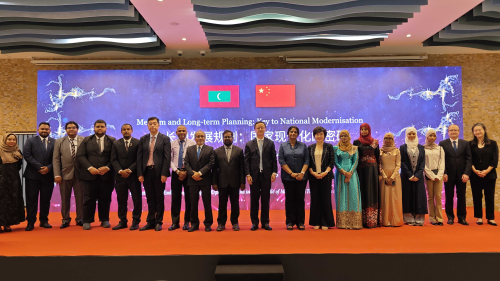
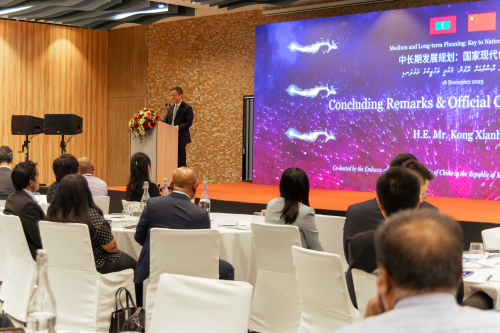
Welcome to the today’s seminar co-hosted by Chinese Embassy in the Maldives and the Maldives National University (MNU). First of all, I would like to express my sincere gratitude to our co-organizer, the MNU, for making this unprecedented seminar possible.
My thanks also go to the Chief Guest Mr. Mohamed Saeed, Minister of Economic Development and Trade, Dr. Ali Haidar Ahmed, Minister of Higher Education, Labour and Skills Development, and all the distinguished guests present here today. Thank you for your valuable support to China-Maldives friendship and practical cooperation.
The theme of today’s seminar is “Medium- and Long-Term Development Planning: The Key to National Modernization”. As a Chinese saying goes, “He who fails to plan, plans to fail.” A Maldivian proverb also tells us, “Don’t fly away before scoping a place to land on.”
At present, China and the Maldives are both at a crucial stage full of opportunities for development. Both sides are formulating medium- and long-term development plans to guide our economic and social development. This seminar will help us learn from each other, strengthen the alignment of our development strategies, achieve integrated development, cement our comprehensive strategic cooperative partnership, and accelerate the building of a China–Maldives community with a shared future.
I. The Five-Year Plans and Chinese Modernization
Modernization is a hallmark of human civilization and progress, and it is a common aspiration of all countries. Chinese President Xi Jinping has pointed out that, “Throughout each of China's 14 five-year plans, the strategic goal and focus have always been to build China into a modern socialist country.”
Since 1953, China has formulated and implemented 14 Five-Year Plans. The concept of Five-Year Plan was not invented by China, nor is it unique to China. We also took detours in the early years. But after more than 70 years of exploration in both theory and practice, China has become one of the countries with the strongest capacity of planning and implementation, creating development miracles that have attracted worldwide attention.
In the early years of the People’s Republic of China, to change the backward situation as quickly as possible, the country implemented the Five-Year Plans to pool limited human, material, and financial resources to advance industrialization. From the 1st to the 5th Five-Year Plan, China built an independent and relatively complete industrial and national economic system.
Since the reform and opening-up, during the 7th Five-Year Plan period, China basically met people’s need for food and clothing. By the 9th Five-Year Plan, people saw their lives rising to a moderately prosperous level on the whole. During the 11th Five-Year Plan, China made the leap from a lower middle income country to an upper middle income country and became the world’s second-largest economy. During the 13th Five-Year Plan, China has secured a complete victory in its fight against poverty, and achieved the goal of building a moderately prosperous society in all respects. On this basis, China aims to basically realize socialist modernization by 2035. This goal will be achieved through the implementation of the 14th, 15th, and 16th Five-Year Plans.
During the 14th Five-Year Plan period, China withstood the severe impact of the pandemic, effectively responded to a series of major risks and challenges, and saw its economic, scientific and technological, and overall national strength reach new heights. China’s GDP surpassed 110 trillion, 120 trillion, and 130 trillion yuan in succession, and is expected to reach about 140 trillion yuan by the end of this year. China’s ranking in the Global Innovation Index rose to 10th, making it one of the fastest-improving economies in innovation capacity. Per capita GDP has exceeded 13,000 US dollars for two consecutive years, and China’s contribution to world economic growth has reached 30%. In the first three quarters of this year, China’s GDP exceeded 100 trillion yuan, up by 5.2% year-on-year, and imports and exports of goods increased by 4%.
From October 20 to 23 this year, The Fourth Plenary Session of the 20th Communist Party of China (CPC) Central Committee deliberated and adopted The Recommendations of the Central Committee of the CPC for Formulating the 15th Five-Year Plan for National Economic and Social Development. The 15th Five-Year Plan period marks a crucial phase for the country to consolidate its foundation and make all-out efforts to accomplish its 2035 target. A key indicator of this goal is that China’s per capita GDP should reach the level of moderately developed countries. In 2024, China’s per capita GDP was about 13,800 US dollars, while that of moderately developed countries ranges from 20,000 to 30,000 US dollars. This means that during the 15th Five-Year Plan period, China’s GDP needs to maintain an average annual growth rate of around 4.5% to 5%.
II. Key Tasks for the 15th Five-Year Plan
The Fourth Plenary Session set the following major objectives for the 15th Five-Year Plan period: significant achievements in high-quality development; substantial improvements in scientific and technological self-reliance and strength; fresh breakthroughs in further deepening reform comprehensively; notable cultural and ethical progress across society; further improvements in quality of life; major new strides in advancing the Beautiful China Initiative; and further advances in strengthening the national security shield.
To accomplish these goals, the plenary session adopted twelve major strategic tasks, providing a top-level design for China’s economic and social development over the next five years. I would like to share some thoughts on several key tasks.
First, build a modernized industrial system and reinforce the foundations of the real economy.
The real economy is the foundation of Chinese modernization. China has the most complete industrial system in the world. Its manufacturing industry accounts for nearly 30 percent of the global total, with manufacturing value added ranking first in the world for 15 consecutive years. China leads the world in the output of over 200 major industrial products. However, there are still bottlenecks in some key and core technologies.
According to the plenary session, China will keep its focus on the real economy, continue to pursue smart, green, and integrated development, and work faster to boost China's strength in manufacturing, product quality, aerospace, transportation, and cyberspace. The share of manufacturing in the national economy should be kept at an appropriate level, and a modernized industrial system should be developed with advanced manufacturing as the backbone.
We will upgrade traditional industries, creating an estimated new market space of about 10 trillion yuan over the next five years.
We will create new pillar industries and accelerate the development of strategic emerging industry clusters such as new energy, new materials, aerospace and the low-altitude economy, which will give rise to several trillion-yuan-level or even larger markets.
We will make forward-looking plans for future industries. These include developing quantum technology, bio-manufacturing, hydrogen and nuclear fusion energy, brain-computer interfaces, embodied intelligence and sixth-generation mobile communications into new economic growth drivers. These industries are poised for significant growth. The newly-added volume for the next decade will be equivalent to that of creating a whole new high-tech sector in China.
Second, achieve greater self-reliance and strength in science and technology and steer the development of new quality productive forces.
Scientific and technological modernization is an important pillar of Chinese modernization. To achieve per capita GDP at the level of moderately developed countries by 2035, China must take a leading position in almost all areas of science and technology. During the 14th Five-Year Plan period, China made major progress in science and technology. Most of the bottleneck technologies in areas such as operating systems, chips, LiDAR, Tunnel boring machine (TBM), and Scanning Electron Microscope (SEM) have been overcome, with many reaching world-leading levels. China has ranked first in the world for five consecutive years in the number of high-level scientific papers and international patent applications. Among the global top 100 science and technology innovation clusters, China takes up 24 in 2025, ranking first in the world for three consecutive years. China has the largest number of R&D personnel in the world and more than 4,500 AI companies. The “AI plus” initiative has been implemented in such key industries as manufacturing, finance, and healthcare, forming new engines of growth.
The plenary session proposed that “we should improve the new system for mobilizing resources nationwide and adopt unconventional measures to drive decisive breakthroughs in core technologies across entire chains in key fields such as integrated circuits, industrial machine tools, high-end equipment, basic software, advanced materials, and bio-manufacturing”, “promote full integration between technological and industrial innovation”, and “advance the digital China initiative”. In short, China missed the first and second industrial revolutions and caught the tail end of the third. Now, in the fourth industrial revolution driven by artificial intelligence, China aims to be a leading force, no longer constrained by others.
Third, work harder to ensure and improve people’s wellbeing and promote common prosperity for all.
Achieving common prosperity for all is an essential characteristic of Chinese modernization. Currently, only around 20 countries in the world have achieved modernization, with a total population of around one billion. For China, a country with a population over 1.4 billion, to enter modernization as a whole is an unprecedented event in human history and will profoundly reshape the global landscape of modernization. It is true that China still faces income disparity issues, which many Maldivian friends who have visited China may have noticed. I would like to emphasize that from winning the world’s largest poverty alleviation campaign and realizing the long-cherished dream of moderate prosperity, to building the world’s largest education, social security, and healthcare systems, China has never forgotten that common prosperity is the essential requirement of socialism.
The 15th Five-Year Plan emphasizes integrating investment in material assets and in human capital, taking the people's ever-growing needs for a better life as our fundamental goal, and promoting well-rounded personal development and steady progress toward common prosperity for all. This is a solemn commitment of the CPC—what is promised must be delivered, and will be delivered.
Fourth, accelerate the green transition in all areas of economic and social development in an effort to build a Beautiful China.
Chinese modernization is one of harmony between humanity and nature. The Financial Times of UK recently said that China is about to become the first “electricity empire” in human history. In 2024, China’s power generation exceeded 10 trillion kilowatt-hours, nearly 30 percent of the global total—2.5 times that of the US and three times that of the EU. In fact, it would be more accurate to call it a “green electricity powerhouse.”
During the 14th Five-Year Plan period, China built the world’s largest and fastest-growing renewable energy system. The installed capacity of renewable energy accounted for about 60 percent of the total, with one in every three kilowatt-hours of electricity coming from green sources. From 2021 to 2024, energy consumption per unit of GDP fell by 11.6 percent, making China one of the countries fastest in reducing energy intensity. China ranks first globally in new energy storage capacity and holds more than 40 percent of global new energy patents. It has been the world’s largest producer and seller of new energy vehicles for ten consecutive years.
China is also the world’s largest exporter of clean technologies. Its PV and wind power products are exported to more than 200 countries and regions, and it has carried out green energy cooperation with over 100 countries and regions, creating 46 percent of global renewable energy jobs. Over the past decade, China’s contribution has helped reduce the global average cost of wind and solar power generation by 60 percent and 80 percent, respectively. During the 14th Five-Year Plan period, China’s wind and solar exports helped other countries cut carbon emissions by about 4.1 billion tons, making an outstanding contribution to the global green transition.
III. Promoting Integrated Development to Accelerate the Building of a China–Maldives Community with a Shared Future
At present, under the leadership of President Dr. Mohamed Muizzu, the Maldives is formulating a 20-year national development plan titled “Resilient Maldives 2045”, which will guide the country’s future economic, social, environmental, and urban development. The goal is to make the Maldives a developed country by 2040 and achieve self-sustaining and resilient development. In this sense, the medium- and long-term plans of China and the Maldives share common values and visions. As traditional neighbors and comprehensive strategic cooperative partners, China and the Maldives can deepen cooperation in the following areas:
First, strengthen exchanges on development planning.
The Five-Year Plan is a distinctive strength of China’s governance, and China has been praised as “the most ambitious planning polity of our times”. Through long-term exploration and practice, China has developed institutional advantages such as the centralized and unified leadership of the CPC Central Committee, the ability to pool resources to accomplish major tasks, promotion of both an efficient market and a well-functioning government, the approach of carrying out the set blueprint until it becomes reality, and nationwide coordination. These strengths have enabled China to create the twin miracles of rapid economic growth and long-term social stability that are rarely seen in the world.
From a poor and underdeveloped country to the “world’s factory”, and then to an innovation hub and global market, Chinese modernization has provided a new option for countries and nations that wish to achieve development while maintaining their independence. Similarly, the Maldives has its own success stories— transforming from one of the least developed countries to a upper middle income country, a global tourism leader, and a champion in addressing climate change. China and the Maldives can strengthen exchanges and cooperation in the formulation and implementation of development plans, align our development strategies, seize shared opportunities, and further enhance mutually beneficial cooperation.
Second, deepen economic integration and development.
The Fourth Plenary Session emphasized the need to promote high-standard opening up, foster mutually beneficial cooperation, and promote the building of a community with a shared future for humanity. China will continue to create new opportunities for the world through its own development. For example, in the Maldives, landmark projects such as the China–Maldives Friendship Bridge, social housing developments, VIA expansion, China–Maldives Friendship Hospital in vilimalé, redevelopment of roads in Malé and vilimalé, and island council office buildings—all have been made possible by China’s sustained and rapid growth.
In his meeting with US President Donald Trump on 30 October, President Xi Jinpin said that “The Chinese economy is like a vast ocean, big, resilient and promising”. We sincerely hope that the Maldives will join this ocean of opportunities to generate strong momentum for shared development.
In the next decade, China’s middle-income population will exceed 800 million, creating unprecedented opportunities for Maldivian industries such as tourism and fisheries. The Maldives is pursuing economic diversification, and China, with the world’s most complete industrial system, is an ideal partner in key areas that the Maldives values most, including modern agriculture, infrastructure, blue economy, green economy, digital economy, and AI. The Maldives aims to generate 33 percent of its energy from renewable sources by 2028 and 100 percent by 2050. China has the most comprehensive toolkit and mature solutions for building zero-carbon islands. As President Xi has emphasized, “To walk with China is to walk with opportunities.”
Third, enhance people-to-people ties between the two countries.
Modernization should be of the people, by the people, and for the people. The ultimate goal of both the 15th Five-Year Plan and Resilient Maldives 2045 is to ensure a better and more prosperous life for our peoples. China and the Maldives share a friendship spanning more than 600 years, and our peoples have genuine goodwill toward each other. Over the past 15 years, except during the pandemic, China has consistently been the largest source of tourists to the Maldives. This is because Chinese tourists can enjoy the natural beauty of the Maldives and also the hospitality of the Maldivian people. With the painful lessons of history, the Chinese people deeply understand, respect, and admire the Maldivian people’s commitment to safeguarding national sovereignty and independence. Today, China–Maldives relations are at their best in history. Our two countries should further increase exchanges, enhance mutual understanding, and build a solid foundation of public support for building a China–Maldives community with a shared future.
Education is an important bridge for this. China’s education in science and engineering is world-renowned. Every year, more than five million graduates in science, technology, engineering, and mathematics (STEM) fields contribute to China’s modernization as a powerful force of engineers. I am pleased to see many young members of Gen Z here at today’s forum. The Prophet Muhammad once said, “Seek knowledge, even if you have to go as far as China.” I hope more of you will choose to study in China, to feel the pulse of Chinese modernization, learn the knowledge and skills needed for the Maldives’ modernization, and build new bridges of friendship between our two nations.
These days, nine outstanding Maldivian high school students are visiting top universities and high-tech enterprises in China’s Sichuan Province. I have also been considering launching a “Chinese language + STEM” education pilot program in the Maldives and gradually expanding it. This will help the Maldives cultivate talent for science and technology innovation and support its high-quality economic and social development.
Now, I look forward to hearing the valuable insights of experts and scholars on the medium- and long-term development plans of China and the Maldives and on the future of China–Maldives cooperation.
Thank you.