


People’s Republic of China


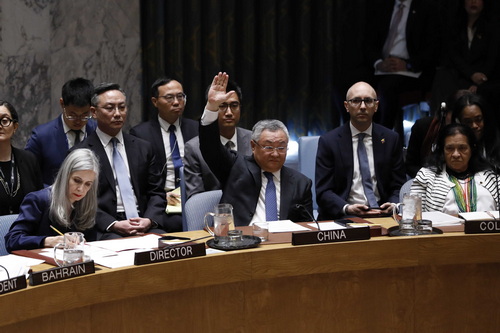
President,
The month-long conflict in Iran and its spillover effect continue to deal a heavy blow to regional and global peace and stability. It is hitting the global economy, causing increasingly widespread disruptions. This is not in the common interest of regional countries and beyond. The merits of this conflict are crystal clear. The US and Israel, without authorization from the Security Council and while negotiations between Iran and the US were underway, launched military strikes against Iran. This is in clear violation of the purposes and principles of the UN Charter and the basic norms of international relations.
At the same time, the sovereignty, security, and territorial integrity of Gulf States must be fully respected. Civilians and non-military targets must be given necessary protection. The safety and security of shipping lanes and energy infrastructure must also be safeguarded. China does not go along with Iran’s attacks on Gulf States and the blockade of the Strait of Hormuz. Like all parties, China hopes that peace and stability will be restored to the Strait as soon as possible and navigation will resume.
China attaches great importance to the draft resolution submitted by Bahrain on behalf of Gulf States. We fully understand their serious concerns. We are committed to solving the issue properly, and we have participated constructively in the consultations. Under the current circumstances, this draft resolution should clearly identify the root causes of this conflict, seek appropriate solutions to address the root causes and ensure the safety and security of shipping lanes, and strive to promote dialogue and achieve peace. It is regrettable, however, that the draft resolution fails to capture the root causes and full picture of the conflict in a comprehensive and balanced manner. It contains one-sided condemnation and pressure, the characterization of the situation as threat to international peace and security, as well as the use of armed escorts. Such language is highly susceptible to misinterpretation or even abuse. At a time when the United States is openly threatening the very survival of a civilization, when the current hostilities imposed on Iran are very likely to further escalate, the draft resolution, should it have been adopted, would send an extremely wrong message and have very serious consequences. The Security Council has lessons to learn from issues such as Libya and the Red Sea. Such past mistakes must not be repeated. The Security Council’s actions should be aimed at deescalating the situation. They must not provide the legal veneer for unauthorized military operations. The Council’s actions must not grant a license to the use of force, let alone further exacerbate tensions and add fuel to the fire, thereby leading to an escalation of the conflict. The Security Council should not rush to vote on the draft resolution where serious concerns among members have been raised. In light of the above, China had no choice but to vote against the draft resolution.
President,
This is a war that should never have happened, and as it continues, it will cause immeasurable harm. At present, the situation in the Middle East continues to deteriorate, and hostilities are escalating. The fundamental solution to ensuring safe passage of ships through the Strait of Hormuz is to achieve cessation of hostilities as soon as possible. The US and Israel are the initiators of this conflict. The fundamental reason for the disruption of navigation in the Strait of Hormuz is the illegal military actions taken by the US and Israel against Iran. China strongly calls on the US and Israel to immediately cease their illegal military actions. Having heard what was said by the US representative, we are much more convinced now that China’s position is objective and impartial, reflecting the image of a responsible major country that upholds international fairness and justice. Our vote will stand the test of history.
At the same time, China calls on Iran to stop attacking relevant facilities in the Gulf, address the legitimate concerns of Gulf States, focus on the common interest of the Global South, and take corresponding positive measures to restore normal navigation in the Strait of Hormuz as soon as possible. China applauds the efforts made by Pakistan, Egypt, Türkiye, and Saudi Arabia to promote dialogue and negotiations and restore regional peace. China commends and supports the work carried out by the United Nations in mediation and alleviating the humanitarian situation, and looks forward to these efforts yielding tangible results at an early date.
Recently, China has made tremendous efforts to restore peace and stability in the Gulf and the Middle East. China has engaged in intensive consultations and mediation with relevant parties. China and Pakistan have issued a Five-Point Initiative for Restoring Peace and Stability in the Gulf and Middle East Region, calling for immediate cessation of hostilities, start of peace talks as soon as possible, security of non-military targets, security of shipping lanes, and primacy of the UN Charter. This is an open initiative and welcomes the response and participation by countries and international organizations.
Taking into account the needs of all parties to resolve the relevant issues, Russia and China have jointly submitted a draft Security Council resolution. The text of that draft resolution is objective and fair, aiming at easing tensions, calling for dialogue and negotiations, and upholding navigational rights and freedoms. We hope that it will receive the support of Council members. China is ready to work with all parties to make greater contributions to the early restoration of peace and stability in the region.
Thank you, President.