


People’s Republic of China


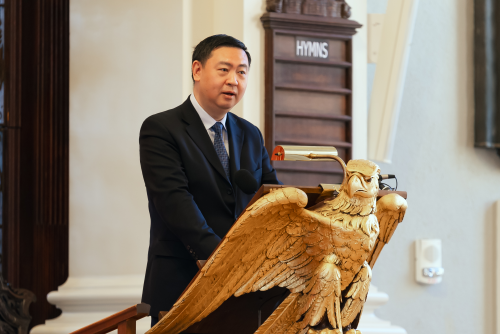
Ladies and gentlemen,
Good morning. It’s a great honor to join you at the HCCF. Let me begin by thanking you all, and Harvard University, for the continued interest in China. Fifty-five years ago, yesterday, Ping-pong diplomacy opened a new chapter in China-US relations. And today, as we gather at the HCCF, that echo in timing reminds us of this forum’s potential to advance exchanges between our two countries.
After working in the U.S. for more than a year, what has impressed me most is that many Americans have a real interest in China and want to learn more about it. Yet what they often encounter is a version of China told by others, one seen in headlines and political speeches, but not always in the lives of ordinary Chinese people or in the reality of Chinese society.
That perception gap is not surprising. Every nation tends to see others through the lens of its own history and values. But in China, we have an old saying: “兼听则明、偏听则暗”, which could be translated as “Listen to all sides and you will be enlightened. And Listen to only one side and you will be in the dark.” To understand a country, it is not enough to hear only how others talk about it. It’s more important to understand how that country sees itself and the world. After all, a nation’s policies are not just reactions to current events. More often, they are shaped by deeper historical memory and cultural traditions.
So today, I’d like to share a few traditional Chinese sayings that reflect how Chinese people understand state-to-state relations. I hope they may offer you some additional perspectives for understanding China.
The first saying is: It is better to resolve enmity than to keep it alive. In Chinese, 冤家宜解不宜结.
In the past five centuries since the emergence of the modern international relations, humanity has never seen a century without war. Some may ask: if peace is rare, and war can bring gains, why does peace still matter?
President John F. Kennedy delivered a famous line, “Mankind must put an end to war, or war will put an end to mankind.” Peace matters because it protects ordinary people from devastation, and the world from a collective cost of disorder.
The Chinese people have a deep historical understanding of war and peace. While the Peloponnesian War was unfolding over 2,400 years ago, China was passing through centuries of turmoil during the Spring and Autumn and Warring States periods. What this history left to the Chinese people was a deep appreciation of peace. Confucius’ belief that “harmony is precious” runs deep in the Chinese cultural tradition, and even The Art of War begins by stressing caution in the use of force.
That is why, in international and regional conflicts, China has consistently advocated peace, dialogue and de-escalation. Restraint is not inaction. We believe that, a responsible major country should not prove its influence by inserting itself into conflicts or turn regional crises into instruments of bloc rivalry, and that true responsibility means judging issues on their own merits, helping ease tensions, and seeking political solutions.
This commitment to peace shapes both China’s approach to international conflict and its path of development. China did not develop through military conquest, or force its way into global markets. As one of the few major countries that have grown through peaceful development, China has neither reason nor intention to change that course.
The second saying is: A skilled chess player first looks to the overall course of the game. In Chinese, 善弈者谋势.
American friends often say that the Chinese are good at thinking long term. In fact, when Chairman Mao met President Nixon for the first time, he famously said, “We will only talk philosophy.” At a time of profound change, only a broader and long-term view of China-U.S. relations can lead to choices that serve both countries and the wider world.
Together, China and the U.S. account for almost one quarter of the world’s population and more than one third of the global economy. The two countries cannot simply turn away from each other. Trying to change the other side is unrealistic. And conflict and confrontation would be unbearable for both.
Many in the American strategic community, influenced by Western historical experience, worry that China will one day challenge America’s global position. But from China’s historical and cultural perspective, the worry is unnecessary. China is not Athens, and the U.S. is not Sparta. The “Thucydides Trap” from over 2,000 years ago is no guide to China-U.S. relations in the 21st century.
China has said repeatedly that we have no intention to challenge or replace the U.S., and that we are ready to be a partner and friend. We mean what we say. As a civilization that has endured for thousands of years, China places great value on credibility, not only as an important principle for individual behavior, but also for China’s diplomacy. China’s development is not aimed at replacing anyone, but about improving people’s lives and bringing more stability and opportunity to the world.
The third saying is: By balancing both sides and holding to the middle, one may achieve harmony. In Chinese, 执两用中,守中致和.
After coming to the U.S., one thing I never expected is that, apart from “Ni Hao” and “Xie Xie”, the Chinese words I would hear very often, are “Yin” and “Yang”. While many American friends tend to see them as symbols of stark opposition, Chinese philosophy places greater emphasis on their complementarity and balance.
In recent years, whenever China is discussed in Washington, the word that always comes up is “competition”, as if everything must be reduced to a binary choice: if you are a competitor, you cannot also be a friend; if there is competition, then cooperation must be impossible. This kind of binary logic does not reflect the reality of China-U.S. relations, where our interests are deeply intertwined. Nor does it help either country meet the challenges we must face together.
Competition is natural. China does not reject it or is afraid of it. But competition should not define the entire relationship, still less become a zero-sum contest. China-U.S. relations matter not only to our two countries, but to the wider world. On issues like climate, AI, public health, and energy security, neither side can solve today’s biggest challenges alone. The world is watching how China and the U.S. interact.
In that sense, China and the U.S. not only have room for cooperation, but a real need for it. The mission of Artemis II reminds us that, in an age of deep interdependence, keeping humanity on a safe and steady course should be a shared goal for both countries. If competition becomes the only lens, opportunities for cooperation will be lost to suspicion. But if mutual benefit remains the goal, competition is far more likely to stay within rational bounds to the benefit of all.
At a time when complete decoupling is impossible and total victory by either side is unrealistic, mutual respect, peaceful coexistence, and win-win cooperation remain the only right choice.
Ladies and gentlemen,
To be frank, since taking up this post, I have encountered no shortage of difficulties and challenges. But I believe this is exactly what diplomacy is about — bridging differences and working toward solutions. It is demanding work, but it is work I care deeply about. If my work can contribute, even in a small way, to greater mutual understanding and better China-U.S. relations, I will feel that my efforts have been worthwhile.
Recently, many in the U.S. education sector talked about a shortage of China expertise in the U.S. and called for more American students to learn Mandarin and spend time in China. I agree.
We do not expect everyone who goes to China to come back with the same conclusions. What we hope is that each person will form an independent judgment, free from pre-conceived notions, and allow long-held perceptions of China to be tested against reality.
Whenever I come to Harvard, I think of Dr. Henry Kissinger. He was, without question, a patriot who served American interests, and a strategic thinker who understood China with rare depth. His ability to rise above ideology, look beyond domestic politics, and recognize the need for accommodation among major countries is especially missed today.
Harvard is a place with a proud tradition and a long line of influential scholars and leaders. I hope that among you, there may emerge another Dr. Kissinger, not to replicate a legend, but to carry forward that same vision and breadth of mind, to truly understand China and the U.S., and to help shape the course of our time.
With that, I wish the forum a full success. Thank you.