


People’s Republic of China


Distinguished Mr. Ulf Pehrsson, Chairman of the Sweden-China Trade Council,
Dear Members of the Sweden-China Trade Council,
Ladies and Gentlemen,
Good afternoon!
It gives me great pleasure to attend the working lunch with the SCTC. Over the past 40 years since its establishment, the SCTC has been committed to promoting China-Sweden economic and trade exchanges and cooperation, and has witnessed the course of China's opening up and China-Sweden economic and trade development. All of you present today are participants in and contributors to China's high-quality development and modernization. Hereby, on behalf of the Chinese Embassy in Sweden, I would like to extend our most sincere appreciation to the SCTC and all member companies for your positive contributions to advancing economic and trade relations between China and Sweden.
Since assuming my post, I have engaged in exchanges with many Swedish government officials, business people, experts and scholars, and gained a more in-depth understanding of China-Sweden relations. Today, I would like to take this opportunity to share my thoughts with you.
I believe you have all noted the 15th Five-Year Plan recently adopted at China's “Two sessions”. The plan is not only a new blueprint for China's development over the next five years, but also an invitation to all countries to pursue shared development, offering vast opportunities for global prosperity and economic growth.
First, a positive economic growth outlook. China sets its GDP growth target for 2026 at 4.5% to 5%. At this growth rate, China's GDP increment will exceed 40 trillion SEK over the next five years, which means its annual GDP increment is equivalent to the GDP of a medium-sized economy. As the world's largest emerging economy, China will continue to see stable conditions and underlying trend supporting its long-term growth. China will remain an anchor and engine of global economic growth, continuing to provide stability and certainty amid a turbulent global landscape.
Second, great market space. China has become world's second-largest consumer and import market. By 2035, China's middle-income population is expected to hit 800 million, an increase nearly equivalent to the current total population of the EU. Over the next five years, China will accelerate its transformation from a major manufacturer into a major consumer in the world. China will fully unleash the potential of service consumption and actively import high-quality international services. China will also expand and upgrade its goods consumption and encourage digital, environmentally-friendly and high-end consumption. Sweden has strengths and unique advantages in these areas. We hope Swedish companies could actively integrate into China's vast market and share in the benefits of China's development.
Third, strong innovative momentum. Over the next five years, China will pursue intelligent, green and integrated development, and accelerate the building of a modern industrial system with advanced manufacturing as its backbone. China will foster six emerging pillar industries, including biomedicine, aviation and aerospace, integrated circuits, new energy storage, low-altitude economy and intelligent robots. It will also nurture six future industries, including biomanufacturing, 6G technology, quantum technology, hydrogen, nuclear fusion power, brain-computer interfaces, and embodied AI. China's manufacturing and service sectors combined are poised to grow by 50 trillion SEK in value. Sweden enjoys a world-leading innovation ecosystem and distinct advantages in advanced manufacturing, biomedicine, and green and low-carbon sectors. Swedish enterprises are welcome to actively integrate into China's innovation and industrial chains and share in opportunities brought by China's industrial development.
Forth, a high level of openness. Over the next five years, China will remain unwavering in advancing high-standard opening up, expand market access and the scope of opening up with a focus on the service sector, and take systematic steps to further open the telecommunication, internet, education, culture, medical service and other sectors. China will further shorten the negative list for foreign investment and continue to improve the business environment for foreign investors in order to provide them with broader investment opportunities in China. China will vigorously develop trade in services and digital trade, and seek balance in imports and exports. China will continue to hold flagship events including “Shopping in China” “Export to China” and “Invest in China”, as well as the China International Import Expo (CIIE), the only national-level import-themed exhibition in the world. An open China is an opportunity for the world. We hope Swedish companies could strengthen their resolve and confidence in deepening their roots in the Chinese market, proactively integrate into China's high-quality development, and achieve success both in China and globally.
At present, the world has entered a new period of turbulence and transformation, with unilateralism and protectionism on the rise. It is upon the people of all countries to decide which way to go in the future. Standing at this historical crossroads, China and Sweden choose to cooperate. Since last year, with the joint efforts of the Chinese and Swedish governments and business communities, positive progress has been made in the economic and trade cooperation between our two countries. High-level mutual visits have increased. The joint committee mechanism on economic, industrial and technical cooperation has restarted. People-to-people exchanges have become closer. Economic and trade cooperation enjoys a positive momentum. To maintain and strengthen this momentum, I believe it is important to properly manage three sets of relationships.
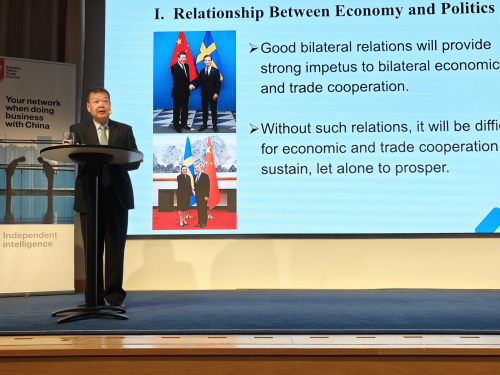
First, the relationship between economy and politics. Sweden is the first western country to have established diplomatic relations with the People's Republic of China, and also the first country to have signed a bilateral investment protection agreement with China after the beginning of reform and opening up. This not only carries great political significance, but also delivers tangible benefits to our two peoples. Over the past 76 years since the establishment of diplomatic ties, our political mutual trust has been consolidated and bilateral economic and trade ties have maintained stable development. It has been proven that good bilateral relations will provide strong impetus to bilateral economic and trade cooperation. Without such relations, it will be difficult for economic and trade cooperation to sustain, let alone to prosper. We hope our friends from the business community could leverage your strengths and influence to contribute to the steady development of bilateral political relations, while continuing to advance our trade cooperation. I believe that with our joint efforts, China and Sweden will be the first to become an example of mutual success between countries with different civilizations, systems, and stage of development.
Second, the relationship between opportunities and risks. In recent years, there has been repeated rhetoric across Europe about “reducing dependence” on and “de-risking” from China. Objectively speaking, risk exists in any market. However, when risk is conflated with politics and security considerations, it may distort judgment and lead to missed opportunities. China has the world’s most complete industrial chain, the broadest range of application scenarios, the most dynamic capital markets, and the richest innovation resource. Business environment in China has continued to improve, providing foreign enterprises with transparent and predictable conditions for development. Integrating into the Chinese market allows enterprises to benefit from strong partners, innovative development models, advanced technologies and high-quality talent, while strengthening and reshaping their core competitiveness through competition. Since the beginning of this year, a number of European leaders have visited China, and many multinational corporations have also traveled to China to explore business opportunities. This consensus of “going to China” reflects their confidence in and optimistic expectation for the future of China's economy.
Third, the relationship between the primary and the secondary. Despite the differences in history, culture, social system, and stage of development, China and Sweden do not have geopolitical conflicts, nor clashes of fundamental interests. Both countries are committed to upholding multilateralism, supporting economic globalization, and advocating trade and investment liberalization and facilitation. Overall, shared interests carry heavier weight in our relationship. Cooperation and consensus should define the tone of our bilateral ties, with differences being secondary, limited and temporary. The recent improvement in bilateral relations has also proven that cooperation is the only way forward and the best solution. We hope both sides will seek common ground while putting aside differences, work in the same direction, and jointly foster new growth drivers with an open mind and concrete actions, so as to bring China-Sweden relations to a new height.
Finally, I would like to once again express my sincere appreciation to the SCTC for the thoughtful arrangement of today’s working lunch. I hope that entrepreneurs would identify new development opportunities arising from the implementation of China's 15th Five-Year Plan, continue to cultivate the Chinese market, and steadily enhance competitiveness. Let’s work together to promote shared progress and development, and jointly create a brighter future of mutual benefit and win-win cooperation for China and Sweden.
Thank you all!