


People’s Republic of China


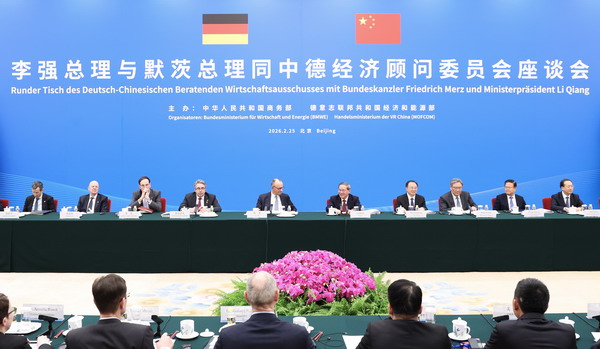
On the afternoon of February 25, 2026, Premier of the State Council Li Qiang, together with German Chancellor Friedrich Merz, attended the symposium of the China-Germany Economic Advisory Committee at the Great Hall of the People in Beijing. The gathering drew the attendance of over 60 representatives from Chinese and German enterprises.
Li Qiang remarked that in the past period of time, the instability and uncertainty plaguing the global economy have been on an overall ascent. As two of the world’s major economies, China and Germany, through sustained and close collaboration, have not only expanded the horizons for their respective development but also injected robust momentum into the global economic landscape. Currently, the global economic arena remains fraught with substantial challenges, the ascendancy and even prevalence of unilateralism and protectionism in certain nations and regions have inflicted severe damage upon the international economic and trade order. It is precisely in such severe circumstances that China and Germany must fortify their cooperation. Cooperation stands as the optimal solution for mitigating risks, while development remains the imperative choice for safeguarding security.
Li Qiang emphasized that at present, both the Chinese and German economies are exhibiting a robust upward trajectory and momentum. With the advent of the “15th Five-Year Plan” period, bilateral economic and trade cooperation is poised to unlock even grander vistas. The fundamental paradigm wherein the Chinese and German economies and industries complement each other’s strengths remains unaltered, with cooperation vastly eclipsing competition. The two nations can adeptly harness this synergy by nurturing a constructive interplay of competition and cooperation, thereby propelling joint development to new heights. To achieve mutual benefit and win-win outcomes at an elevated level, both sides should concentrate their efforts on three pivotal domains. Firstly, the bedrock of traditional collaboration must be fortified. Enterprises from both nations should delve deeper into cooperative endeavors in sectors such as machinery, equipment, and chemicals, expediting business localization to bolster resilience and streamline efficiency. Secondly, new opportunities for future development should be seized. Support should be rendered to enterprises and research institutions from both countries to facilitate the bidirectional flow of innovation resources, engage in profound and collaborative technological exploration, jointly construct platforms and share the fruits of innovation in a mutually beneficial approach. Furthermore, both sides could embark on a joint venture to explore and tap into the vast potential of third-party markets. Thirdly, a conducive environment for investment and business endeavors should be cultivated. China remains resolute in its commitment to broadening high-caliber opening-up and proactively addressing the reasonable appeals of foreign-invested enterprises, including those from Germany. It is hoped that the German government will furnish an open, equitable, and non-discriminatory business environment, enabling enterprises from both nations to engage in cooperation and competition guided by market principles. Furthermore, it is anticipated that Chinese and German entrepreneurs will assume a pivotal role, not only in propelling economic and trade cooperation between the two countries, but also in augmenting mutual communication and comprehension, thereby contributing to the stability of bilateral relations.
Merz remarked that Germany and China stand as pivotal economic and trade collaborators. He noted that the bilateral economic and trade relations, replete with vitality, have consistently maintained a trajectory of high-level development over the years, thus serving as a potent catalyst for economic growth in both countries. Germany is dedicated to fostering reciprocal learning with China, intensifying mutually beneficial cooperation across diverse domains, including automotive, chemicals, machinery and equipment, renewable energy, and the digital economy. These collaborative endeavors are intended to catalyze shared prosperity and bolster the long-term, stable progression of Germany-China relations. The German side, affirming support for German enterprises to deepen their investment and expand their foothold in the Chinese market, expressed its willingness to continuously refine the business environment. The German side also extended a welcoming embrace to more Chinese enterprises to invest and establish operations in Germany, thereby generating employment opportunities and fortifying interconnectedness.
Wu Zhenglong participated in the aforementioned activities.