


People’s Republic of China


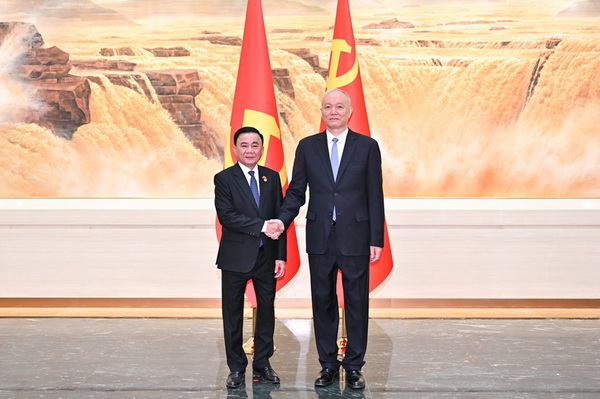
On April 15, 2026, Member of the Standing Committee of the Political Bureau of the Communist Party of China (CPC) Central Committee and Member of the Secretariat of the CPC Central Committee Cai Qi held talks with Member of the Political Bureau of the Communist Party of Viet Nam (CPV) Central Committee and Permanent Member of the CPV Central Committee Secretariat Tran Cam Tu at the Museum of the Communist Party of China.
Cai Qi said that today General Secretary Xi Jinping held in-depth and extensive talks with General Secretary To Lam on overarching and strategic issues of common concern, reaching many important consensuses, and jointly charting a new blueprint for the China-Viet Nam community with a shared future. The two Parties should exercise overall leadership and coordination and effectively guide various departments, localities and institutional platforms in implementing the latest important consensuses reached by the two General Secretaries.
Cai Qi pointed out that in today’s turbulent international landscape, the two Parties and two countries shoulder the important responsibility of advancing the socialist cause and promoting peace and progress for humanity. China stands ready to work with Viet Nam to keep to the right political direction, maintain close high-level exchanges, and continuously consolidate political mutual trust; remain steadfast in ideals and convictions, fully leverage the special role of Party-to-Party channels, make good use of the China-Viet Nam “3+3” strategic dialogue on diplomacy, defense and public security, and continue to strengthen exchanges and mutual learning on governance experience; focus on mutual benefit and win-win outcomes, serve the alignment of the two countries’ development strategies, and advance practical cooperation across the board; remain true to the original aspiration and mission, guide trade unions, youth organizations, women’s federations and other organizations of the two countries to enhance the effectiveness of exchanges, facilitate personnel exchanges, carry out in-depth cooperation on news media, culture, sports and the arts, and carry forward the traditional friendship between China and Viet Nam; and strengthen multilateral coordination, unequivocally uphold multilateralism and free trade, and actively conduct cooperation under the framework of building a community with a shared future for humanity and the four major global initiatives.
Tran Cam Tu expressed appreciation to the Chinese side for attaching great importance to and extending warm hospitality to General Secretary and President To Lam’s visit. He said that General Secretary To Lam and General Secretary Xi Jinping reached new important consensuses on the further development of relations between the two Parties and two countries in the new era. Viet Nam stands ready to work with China to continue to leverage the special role of Party-to-Party channels and promote the implementation of the important consensuses reached by the top leaders of the two Parties and two countries. General Secretary To Lam paid a special visit to the Museum of the Communist Party of China during this trip, which fully demonstrates the close bond, mutual trust and political will to forge ahead hand in hand between the two Parties. He expressed the expectation that the two sides enhance the level of strategic mutual trust and steer the course for the growth of relations between the two Parties and two countries from an overall perspective; work together to resolutely uphold political security and strengthen regular contacts between important departments; further elevate bilateral cooperation and consolidate the material foundation of bilateral relations; jointly guide exchanges between people’s organizations of the two sides and further strengthen people-to-people bonds between the two countries; and enhance multilateral coordination and enable the two countries to play a greater role in regional and global affairs.