People’s Republic of China


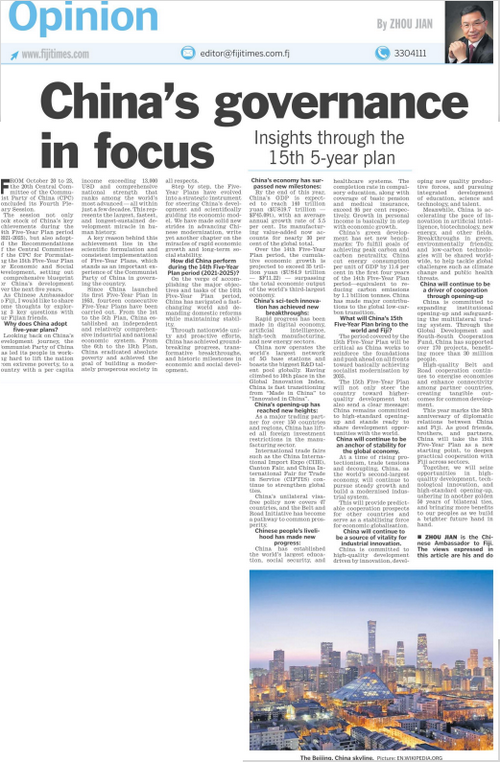
On November 21 and 22, Ambassador Zhou Jian published an article titled “China’s Governance in Focus: Insights through the 15th Five-Year Plan” on Fiji Sun and The Fiji Times, two mainstream newspapers in Fiji. In the article, Ambassador Zhou elaborated on key outcomes of the Fourth Plenary Session of the 20th Central Committee of the Communist Party of China (CPC), and explained how the 15th Five-Year Plan will share development opportunities with the world through high-level opening up. The full text is as follows:
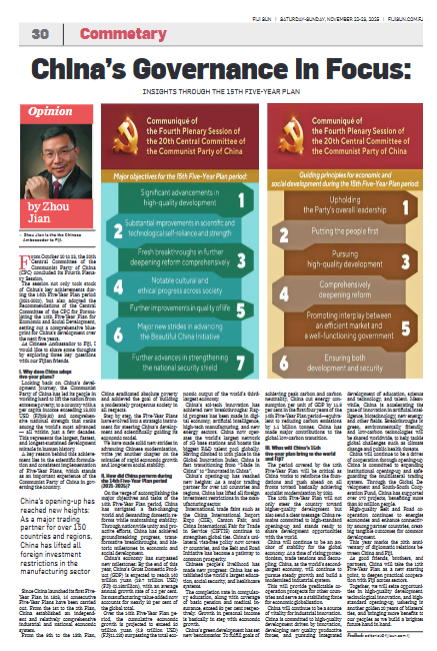
From October 20 to 23, the 20th Central Committee of the Communist Party of China (CPC) concluded its Fourth Plenary Session. The session not only took stock of China’s key achievements during the 14th Five-Year Plan period (2021-2025), but also adopted the Recommendations of the Central Committee of the CPC for Formulating the 15th Five-Year Plan for National Economic and Social Development, setting out a comprehensive blueprint for China’s development over the next five years.
As Chinese Ambassador to Fiji, I would like to share some thoughts by exploring 3 key questions with our Fijian friends.
I. Why does China adopt Five-Year Plans?
Looking back on China’s development journey, the Communist Party of China has led its people in working hard to lift the nation from extreme poverty, to a country with a per capita income exceeding 13,000 USD and comprehensive national strength that ranks among the world’s most advanced — all within just a few decades. This represents the largest, fastest, and longest-sustained development miracle in human history.
A key reason behind this achievement lies in the scientific formulation and consistent implementation of Five-Year Plans, which stands as an important experience of the Communist Party of China in governing the country.
Since China launched its first Five-Year Plan in 1953, fourteen consecutive Five-Year Plans have been carried out. From the 1st to the 5th Plan, China established an independent and relatively comprehensive industrial and national economic system. From the 6th to the 13th Plan, China eradicated absolute poverty and achieved the goal of building a moderately prosperous society in all respects.
Step by step, the Five-Year Plans have evolved into a strategic instrument for steering China’s development and scientifically guiding its economic model. We have made solid new strides in advancing Chinese modernization, writing yet another chapter on the miracles of rapid economic growth and long-term social stability.
II. How did China perform during the 14th Five-Year Plan period (2021-2025)?
On the verge of accomplishing the major objectives and tasks of the 14th Five-Year Plan period, China has navigated a fast-changing world and demanding domestic reforms while maintaining stability. Through nationwide unity and proactive efforts, China has achieved groundbreaking progress, transformative breakthroughs, and historic milestones in economic and social development.
China’s economy has surpassed new milestones: By the end of this year, China’s GDP is expected to reach 140 trillion yuan (19.7 trillion USD), with an average annual growth rate of 5.5%. Its manufacturing value-added now accounts for nearly 30% of the global total. Over the 14th Five-Year Plan period, the cumulative economic growth is projected to exceed 35 trillion yuan (4.9 trillion USD)—surpassing the total economic output of the world’s third-largest economy.
China’s sci-tech innovation has achieved new breakthroughs: Rapid progress has been made in digital economy, artificial intelligence, high-tech manufacturing, and new energy sectors. China now operates the world’s largest network of 5G base stations and boasts the biggest R&D talent pool globally. Having climbed to 10th place in the Global Innovation Index, China is fast transitioning from “Made in China” to “Innovated in China”.
China’s opening up has reached new heights: As a major trading partner for over 150 countries and regions, China has lifted all foreign investment restrictions in the manufacturing sector. International trade fairs such as the China International Import Expo (CIIE), Canton Fair, and China International Fair for Trade in Services (CIFTIS) continue to strengthen global ties. China’s unilateral visa-free policy now covers 48 countries, and the Belt and Road Initiative has become a pathway to common prosperity.
Chinese people’s livelihood has made new progress: China has established the world’s largest education, social security, and healthcare systems. The completion rate in compulsory education, along with coverage of basic pension and medical insurance, exceeds 95% respectively. Growth in personal income is basically in step with economic growth.
China’s green development has set new benchmarks: To fulfill goals of achieving peak carbon and carbon neutrality, China cut energy consumption per unit of GDP by 11.6% in the first four years of the 14th Five-Year Plan period—equivalent to reducing carbon emissions by 1.1 billion tonnes. China has made major contributions to the global low-carbon transition.
III. What will China’s 15th Five-Year Plan bring to the world and Fiji?
The period covered by the 15th Five-Year Plan will be critical as China works to reinforce the foundations and push ahead on all fronts toward basically achieving socialist modernization by 2035. The 15th Five-Year Plan will not only steer the country toward higher-quality development but also send a clear message: China remains committed to high-standard opening up and stands ready to share development opportunities with the world.
China will continue to be an anchor of stability for the global economy. At a time of rising protectionism, trade tensions and decoupling, China, as the world’s second-largest economy, will continue to pursue steady growth and build a modernized industrial system. This will provide predictable cooperation prospects for other countries and serve as a stabilizing force for economic globalization.
China will continue to be a source of vitality for industrial innovation. China is committed to high-quality development driven by innovation, developing new quality productive forces, and pursuing integrated development of education, science and technology, and talent. Meanwhile, China is accelerating the pace of innovation in artificial intelligence, biotechnology, new energy, and other fields. Breakthroughs in green, environmentally friendly, and low-carbon technologies will be shared worldwide, to help tackle global challenges such as climate change and public health threats.
China will continue to be a driver of cooperation through opening up. China is committed to expanding institutional opening up and safeguarding the multilateral trading system. Through the Global Development and South-South Cooperation Fund, China has supported over 170 projects, benefiting more than 30 million people. High-quality Belt and Road cooperation continues to energize economies and enhance connectivity among partner countries, creating tangible outcomes for common development.
This year marks the 50th anniversary of diplomatic relations between China and Fiji. As good friends, brothers, and partners, China will take the 15th Five-Year Plan as a new starting point, to deepen practical cooperation with Fiji across sectors. Together, we will seize opportunities in high-quality development, technological innovation, and high-standard opening up, ushering in another golden 50 years of bilateral ties, and bringing more benefits to our peoples as we build a brighter future hand in hand.