


People’s Republic of China


On 23 November, Ambassador Huang Shifang published in Le Mauricien a byline titled “Charting China’s Course, Forging Ahead on a New Journey”, presenting the key messages of the Fourth Plenary Session of the 20th Central Committee of the Communist Party of China. The full text is as follows:
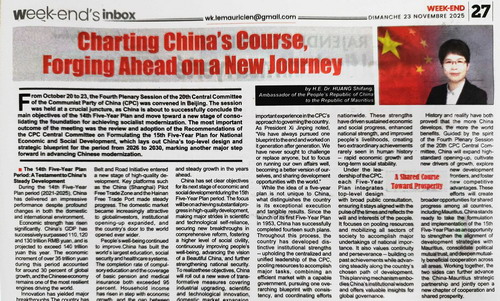
From October 20 to 23, the Fourth Plenary Session of the 20th Central Committee of the Communist Party of China (CPC) was convened in Beijing. The session was held at a crucial juncture, as China is about to successfully conclude the main objectives of the 14th Five-Year Plan and move toward a new stage of consolidating the foundation for achieving socialist modernization. The most important outcome of the meeting was the review and adoption of the Recommendations of the CPC Central Committee on Formulating the 15th Five-Year Plan for National Economic and Social Development, which lays out China’s top-level design and strategic blueprint for the period from 2026 to 2030, marking another major step forward in advancing Chinese modernization.
The 14th Five-Year Plan Period: A Testament to China’s Steady Development
During the 14th Five-Year Plan period (2021-2025), China has delivered an impressive performance despite profound changes in both the domestic and international environment.
Economic strength has risen significantly. China’s GDP has successively surpassed 110, 120 and 130 trillion RMB yuan, and is projected to exceed 140 trillion yuan this year. The economic increment of over 35 trillion yuan during this period accounted for around 30 percent of global growth, and the Chinese economy remains one of the most resilient engines driving the world.
Innovation has yielded major breakthroughs. The country has maintained its position as the world’s largest manufacturer. Its production and sales of new energy vehicles have ranked first globally for several consecutive years. Breakthrough achievements such as the C919 large passenger jet, the Fujian aircraft carrier, and fourth-generation nuclear power plants stand as vivid examples of China’s innovation-driven development.
Green development has become a defining feature. China’s forest coverage has increased to over 25 percent, contributing one-quarter of the world’s new green area. Its installed renewable energy capacity has, for the first time, exceeded that of coal, marking a historic milestone. Having built the world’s largest clean energy system, China is moving steadily toward its dual carbon goals of peaking emissions before 2030 and achieving carbon neutrality before 2060.
Opening up and cooperation have reached new heights. The Belt and Road Initiative entered a new stage of high-quality development. Key platforms such as the China (Shanghai) Pilot Free Trade Zone and the Hainan Free Trade Port made steady progress. The domestic market became increasingly attractive to global investors, institutional opening up expanded, and the country’s door to the world opened ever wider.
People’s well-being continued to improve. China has built the world’s largest education, social security and healthcare systems. The completion rate of compulsory education and the coverage of basic pension and medical insurance both exceeded 95 percent. Household income has risen in step with economic growth, and the gap between urban and rural residents has further narrowed.
China’s modernization has made solid progress during the 14th Five-Year Plan period, laying a strong foundation for the goal of basically achieving socialist modernization by 2035.
The 15th Five-Year Plan: Steering China’s Progress
The Fourth Plenary Session made clear that the 15th Five-Year Plan period will be a crucial phase in China’s journey toward socialist modernization. China’s economy is underpinned by solid fundamentals, multiple strengths, strong resilience, and vast potential, and the conditions and underlying trend supporting its long-term growth remain intact. Building on four key strengths -- the socialist system, a vast domestic market, a comprehensive industrial base, and abundant human resources -- China will leverage these advantages to drive high-quality development and sustain sound and steady growth in the years ahead.
China has set clear objectives for its next stage of economic and social development during the 15th Five-Year Plan period. The focus will be on achieving substantial progress in high-quality development, making major strides in scientific and technological self-reliance, securing new breakthroughs in comprehensive reform, fostering a higher level of social civility, continuously improving people’s well-being, advancing the vision of a Beautiful China, and further strengthening national security. To realize these objectives, China will roll out a new wave of transformative measures covering industrial upgrading, scientific and technological innovation, domestic market expansion, rural revitalization, coordinated regional development, social welfare enhancement, ecological conservation, and national defense modernization. High-quality development will remain the overarching theme, reform and innovation the key driving forces, and the people’s aspiration for a better life the ultimate purpose. China will seek both qualitative improvement and well-balanced quantitative growth, promote all-round human development and common prosperity for all, and make steady progress toward the goal of basically achieving socialist modernization by 2035.
Building on its long-standing commitment to openness, China will pursue broader and deeper engagement with the world. The Fourth Plenary Session called for expanding high-standard opening up, fostering new forms of win-win cooperation, and advancing building a community with a shared future for humanity. The Recommendations for the 15th Five-Year Plan set out concrete actions to make this a reality -- from promoting innovation in trade and expanding two-way investment to further advancing China’s self-initiated opening up. Together, these efforts send a clear message that China is committed to working with all partners to achieve mutual benefit and shared progress at a higher and more inclusive level.
The Five-Year Plans: Decoding China’s Governance Model
The scientific formulation and consistent implementation of the Five-Year Plans constitute important experience in the CPC’s approach to governing the country. As President Xi Jinping noted, “We have always pursued one blueprint to the end and worked on it generation after generation. We have never sought to challenge or replace anyone, but to focus on running our own affairs well, becoming a better version of ourselves, and sharing development opportunities with the world.”
While the idea of a five-year plan is not unique to China, what distinguishes the country is its exceptional execution and tangible results. Since the launch of its first Five-Year Plan in 1953, China has successfully completed fourteen such plans. Throughout this process, the country has developed distinctive institutional strengths -- upholding the centralized and unified leadership of the CPC, pooling resources to accomplish major tasks, combining an efficient market with a capable government, pursuing one overarching blueprint with consistency, and coordinating efforts nationwide. These strengths have driven sustained economic and social progress, enhanced national strength, and improved people’s livelihoods, creating two extraordinary achievements rarely seen in human history -- rapid economic growth and long-term social stability.
Under the leadership of the CPC, each Five-Year Plan integrates top-level design with broad public consultation, ensuring it stays aligned with the pulse of the times and reflects the will and interests of the people. It focuses on pooling resources and mobilizing all sectors of society to accomplish major undertakings of national importance. It also values continuity and perseverance -- building on past achievements while advancing steadily along the country’s chosen path of development. This planning mechanism embodies China’s institutional wisdom and offers valuable insights for global governance.
A Shared Course Toward Prosperity
History and reality have both proved that the more China develops, the more the world benefits. Guided by the spirit of the Fourth Plenary Session of the 20th CPC Central Committee, China will expand high-standard opening up, cultivate new drivers of growth, explore new development frontiers, and foster new competitive advantages. These efforts will create broader opportunities for shared progress among all countries, including Mauritius. China stands ready to take the formulation and implementation of the 15th Five-Year Plan as an opportunity to strengthen the alignment of development strategies with Mauritius, consolidate political mutual trust, and deepen mutually beneficial cooperation across all areas. Working together, the two sides can further advance the China-Mauritius strategic partnership and jointly open a new chapter of cooperation and shared prosperity.