


People’s Republic of China


On 26 November, Ambassador Huang Shifang gave a written interview to the Mauritian media Business Magazine, presenting the key messages of the Fourth Plenary Session of the 20th Central Committee of the Communist Party of China and the 15th Five-Year Plan.
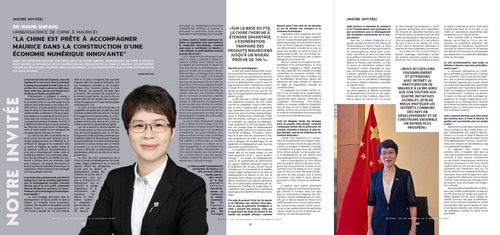
1.In your recent press reception, you mentioned that the meeting between President Xi Jinping and President Donald Trump on 30 October 2025 produced important agreements and aimed at addressing global challenges. As China’s Ambassador to Mauritius, how do you see this meeting benefiting both the world and Mauritius specifically?
On October 30, 2025, President Xi Jinping met with President Donald Trump in the Republic of Korea. The two leaders exchanged views on China-U.S. relations and issues of mutual concern.
Under their joint guidance, China-U.S. relations have remained stable on the whole. China and the U.S. should be partners and friends, steering the giant ship of bilateral relations steadily forward despite differences. President Xi noted that China’s economy remains resilient and full of potential, with GDP growing by 5.2 percent in the first three quarters of 2025. China will deepen reform and opening up, pursue high-quality development, and share new opportunities with the world.
China stands ready to work with the U.S. to act on the important common understandings between the two presidents, and continuously shorten the list of problems and lengthen the list of cooperation through dialogue and consultation in the spirit of equality, mutual respect and mutual benefit.
I believe that the steady, sound, and sustainable development of China-U.S. relations will bring greater certainty and stability not only to Africa as a whole but also to Mauritius. Such progress will foster a more favorable and amicable environment for cooperation, ultimately delivering more tangible benefits to the Mauritian people.
2.President Xi Jinping’s next Five-Year Plan aims to create new opportunities for global development. How can Mauritius benefit from these initiatives, particularly in trade, investment, technology, and sustainable development?
China is committed to advancing high-quality development and fostering new quality productive forces. Remarkable achievements have been scored. During the 14th Five-Year Plan period, China has seen its GDP surpass RMB 130 trillion and breakthroughs in such emerging industries as artificial intelligence and new energy. The “world’s factory” has become the global innovation powerhouse. China is committed to high-standard opening up. China further shortened the negative list for foreign investment and its overall tariff level has been cut to 7.3 percent. We forged high-quality Belt and Road cooperation ties with more than 150 countries and over 30 international organizations. China’s contribution to global economic growth has stood at around 30 percent, making it a key driver and source of growth for global development.
The fourth plenary session of the 20th CPC Central Committee deliberated over and adopted the Recommendations for Formulating the 15th Five-Year Plan, sending out the message that the consistency of China’s policy and its steady economic growth and development prospects provide valuable certainty to this volatile world. From the 14th Five-Year Plan to the 15th Five-Year Plan, China has shown its firm resolve and perseverance and spelled out the key to China’s good governance.
The concept of high-quality development embedded in China’s Five-Year Plans aligns with Mauritius’ development vision, offering expanded opportunities in sustainable development, high-tech industries, infrastructure, and trade and investment, while also fostering experience sharing and enhanced connectivity. Also, China will facilitate Global South cooperation with countries like Mauritius, advocate a universally beneficial and inclusive economic globalization, and promote the building of a community with a shared future for humanity.
3.China introduced the Global Governance Initiative in September 2025 to enhance international cooperation. How do you see Mauritius contributing to, and benefiting from, this initiative?
On September 1 this year, Chinese President Xi Jinping put forward the Global Governance Initiative (GGI), emphasizing sovereignty equality, international rule of law, multilateralism, a people-centered approach, and real actions. The most unequivocal message from the GGI is a call for stronger solidarity. China is ready to work with all parties to put the GGI into action. We will engage consistently in equal consultation, listen to different views, and take useful advice with an open mind to build maximum consensus. We will base our creativity on past achievements, and make timely changes to reform and improve, rather than replace, the current international system. We will promote global governance reform with gradual and sustained efforts to make it beneficial to the whole world.
The GGI, the Global Development Initiative, the Global Security Initiative and the Global Civilization Initiative, each has its own focus and at the same time complements each other. These four global initiatives form a systemic public good that China presented to the world. It injects stability and certainty into a turbulent world, and shines a spotlight on China’s commitment and contribution in international affairs. China looks to work with all parties, including Mauritius, to advance the four initiatives, and deliver peace and development to people across the world.
4.China welcomes Mauritius’s participation in the Belt and Road Initiative. What concrete opportunities could Mauritius gain in areas such as trade, investment, infrastructure, and educational or technological exchanges?
The Belt and Road Initiative (BRI) is an important platform for mutual development. It transcends the past patterns of international cooperation and aims at common development with countries around the world. It is open, inclusive and not targeted at any specific countries or groups of countries. By now, over 150 countries and 30 international organizations have joined the BRI.
The BRI is not an abstract slogan but a platform supported by concrete cooperation projects. Through this initiative, China has worked with many partner countries to build ports, highways, industrial parks, energy networks and digital infrastructures, creating jobs, enhancing connectivity and strengthening development capacity. China is now advancing the Belt and Road into a new stage of high-quality development, focusing on green growth, digital economy, scientific innovation and people’s well-being. Through this platform, China is ready to share a new wave of its development dividends with all partners, including Mauritius.
China and Mauritius have already enjoyed a solid foundation of cooperation. Our Free Trade Agreement (FTA), livelihood projects and capacity-building programs all reflect the true spirit of the Belt and Road cooperation. Also, the BRI’s emphasis on connectivity and win-win outcomes profoundly aligns with Mauritius’ own vision for development and its role as a gateway between Africa and Asia. We sincerely look forward to Mauritius’ joining the BRI. We believe Mauritius’ participation in the BRI would further boost its development, inject new momentum into China-Mauritius cooperation and contribute more to the prosperity of Africa and the wider region.
5.Following last year’s FOCAC summit and the elevation of China-Mauritius relations to a strategic partnership, China announced measures like zero-tariff treatment and support for African products. How can Mauritius leverage these developments to boost trade and economic growth?
Providing zero-tariff coverage on 100% of tariff lines to the 53 African countries that have diplomatic relations with China expands China’s voluntary opening-up. It is a vivid demonstration of advancing the outcomes of the FOCAC Beijing Summit, fostering an all-weather China-Africa community with a shared future for the new era.
Amid resurgent unilateralism and protectionism, China and Africa are resolved to jointly address these challenges, injecting stability and constructive energy into global trade. This landmark measure aligns with the trend of economic globalization, responds to African countries’ aspirations, and complies with the World Trade Organization (WTO) rules.
Leveraging China’s mega-sized market and the achievements of Chinese modernization, this initiative will create more opportunities for Mauritius, deepen China-Africa economic cooperation, establish a new benchmark for Global South cooperation through common development of China and Africa, and make economic globalization more inclusive and beneficial for all.
6.Next year is designated the China-Africa Year of People-to-People Exchanges. How does the Embassy plan to promote cultural activities in Mauritius, and what impact do you expect these initiatives to have on bilateral relations?
2026 marks the 70th anniversary of the start of diplomatic relations between China and African countries. As pointed out by Chinese President Xi Jinping, “The foundation and lifeline of China-Africa relations lie with the people. Therefore, the development of our relations should be more people-oriented.” In line with the affinity between Chinese and African people, during the 2024 FOCAC Beijing Summit, the leaders from both sides have agreed that in 2026, a series of people-to-people exchange activities under the theme of “Consolidate All-Weather Friendship, Pursue Shared Dream of Modernization” will be held.
In Mauritius, we will better leverage the long and rich history of people-to-people and cultural exchanges between our two countries and continue to hold flagship cultural events such as the “Chinese New Year Gala” and “Float Parade” in Port Louis in 2026. Other activities include “Tea for Harmony Yaji Cultural Salon” and performances of intangible cultural heritage will also be on the list to bring vibrant cultural experiences to the Mauritian public.
7.You highlighted that China’s openness can provide more opportunities for Mauritius’ development. Which sectors or areas of trade and investment do you see as most promising for Mauritian businesses in the Chinese market?
With its 1.4 billion population and a growing middle-income group of more than 400 million people, China is bound to be the world’s largest consumer market in this century. This provides the solid foundation and confidence for China to expand its opening-up and strengthen its cooperation with Mauritius and other African countries. The implementation of the zero-tariff treatment will help attract more Chinese capital, technology, and services to Mauritius, creating greater added value and more job opportunities locally, while enabling more “Made in Mauritius” products to reach the Chinese market.
The Chinese side attaches great importance to the concern of the Mauritian side to continuously expand exports to China. Ever since the entry into force of the China-Mauritius Free Trade Agreement (FTA) in 2021, the agreement has brought great opportunities for the export of Mauritian specialty products to the Chinese market. From January to August this year, Mauritius’ exports to China increased by 31%. Products such as sugar and textiles saw a strong rebound, fully demonstrating the great potential of our trade cooperation.
Based on the existing FTA, the Chinese side will seek to further expand zero-tariff treatment for Mauritian products to as close to 100% as possible, which will make Mauritius’ exports to China more competitive.
We are ready to work with Mauritius, through the FTA and relevant cooperation mechanisms, to support Mauritian companies in accessing into the Chinese market, and to foster more balanced and mutually beneficial economic and trade relations between our two countries.
8.As Ambassador, is there a particular project or initiative in Mauritius that is especially close to your heart?
From October 27 to November 5, the Overseas Seminar on Artificial Intelligence has been successfully held. This is the first bilateral training program held in Mauritius, providing an important platform for deepening China-Mauritius cooperation in the field of artificial intelligence, supporting Mauritius’ digital transformation.
In the future, China is willing to share its experience in AI technology applications, industry development, and talent cultivation to support Mauritius in building an innovative digital economy.
9.Finally, how would you describe the current state of relations between China and Mauritius, and what are your priorities for the coming years?
Mauritius is an important partner of China in Africa and the Indian Ocean region. Since the establishment of diplomatic relations 53 years ago, China and Mauritius have been adhering to mutual respect and pursuing common development. Last year, the two countries elevated their ties to a Strategic Partnership.
Looking ahead, we are willing to work hand in hand with the Mauritian government to continue firmly supporting each other’s core interests, enhancing mutual trust, and carrying forward the traditional friendship. We are willing to make full use of the China-Mauritius Free Trade Agreement to deepen mutually beneficial and win-win cooperation. We are willing to seize the opportunities of the upcoming 2026 “China-Africa Year of People-to-People Exchanges” to advance cultural integration.
We welcome and look forward to Mauritius’ participation in the Belt and Road Initiative (BRI) and its support for the four global initiatives to better safeguard the common interests of developing countries and jointly build a more thriving world. As long as the people of China and Mauritius stand together, our strategic partnership will embrace an even brighter future.