


People’s Republic of China


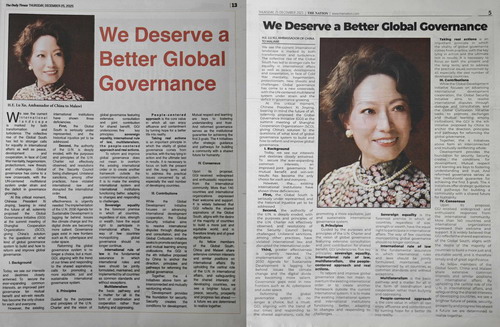
On December 25, 2025, an article titled “We Deserve a Better Global Governance” by H.E. Lu Xu, Chinese Ambassador to Malawi, was published in the Nation and Daily Times, introducing the Global Governance Initiative. The following is the full text of the article:
We see the current international landscape is marked by both transformation and turbulence. The collective rise of the Global South has led to stronger calls for equality in international affairs as well as peace, development and cooperation, in the face of Cold War mentality, hegemonism, protectionism, new threats and challenges. Global governance has come to a new crossroads, with the UN-centered multilateral system under strain and the growing deficit in governance.
At this critical moment, Chinese President Xi Jinping, bearing in mind the future of all, solemnly proposed the Global Governance Initiative (GGI) at the summit meeting of Shanghai Cooperation Organization+ (SCO), giving China’s solution to the questions of what kind of global governance system to build and how to reform and improve global governance.
I. Background
Today, we see our interests and destinies closely entwined. To secure the ever-expanding common interests, an improved joint governance for mutual benefit and win-win results has become the only choice for each and every one.
However, the existing international institutions have shown three deficiencies.
First, the Global South is seriously underrepresented, and the historical injustice has yet to be addressed.
Second, the authority of the U.N. is deeply eroded, with the purposes and principles of the U.N. Charter not effectively observed, and resolutions of the Security Council being challenged. Unilateral sanctions, among other practices, have violated international law and disrupted the international order.
Third, greater effectiveness is urgently needed. The implementation of the U.N. 2030 Agenda for Sustainable Development is lagging far behind. Issues like climate change and the digital divide are becoming more salient. Governance gaps exist in new frontiers such as AI, cyberspace and outer space.
Reforming the global governance system is no longer a choice, but a must. The GGI, aligning with the trend of our times and responding to the shared aspirations, calls for promoting a more equitable, just and sustainable international governance system.
II. Principles
Guided by the purposes and principles of the U.N. Charter and the vision of global governance featuring extensive consultation and joint contribution for shared benefit, the GGI underscores five key principles: sovereign equality, international rule of law, multilateralism, the people-centered approach and real actions.
To reform and improve global governance does not mean to overturn the existing international order or to create another framework outside the current international system. It is to make the existing international system and international institutions function better, adapting to changes and responding to challenges.
Sovereign equality is the foremost premise on which all countries, regardless of size, strength or wealth, have the equal right to participate in international affairs. The way of a few countries monopolizing global governance should no longer continue.
The international rule of law is the fundamental assurance that international rules and laws should be jointly formulated, maintained, and implemented by all countries as common standards and without exception.
Multilateralism is the basic pathway and a matter for all in the form of coordination and cooperation rather than bullying and oppressing.
The people-centered approach is the core value in which all can enjoy affluence and contentment by turning hope for a better life into reality.
Taking real actions is an important principle in which the vitality of global governance comes from practice, with the key lying in action and the ultimate test in results. It is necessary to focus on both the present and the long term, and to address the practical issues concerned by all, especially the vast number of developing countries.
III. Contributions
While the Global Development Initiative focuses on advancing international development cooperation, the Global Security Initiative aims to resolve international disputes through dialogue and consultation, and the Global Civilization Initiative seeks to promote exchanges and mutual learning among civilizations, the GGI is the 4th Initiative proposed by China to anchor the direction, principles and pathways for reforming global governance.
Together, the 4 Initiatives above form an interconnected and mutually reinforcing whole:
Development provides the foundation for security. Security creates the conditions for development. Mutual respect and learning are keys to fostering understanding and trust. And reformed governance serves as the institutional guarantee for achieving the first 3 goals. The 4 Initiatives offer strategic guidance and pathways for building a community with a shared future for humanity.
IV. Consensus
Upon its proposal, the GGI received widespread and enthusiastic responses from the international community. More than 140 countries and international organizations expressed their welcome and support. It is widely believed that the GGI reflects the shared aspirations of the Global South, aligns with the desire of the majority of countries to build a more just and equitable world, and is therefore timely and of great significance.
As fellow members of the Global South, China and Malawi share extensive common interests and similar positions on international affairs. By upholding the central role of the U.N. in international affairs, and safeguarding the shared interests of developing countries, we see a brighter future of peace, security, prosperity and progress lies ahead ---- a future we are determined to realize together.