People’s Republic of China


Distinguished guests,
Ladies and gentlemen,
Dear friends,
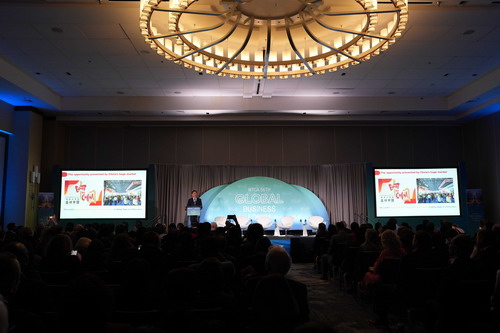
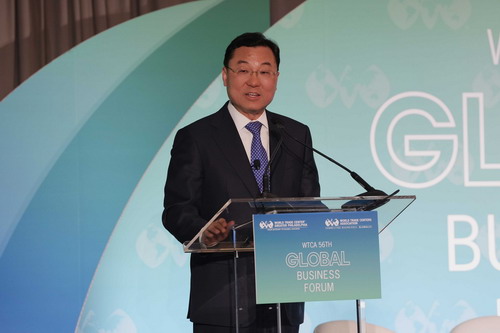
Good morning. It gives me great pleasure to attend the 56th Annual WTCA Global Business Forum in Philadelphia. The theme this year, “Historic Foundations, Future Collaborations: Cultivating New Business Frontiers”, could not be more relevant, as it invites us to both revisit history and look ahead to future collaboration. First of all, I would like to extend my warmest congratulations on the opening of the forum.
For both China and the United States, the year 2026 is a crucial year for building on the past and paving the way for the future. In China, this year marks the beginning of our 15th Five-Year Plan. Last month, I had the honor to attend the annual “two sessions” as a member of the National Committee of the Chinese People’s Political Consultative Conference, at which I witnessed the adoption of the plan. The 15th Five-Year Plan is both a roadmap for advancing Chinese modernization in the coming five years, and an invitation to the rest of the world to share in China’s development opportunities. So how can we better understand it? I would like to share with you four key terms.
First, people-centered. China puts people first in mapping out economic and social development during the 15th Five-Year Plan period. Among the 20 main indicators outlined in the plan, seven, which is more than one-third of the total, focus on improving people’s wellbeing throughout all stages of life, shifting the emphasis from ensuring basic coverage to enhancing service quality. For instance, we will boost childcare enrollment for children under three years old by 6%, increase the average duration of education for the working-age population to 11.7 years, and raise our average life expectancy to 80 years. In the coming five years, China will ensure that public services are inclusive, meet essential needs, and provide a cushion for people most in need, so that all our people can lead a better life.
Second, innovation-driven. Innovation is the primary driving force behind development. The 15th Five-Year Plan stresses the importance of pursuing full integration between technological and industrial innovation and continuously fostering new quality productive forces. Artificial intelligence (AI) has become a key driver of the current wave of innovation. Apart from sharing with the world products such as DeepSeek and Seedance, China has also proposed the establishment of a World Artificial Intelligence Cooperation Organization and put forward the AI+ International Cooperation Initiative, advocating AI for good and for all. In the coming five years, China will foster more strategic emerging industries of “tomorrow” and pillar industries of “the day after tomorrow”, which will give stronger impetus to global innovative development.
Third, green transition. Lucid waters and lush mountains are invaluable assets. During the 15th Five-Year Plan period, China will go further in green technology, green energy, and green finance. Protecting the ecosystem and addressing climate change remain a pressing challenge for humanity. The recent international situation has reminded us that fossil fuels such as oil and gas are highly concentrated, and countries often need to import and transport them across borders. In comparison, renewable energy such as wind and solar power is inexhaustible, and can serve as an important complement. In the coming five years, China will continue to be a doer in green development, and make its unique contributions to global environmental and climate governance.
Fourth, open cooperation. Openness is the path every country needs to take to achieve prosperity and development, and also a defining hallmark of Chinese modernization. During the 15th Five-Year Plan period, China will steadily deepen institutional opening up, take the initiative to open the service sector wider, and align with high-standard international rules in areas including finance, medical services, education, and cross-border data flow. China will continue to hold major events such as the China International Import Expo, the Canton Fair, and the China International Fair for Trade in Services, and build the Hainan Free Trade Port with high standards. In the coming five years, China will further expand high-standard opening up, and share development opportunities with the rest of the world.
So during the 15th Five-Year Plan period, the world will see a China brimming with vitality and full of potential. We welcome friends with vision from all countries to seize the historical opportunities, to invest, grow and prosper in the Chinese market, which has become a global arena. At least four key opportunities are now emerging:
First, the opportunity presented by China’s huge market. Market is the scarcest resource in today’s world. In China, the world’s largest and most vibrant consumer market is taking shape at a faster pace. We welcome more foreign-funded businesses to invest in sectors such as advanced manufacturing, modern services, and high-tech industries in China, and especially in value-added telecom services, biotechnology, and wholly foreign-owned hospitals, where we will further expand opening-up trials during the 15th Five-Year Plan period.
Second, the opportunity presented by China’s world-leading innovation ecosystem. China has the world’s largest, most complete, and most comprehensive industrial system, as well as fast-emerging talent dividends. Combined with the convenient infrastructure and a vast range of application scenarios, this means “1” in the lab can be quickly scaled to “100” on the production line, translating innovation into tangible industrial value.
Third, the opportunity presented by China’s new energy revolution. With the world’s largest clean energy system and most complete new energy industry chain, China is a pilot field and a rollout platform for global green technologies. We welcome various sides to enter the green and low-carbon sector, join hands with China to develop clean energy, low-carbon industries, and circular economy, and share the benefits of green development.
Fourth, the opportunity presented by China’s first-class business environment. China is good at keeping working on the same blueprint until it becomes reality. Our plans are consistent, and our policies stable. We are continuously fostering a market-oriented, law-based, and internationalized business environment, so that foreign companies can feel at ease in China. For instance, it took only two days for the American company Albemarle Corporation to obtain approval for its lithium hydroxide battery project in Sichuan Province. In an increasingly uncertain world, China is committed to being a “harbor of stability” and “predictable partner”. Believing in China is believing in a better tomorrow, and investing in China is investing in the future.
Ladies and gentlemen,
Dear friends,
The world today is far from tranquil, and peace and development are facing serious threats. Amid all the turbulence, people have come to realize more clearly that a stable, sound, and sustainable China-U.S. relationship not only meets the interests of both sides, but also serves as a ballast, propeller and engine of global peace and prosperity. In other words, only with the steady and sustained development of China-U.S. relations can both our peoples benefit and global stability and development be secured. Over the past few years, China-U.S. relations have forged ahead despite ups and downs, which has not come easily. Looking ahead, we face both grave challenges and rare opportunities in bilateral cooperation. The two sides need to show greater courage and wisdom, and properly handle four key issues that bear on the healthy development of bilateral relations.
First, it is important to establish a right strategic perception, and choose to be partners rather than rivals. How should we perceive each other, partners or rivals? This is always fundamental to the China-U.S. relationship, just like the first button of a shirt that must be put right. Facts have proven time and again that, from providing affordable, high-quality daily necessities to the American people, to addressing challenges such as the fentanyl issue, to revitalizing American traditional industries like shipbuilding and car manufacturing, to opening new frontiers such as AI, biomedicine, and the peaceful utilization of outer space, and to helping deescalate regional hotspots and resolve challenges, none could be achieved without China-U.S. cooperation.
China has no intention to challenge or displace the U.S. We hope the U.S. side will reject the Cold-War mentality, stop containing and suppressing China, and make up its mind to be partners and friends with China, so that together we can do more big, practical and good things that benefit both our countries and the world.
Second, it is important to advocate fair competition, and help each other succeed, instead of engaging in a zero-sum game. It is only natural that China and the U.S. have competition in areas such as economy and trade. What matters more is how we choose to compete. In this regard, the healthy competition between Tesla and Chinese electric vehicle (EV) companies can offer us some valuable insights. In 2019, Tesla decided to establish a gigafactory in China. The Chinese side warmly welcomed and supported the project, helping it come to fruition and begin operations in the same year it broke ground. Facing the pressure, Chinese EV companies strove for strength and accelerated innovation, achieving collective growth in just a few years, which in turn motivated Tesla in a positive way.
Such a race to the top is mutually beneficial and win-win, and also serves the best interests of global consumers. This sets an example for competition between China and the U.S., which should be like competing for excellence in a racing field, not beating one another down in a wrestling ring. Moreover, the playing field should be level, and the rules should be observed. As the saying goes, “Some days you win, some days you lose.” One should accept either outcome with grace, instead of applying double standards, extolling free trade when one is competitive, yet turning to fair trade when outcompeted. It also means one should not predetermine the result, accepting only scenarios in which they win, while denying others the right to outperform them. Still less should one resort to smearing, trapping, or tripping others up in order to undermine them.
Third, it is important to clarify the boundaries of national security, and restore common sense and reason to economic, trade, and science and technology cooperation. While safeguarding national security is both legitimate and essential, the concept should not be overstretched or misused as a catch-all. Even now, we still cannot figure out why Chinese EVs have been singled out and accused of being “data collectors on wheels”; where the so-called “spy equipment” is installed in Chinese cranes; and how Chinese garlic could ever possibly be classified as a “national security threat”.
This kind of paranoid illusion lacks basic common sense, and does not hold up against the facts. It would only destabilize global industrial and supply chains, suffocate innovation, and ultimately serve no one’s good. The yardstick of national security should be brought back to its proper measure. What we need is fewer unfounded suspicions and accusations, and more rationality grounded in market rules and commercial logic. Only then can the vast potential of China-U.S. cooperation be fully unleashed.
Fourth, it is important to break free from the constraints of the “chilling effect”, and build greater momentum for exchange and cooperation. In recent years, being tough on China has become an almost unchallengeable form of “political correctness” in the U.S. Daunted by the atmosphere, many friends who support China-U.S. friendship hold back from speaking up. It was early summer when I arrived in the U.S. in May 2023, but I could feel the chill in the air. So I decided that one of my tasks would be to find out all those who stand for developing China-U.S. relations, so we can pitch in together. In October 2023, President Xi Jinping proposed the “50,000 in five years” initiative, encouraging more young Americans to visit China on exchange and study programs.
Three years on, I am heartened to see that the voices supporting U.S.-China cooperation are growing louder and louder here. In 2025, major U.S. public opinion surveys on China demonstrated a positive rebound for the first time in five years, and a poll by the Chicago Council on Global Affairs showed that 53% of Americans favor friendly cooperation and engagement with China. According to a latest Pew Research Center survey, the proportion of Americans having a positive opinion of China has nearly doubled since 2023. We are also seeing “Becoming Chinese” trending on U.S. social media platforms, and pickleball building new bridges in the same spirit as ping-pong diplomacy. All of these speak of our peoples’ eagerness to better understand and draw closer to each other. We need to build on the momentum, foster closer ties of goodwill between our two peoples, and galvanize public support for the development of bilateral relations.
Ladies and gentlemen,
Dear friends,
This year is a big year for China-U.S. relations. We will see a series of high-level exchanges, and will also respectively host the APEC Economic Leaders’ Meeting and the G20 Summit. Head-of-state diplomacy is the compass and anchor of China-U.S. relations. Currently, our two sides are in close communication regarding President Trump’s visit to China. We need to follow the strategic guidance of the two Presidents without wavering, adhere to the three principles of mutual respect, peaceful coexistence and win-win cooperation without deviating, and enhance whole-process management for high-level interactions without slacking. We look forward to acting together with friends from various sectors, to sow the seeds of exchange and mutual trust, and plow the soil for win-win cooperation, so as to advance the stable, sound, and sustainable development of bilateral relations this year, and also actively explore the right way for China and the U.S. to get along in the new era.
Thank you very much.