People’s Republic of China


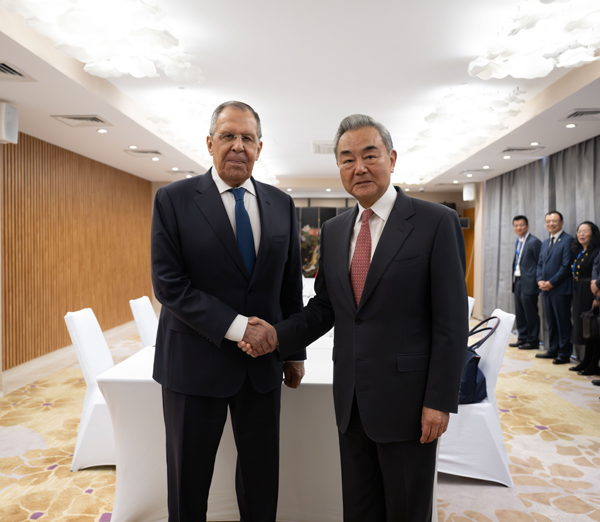
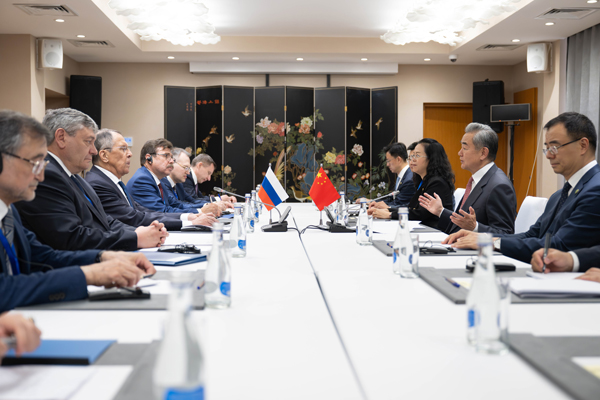
On July 24, 2026, Member of the Political Bureau of the CPC Central Committee and Foreign Minister Wang Yi met with Russian Foreign Minister Sergey Lavrov on the sidelines of the Meeting of the Council of the Ministers of Foreign Affairs of the Shanghai Cooperation Organization (SCO) Member States in Kyrgyzstan.
Wang Yi stated that in May this year, President Xi Jinping held an important meeting with President Vladimir Putin in Beijing, which has ushered bilateral relations into a new stage of greater achievements and faster development. China wishes Russia success in its State Duma elections to be held in September, and firmly supports the choice independently made by the Russian people. This year marks the 25th anniversary of the signing of the China-Russia Treaty of Good-Neighborliness and Friendly Cooperation and the 25th anniversary of the SCO. The treaty has guided the two countries in setting an example of a new type of state-to-state and major-country relations. The SCO has become a force for global stability with growing international influence. Both sides should jointly support the organization’s development, carry forward the “Shanghai Spirit”, and inject new vitality into improving global governance and building a community with a shared future for humanity.
Wang Yi noted that the current international situation is complex and turbulent. In the face of the question of the times regarding the future of the world, China and Russia have a firm and clear answer. Both sides should follow the important consensus reached by the two heads of state, stay on the path of independent development and rejuvenation, and forge ahead on the path of mutual trust through comprehensive strategic coordination. The two countries should plan well for high-level exchanges in the next phase, sustain the momentum of growth in pragmatic cooperation, and enhance the determination and resilience of bilateral cooperation. China and Russia should strengthen strategic coordination, uphold the outcomes of World War II, and never allow Japan to rearm. Both sides should also intensify multilateral coordination. China looks forward to Russia’s continued support for the APEC “China Year” events, and the two sides should maintain closer coordination and mutual support in multilateral frameworks including the United Nations.
Sergey Lavrov stated that head-of-state diplomacy serves as an important driving force for Russia-China relations. President Vladimir Putin’s successful visit to China this year and the more than 50 meetings between the two heads of state have continuously elevated bilateral relations to new heights. The two countries recently jointly celebrated the 25th anniversary of the signing of the Treaty of Good-Neighborliness and Friendly Cooperation, demonstrating the enduring and robust level of mutual trust between them. The Russian side congratulated China on successfully hosting the 2026 World Artificial Intelligence Conference, and Russia has joined the World Artificial Intelligence Cooperation Organization and looks forward to deepening bilateral cooperation in innovation and science and technology through this platform. Over the past 25 years since its founding, and driven by Russia and China, the SCO has developed into a regional organization full of potential, attracting an increasing number of like-minded countries to join. Russia remains highly vigilant against and firmly opposes Japan’s accelerated remilitarization and pursuit of nuclear weapons capability. The two sides can further strengthen strategic coordination within multilateral frameworks such as the United Nations, APEC, the G20, BRICS and East Asia cooperation, and jointly promote a more democratic and equitable multipolar world.
The two sides also had an in-depth exchange of views on international and regional issues of common concern.