


People’s Republic of China


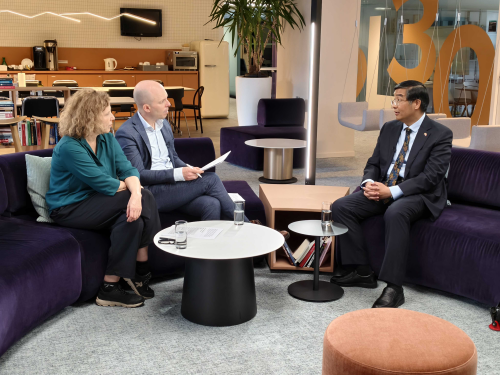
Tom Van de Weghe: Welcome, Mr. Ambassador. Ambassador Fei, thank you very much for joining us here at VRT today. We particularly appreciate that you have made time for us this exact moment while President Xi is hosting President Trump in Beijing that tells us that this conversation matters to you. And we are very grateful of that.
Veerle De Vos: We will speak in English not in Chinese, so our listeners across Belgium can follow you directly. We have prepared three blocs of questions. First, the summit that is unfolding right now in Beijing, then the broader geopolitical picture and finally, the relationship between China, Belgium and the European Union.
Tom Van de Weghe: So, Mr. Ambassador, as we speak, President Trump is in Beijing, as we said, first visit in nine years, almost ten. How does Beijing see this summit and what would China consider a successful outcome by the time President Trump leaves tomorrow?
Ambassador FEI Shengchao: Thank you for having me. And good morning to you and to your audience. I'm particularly happy to be at your program once again. I think that, yes, everybody is following the visit now going on in China very closely. The Europeans, the Americans and the Chinese, of course. I think that as far as the Chinese are concerned, certainly we attach a lot of importance to this visit because we all know that we do not live in the best of times probably today.And we see so much uncertainty and instability everywhere in the world. So what is important is for us to have more stability and certainty. And we do believe China-US relationship is among the most important bilateral relationships in the world. So a stable and certain China-US relationship is important to both countries and to the world at large.And of course, it will have a major impact on world peace and development. And that's why we take the visit very seriously. And we believe that, you mentioned the success of the visit, I think the visit will be a success.And how to measure the success, because I mentioned, now stability and certainty has almost become a rare asset, so I think that this time the visit itself will provide this rare asset for China, for the United States, for China-US, not only political relationship, but also economic relationship. And that will be good news to an uncertain and unstable world. So I think that the visit will be successful. It's just how successful it will become. I think it will be successful because the official talks already took place and people may have already read the readouts.And at the same time, people have directly watched the opening remarks by both presidents. I think that the message is consistent from both sides. President Trump also talks about a fantastic future for the relationship. As far as the Chinese President is concerned, he made it clear that this relationship is important and both countries need to take up the responsibilities, and he is willing to work with President Trump to try to properly take the helm and chart the course for this giant ship of China-US relationship, that is actually answering the question of history, of the people and of the world.
Tom Van de Weghe: Something remarkable this morning already when President Xi told President Trump this morning that Taiwan is the most important issue and could push relations to a dangerous place, that's what he literally said. Is Taiwan the price tag that Beijing has put on everything else? Why did President Xi say this?
Ambassador FEI Shengchao: First and foremost, I think the Taiwan question is the core of core concerns for China and the Chinese people. This is nothing new. This has been the Chinese position for decades because China is the only permanent member on the UN Security Council that is yet to be reunified. So you can see that how important this issue is to our country and to our people. Our Ambassador to the United States just gave an interview to Newsweek, I think, yesterday.And he also quoted a saying in the United States that a divided house cannot stand. We all know the history of the United States and we know the history of Europe. Europe is now also promoting the European integration. So everybody knows how important unity is. So I think the Taiwan question has always been a most important issue for China and the Chinese government.And we have been putting forward this message not only to our American friends, but also to our European friends and our friends from all over the world. But at the same time, I would like to stress China never puts a price tag on Taiwan. It's something non-negotiable or non-tradable. So Taiwan is important, and that is actually a premise for our diplomatic relations for all countries in the world, be it the United States or European countries or any other country in the world. As a matter of fact, that China and Belgium established diplomatic ties 55 years ago. This year is a special anniversary of our diplomatic relations and our diplomatic relationship was built 55 years ago exactly on this premise that there is only one China in this world and Taiwan is part of China.
Veerle De Vos: Analysts have suggested that expectations for this summit are modest,given all the unresolved differences between the two countries on trade, technology and other issues.What concessions does China hope to obtain from Washington? If we talk about tariffs, for example, or rare earth export controls or even Taiwan, does China expect tangible, real concessions from the Americans?
Ambassador FEI Shengchao: I will not say about particular concessions. I think, because I'm a career diplomat. In diplomacy, I think many times we try to work out differences and try to find solutions to sometimes even difficult and thorny issues in a way that is acceptable to all different sides. That's what diplomacy is about. So certainly now the summit diplomacy is taking place in Beijing between the Chinese President and the US President.There is a lot that they will go through and talk about. And certainly I think there are things that the United States would like to take and there are things that China would like to take.That will cut across a wide range of areas. As in the opening remarks, they already made it clear that they are going to cover all important and significant issues concerning the China-US relationship and the world.So I think at the end of the day, it will be a meeting that will strengthen the communication and mutual understanding of the two countries. And hopefully, there are also specific areas that the two countries will have more common ground and work out solutions as well.
Veerle De Vos: There are several businessmen sitting at the table as well, American businessmen, Tim Cook, Elon Musk and Jensen Huang. Just a month ago, Washington blocked exactly such a meeting between US CEOs and Chinese Party officials. What is President Xi promising these three CEOs? Can you promise them certain things?
Ambassador FEI Shengchao: I think it's more than three CEOs, according to what I heard, it’s about 30 CEOs, in President Trump's words,the 30 best in the world. I guess they are also best CEOs from Europe, from China as well. And certainly we attach a lot of importance to business interactions and trade and economic cooperation. Belgium is known for its open stance for business.Belgium is open for business. So is China. So we open our doors not only to the American President, but also to presidents of various companies, CEOs of various companies. As a matter of fact, before President Trump went to Beijing this time, many of the CEOs you have seen this time have been to China on previous occasions and even this year.So China's door is wide open for business. And I think that what we can promise the international CEOs, not only from the States but also from Europe and other parts of the world, is that China's door for opening up will continue to be there. China will continue to be open for business and open for dialogue and communications. We are open for joint efforts to tap the business potentials in China, and elsewhere in the world.And at the same time, when there is any difference or when there is any friction, no problem,we are open for dialogue and communication to sort them out.
Tom Van de Weghe: We will talk about relations between China and European Union later on, but let's continue maybe on the Trump visit. Iran is a very important topic. Both Secretary Rubio and Secretary Bessent have publicly said that they hope China will help end the war in the Middle East. Foreign Minister Wang Yi met his Iranian counterpart in Beijing last week, I believe.What is actually happening from China's side? Can you help us understand? And what role does Beijing see for itself in reopening the Strait of Hormuz?
Ambassador FEI Shengchao: Talking about the Gulf crisis and the reopening of the Hormuz Strait, I think that it will certainly also draw to our attention that there is even more than one conflict in today's world,the Gulf in the Middle East and also at the doorstep of Europe as well. And when people talk about conflicts, usually it will be after months that people will talk about what kind of role China can play.So this shows clearly that always China has never been the root cause for any conflict in today's world. But at the end of the day, when people find it difficult to finish a conflict, people would think of China. But what I would like to say here is China has always been a staunch force for peace. So for the previous three conflicts I mentioned just now, China, from the very start, of all the crises and conflicts, China has always been there, asking the parties to talk, urging the parties for political dialogue and political, diplomatic solution to the conflicts. The same is true in today's conflict in the Gulf, and in reopening the Hormuz Strait. This is a war that should not have started in the first place. And this is a war that none of us, the Chinese, the Americans, the Europeans, the Africans or Latinos should pay the price for (this war).And we are paying the price. So what is most important is to stop the war right now. Fortunately, there is a ceasefire now. So what is important is for all the parties to try to do more to further deescalate the situation and try to prevent the ceasefire from breaking down and the war from restarting again. And in this regard, I think that the Chinese Foreign Minister who met with the Belgian Deputy Prime Minister and Foreign Minister just a few weeks ago and they had very good talks.And the Chinese Foreign Minister already talked to foreign ministers of the major parties involved over the past one month and more on 30 different occasions. The Chinese Special Envoy has been to the Middle East on various occasions and the Chinese President has put forward a four-point proposal which is endorsed by many in the world, including the Iranian Foreign Minister, just a week ago.The four-point proposal is very important. Number one is peaceful coexistence that all the Gulf states are neighbors that cannot be moved away. They have to coexist peacefully. Number two, it's about the sovereignty and territorial integrity of all countries in the Gulf that should be respected and protected. And number three is the respect for the international rule of law, the UN charter, and also resolving differences and conflicts through diplomatic means.And number four and the last one is also important that we need to have a balanced approach towards development and security, because they will only mutually reinforce each other rather than at the expense of each other. So I think this forms a very good basis for any political or diplomatic solution for this crisis. And China will continue to put the message across and work on various parties to try to work out a political and diplomatic solution as quickly as possible.Of course, to do that, China cannot do it alone. We need the support of many more of our partners, including our European partners. And I think China and Belgium and China and European countries share a lot in common in this regard.
Tom Van de Weghe: Still, of course, one of the biggest talking points of President Trump in Beijing will be, China, you have to step up because we have to reopen the Strait of Hormuz and you are suffering, you should step up and help us open the Strait, even militarily. Is China prepared to do that?
Ambassador FEI Shengchao: China is not prepared to use military force to reopen the Strait, and we do not believe it will work out even by other parties. I think, as I said before, that among the four-point proposal put forward by President Xi that we should not opt for the use of force. The use of force has already been seen, has it worked out?No. So we need to use a wiser approach. I think the same approach is also shared by our European friends and Belgian friends. So now is not the time to talk more about the use of force or escalating the situation rather than the country. We need to urge for more diplomacy, more dialogue, and quicker solution to this issue.So although it's about reopening the Hormuz Strait, but it's more than that. It's about removing the root causes for this conflict and the war.
Veerle De Vos: On April 7th, China voted against a U.N. Security Council resolution to reopen the Strait. Why did Beijing block that resolution?
Ambassador FEI Shengchao: I think that our Ambassador to the UN, Mr. Fu Cong, who used to be our Ambassador to the EU, had made it very clear after the vote cast in the U.N. Security Council. I think that we fully understand the concerns of the Gulf states. They are suffering, and we are suffering, too. At the same time, we believe, as I mentioned just now, that the last thing we should do at this moment is to add more use of force to try to resolve the situation, because it has proven it did not work out.And another thing we should watch out against is to try to legalize an illegal war in the Gulf because that will further complicate the situation and even escalate the situation. That will serve the purpose of nobody, even for those who started the war. No.
Veerle De Vos: Some analysts argue that the United States attacked Iran, but also Venezuela, to target China and target China's oil imports that is in a way specifically an action against China's interests. How does Beijing see this?
Ambassador FEI Shengchao: We see this probably not just from the common geopolitical views, but we see this as part of the thing I talked about at the very start, this unstable world, this uncertainty in this world. The things you mentioned just now actually greatly undermines the stability and the rule of law in the international arena. That's much bigger concern for China and for many other countries, including many countries in this part of the world, in Europe.So we believe we still need to advocate the compliance with the U.N.Charter, the respect for sovereignty and territorial integrity. And we should continue to advocate with all our friends and partners for multilateralism, for the rule of international law.
Tom Van de Weghe: But if you look at the past year, it's been a remarkable year already since January.We have Venezuela, President Maduro was captured in Caracas, the United States imposed a blockade on Iranian ports, Beijing chose to suspend its second wave of rare earths exports control in November already. So from a Chinese perspective, is the room for maneuvering shrinking? And what does that mean of how President Xi is engaging with the US, but also with Europe?
Ambassador FEI Shengchao: I don't see it as what you said just now, that the room is shrinking. As we see it, yes, there is a crisis in international order, in world order, in the certainty we have known for long. At the same time, we have also seen the opportunity. The opportunities where?In my personal view, first and foremost,what we have seen last year, certainly that those things do not always work out for anybody, even for those who started it. So we still see the very value of international law, the United Nations, the WTO, although now probably there is a large absence of the roles properly played by those international institutions. But people still would like to go back to those rules rather than go back to the jungle.
Tom Van de Weghe: It is remarkable that China now is the biggest defender of international law in the world.
Ambassador FEI Shengchao: As we talked about it previously, there is a huge misunderstanding of China. China's success is based on complying with international law, going for multilateralism, and China has always been a strong supporter of the United Nations and the WTO. China's success, particularly in the past two decades, had a lot to do with China's accession to the WTO and following WTO rules.So if anyone would like to take anything from China's success, then the international law, the UN, the WTO certainly are major factors.
Tom Van de Weghe: To continue on Venezuela maybe. Caracas still owes China approximately $10 billion, I believe. If you look at what's happening in the Netherlands, the Dutch government took over the Chinese owned chip company, Nexperia, in September. Beijing has not been able to reverse that also. Is there a pattern that China is being forced on taking a position it cannot really force through?
Ambassador FEI Shengchao: Some countries are certainly not doing things consistent with international law and the norms we are familiar with. And some other countries may follow suit. But it's not China. China is not going to do the things that those countries may like to do. But I think what we will do is certainly firmly defend our legitimate rights and interests consistent with international law and the norms of international institutions.And at the same time, we will continue to urge all parties to continue the approach of open and free trade and multilateralism, because that serves the interest of not only China but everybody else. That's the principle we are going to put across to all our partners.
Veerle De Vos: It's probably staying in with the same theme, we're almost done, we forgot one country which got into the news this year, which is Greenland, of course. President Trump has spoken publicly and repeatedly about acquiring Greenland including the possibility of using economic and even military pressure. In Europe it made a lot of, we were very impressed and we were worried as well. How does China view this, this particular claim on Greenland?
Ambassador FEI Shengchao: I think this claim has a lot to do with the things happened that we talked about just now. So it brings me back actually also to the Global Governance Initiative that China put forward last year by Chinese President Xi Jinping.On that Global Governance Initiative, because we believe in today's world particularly, amidst all this instability and uncertainty, it's about governance in absence.Without proper governance, like the multilateral institutions we talked about, then there is this going back to the jungle. That's not good for anybody. So we still need to go back to this initiative. This Global Governance Initiative is about sovereign equality. It's about respect for the international rule of law, the UN charter. It's about putting human first, humanity first.It's about taking actions rather than just the talk. So I think this makes sense. And we just hope that more and more parties will come to realize that even when others may do wrong things or things are not right, it does not mean that you have to do the same thing because that will not serve your interest.
Tom Van de Weghe: Let's go to the war in Ukraine because it's still ongoing, since the last time we've seen each other. On April 23, the European Union adopted its 20th sanctions package against Russia, which again included Chinese entities accused of supplying dual-use components. Beijing has rejected these listings.
Ambassador FEI Shengchao: Certainly. Categorically.
Tom Van de Weghe: How do you see China's actual position right now on the war in Ukraine?
Ambassador FEI Shengchao: As I said, there is a huge misunderstanding on China in many areas and Ukraine is a typical example.China has, from the very start of the Ukrainian crisis, been a strong supporter for political dialogue and diplomatic solution, because China has been a good friend and partner of both Russia and Ukraine. The last thing we would like to see is our good friends fight among themselves.So we believe the best thing is for them to stop the fighting and try to negotiate a solution. And the last thing we would do is to try to provide knives or munitions to our friends to continue fighting. And you mentioned the EU sanctions, that's the thing we always strongly and categorically oppose because we oppose whatever unilateral sanctions without a UN mandate.And also, you mentioned its 20th round of sanctions. Does any of the 20 rounds really work out a solution? Do you think that the 20th round of sanctions would actually reinforce the EU position and help bring a quicker end to the conflict?
Tom Van de Weghe: But the Russian economy is suffering.
Ambassador FEI Shengchao: The Russian economy is suffering, so is everybody else, even the European economy: the energy crisis, the soaring fuel prices. I think everybody is suffering, not only Russia and Europe.
Tom Van de Weghe: But could China step up? Because if you see how Russian oil imports to China hit a record over the last few months and the European Union name specific Chinese companies as suppliers. Are these companies acting against Beijing's wishes or with Beijing's knowledge?
Ambassador FEI Shengchao: I think that you mentioned the sanctions about dual-use items. Dual use items in many cases are goods trading normally. It's not just between China and Russia, but also between Europe and Russia as we speak and between Russia and the United States as we speak.There are always been trade flows between all these major countries and blocs of countries.So why Chinese companies should be singled out for these actions? We provide no lethal weapons. We do not provide military goods. They’re just normal trade items. If it's about dual-use items of your concern, we can talk about it. China and EU have proper mechanisms to sort out dual-use items export control, no problem. So I think that's not the proper way to do it and it will not serve the purpose of anybody, not the Europeans, not the Chinese.So that's our position. And as for your question about how China can strengthen its role, China has always been very active and very strong in advocating for peace. But we do not believe more sanctions, more munitions to the battleground will bring the conflict to a quicker end.Some parties may have tried it for the past three or four years.What's the result?
Tom Van de Weghe: So what is the solution?
Ambassador FEI Shengchao: More dialogue. I think even now we have read reports about such kind of inclination in Europe. To have a dialogue does not mean you need to agree with everybody, but at least dialogue is better than fighting each other. More munitions will not bring an end to this conflict. That's already clear, crystal clear, for us to see.
Veerle De Vos: From Ukraine to Taiwan. At the end of December, the People's Liberation Army conducted very large drills, I think the largest drills since 2022 around the islands, it's called Justice Mission 2025. From European perspective, military pressure in Taiwan, in the Taiwan Strait raises real concerns about regional stability,about global supply chains. How does Beijing want Europeans to interpret these exercises?Because they make a big impressions on people here.
Ambassador FEI Shengchao: I understand why this is widely reported here, but I would also like to draw your attention to the fact that I mentioned at the very beginning. Taiwan question is the most important issue for China and the Chinese people. Of course, many people are concerned about the peace and stability in the Taiwan Strait. But I think there is no one in the world who cares about the peace and stability in the Taiwan Strait more than the Chinese people on both sides of the Taiwan Strait, because it's part of China.And peace and stability in the Taiwan Straits, first and foremost, will have its direct and immediate impact on the Chinese on both sides of the Taiwan Strait. So, yes, but I think what is threatening peace and stability in the Taiwan Strait is not actually any move by the Chinese people or the Chinese government, because we care most about peace and stability.It's about some forces, or they probably still have their mindsets in the past centuries about so-called a divide and control mindset who probably would also like to introduce or export what has happened at the doorstep of Europe, in the Middle East or other parts of the world to East Asia. That's the last thing China, Japan, Koreas, Southeast Asian nations would like to see.We enjoy peace and stability in this region. We do not want any import of whatsoever conflicts into our part of the world. So that's the thing we need to watch out against. And now the biggest threat to peace and stability is actually some forces inside Taiwan and some forces outside Taiwan try to propagate and to promote so-called “Taiwan independence”, because “Taiwan independence” would be the biggest move to sabotage the current state, peace and stability in the Taiwan Strait. If everybody is united in saying no to “Taiwan independence”, there's no need for concern or worry about peace and stability in the Taiwan Strait.
Veerle De Vos: You talk about outside forces. Can you name these forces?
Ambassador FEI Shengchao: I think that if you just read the newspapers, it's not difficult for you to come to your conclusion who are the forces. But even when we talk about those forces, I do not mean just one particular country. They are people in one particular country or another, and there are also other people. So I would like to call on all peace-loving people to be united, to say no to dangerous moves of so-called “Taiwan independence”, and try to keep peace and stability in East Asia and the world at large.
Veerle De Vos:We already talked about this, on this morning in Beijing, President Xi told President Trump that Taiwan could push relations to a dangerous place. Is that a warning or is it a threat, because in a way, it sounds like a threat.
Ambassador FEI Shengchao: I think it's not a threat at all. It's a long-held position, open position of China and the Chinese government and representing the wishes of the Chinese people: do not meddle in China's own domestic affairs.As long as you stay away from China's domestic affairs,everybody's fine. And peace and stability will continue to prevail in the Strait.Although we always have our differences with ourselves, with our compatriots, with the Chinese on the other side of the Taiwan Strait, no problem. We have our own ways to work out our own differences. And just not long ago, a major opposition party leader from Taiwan visited the mainland, which was very successful. And you can see, there is plenty of room for us to go for dialogue, for communication and for peaceful means rather than the contrary.
Veerle De Vos:Rather than violence.
Ambassador FEI Shengchao: Violence is the thing we hate most, being Chinese. Peace and harmony are in the gene of the Chinese.
Tom Van de Weghe: By using the military exercises, China is showing pressure. That's how we should understand it?
Ambassador FEI Shengchao:When so many people and parties are trying to threaten China with their military exercise, you mentioned one military exercise by China in its own territory and seas. But if you check it up at the same time, it's only about May this time,over the past five months, how many military exercises have been held in China’s surroundings, by who?And how many ships, how many planes were involved? It’s much larger than the Chinese troops. So who is threatening who?
Tom Van de Weghe: Who is threatening who, good question. Let's talk about Belgium and the European Union, of course. On March 21, our Belgian Prime Minister Bart de Wever sent a letter to European Commission President von der Leyenin which he stated, and I quote, that China is devastating our economy. He called for a firmer European approach. The European trade deficit with China reached approximately €360 billion last year.What is your response to that letter and to that diagnosis?
Ambassador FEI Shengchao:I think that many people are very much concerned about the letter here in Europe and back in China. It's something, a serious message. That's why that we have been keeping our communication with our fellow colleagues in Belgium and in Europe as well. I think that according to what I learned, that, yes, there is this letter and there is this message about a E.U. stance towards China.But much of the media reports about this letter, I was told,is fake news. So, yes, there is some truth in the letter, but many of the hype-ups are simply not true. So it's important, I think, that for China and Belgium and for China and Europe, to have more direct communication, frank, honest and productive communication. Yes, of course, we can all go to the media and try to enable the public to learn more about the specifics, concerns or issues that we may have.At the same time, if we really want to resolve issues, it's not through media or megaphone diplomacy. So what's important is for us to have more communication. That's why I think it's important that the Belgian Deputy Prime Minister and Foreign Minister Maxime Prévot just paid a successful visit to China. He met with his counterpart in China, the Chinese Foreign Minister.He also met with the Vice-Premier of China who is in charge of foreign trade. And so I think that, to my knowledge, that the visit went very well. It's not only the official talks. What is important is for the leaders to visit businesses and meet with people. And this time, he also did that. He's been to a number of Chinese businesses, high tech, robots, A.I. and also Belgian businesses doing business with and in China.And that has shown very clearly, I very much agree what he concluded upon conclusion of his visit, the challenges and opportunities are immense, which means that both challenges and opportunities we need to take very seriously. And he also said that the while defending European interests, we need to seek partnerships with China. One particular sentence that strikes me most is he said that China's train of economic development will not slow down.So whether people like it or not, China will continue to focus on economic development and better lives for the Chinese people. So China's development will continue and this will present not just a challenge, but probably also the next biggest opportunity for everybody. Yes. And for example, last year, our foreign trade totals about, I think, USD 6 trillion.And I think that in the coming years, China is going to become the biggest consumer market for the world as well. Now we are the second biggest, which means that trillions of dollars of imports, goods, services from Europe, from the States, from Asia, Africa, many other parts. So, yes, we understand people may have their concerns. It's also reasonable that you may defend your own interests.China will do the same, but we hope it will be consistent with WTO rules. It will be consistent with market rules, as the case you mentioned just now happening in another country, not Belgium, I think that's simply not consistent with market rules. That certainly has had its impact on the business confidence of many Chinese business leaders in investing in Europe.And that's bad for everybody.
Tom Van de Weghe: But you just mentioned fake news. We cannot deny there's this word devastating in the letter that our Prime Minister wrote, China's devastating our economies. We can see this with the deficit growing and so on.In a way, European countries are feeling that China is killing the biggest customer of China, we are a big consumer of Chinese goods.
Ambassador FEI Shengchao: That's the last thing we would ever do.
Tom Van de Weghe:Yeah, but in reality, our companies have to shut down, factories are closing because they cannot compete with these Chinese prices. Do you understand this, that from European perspective, it's devastating for our economies? How do we have to reply on this?
Ambassador FEI Shengchao: First and foremost, I think we need to have more communication because there is a huge misunderstanding. We all understand the challenges here in Belgium and in Europe, but I don't think it's appropriate to put the blame on China only. There are many factors, but it's always easy to blame China for whatever that people may suffer from. No, it's not the case.We talk about the energy prices, we talk about the many other domestic factors here. Also blaming China may be easy for politics, but it will never help resolve the real issues. As a matter of fact, I know that the Europeans and Belgians care most about the security on the one hand and competitiveness on the other hand. Blaming China will not make Europe or Belgium safer or more competitive.You talk about the trade deficit,yes, it is true,there's no denial. But at the same time, just take a look at China,since China opened its door more than 40 years ago. China used to have huge trade deficit in its trade with Europe. Yes, it may not be good for many of the Chinese businesses, but we never say that's decimating or devastating for Chinese businesses. We did it on purpose to open our door to European businesses and the American businesses, even with WTO. China's accession to the WTO has actually brought down many Chinese businesses. But without opening our door, without acceding to the WTO, you'll never see the competitive Chinese businesses today. That's why my recommendation would be, for our Belgian and European friends,yes, you can consider whatever you have to, have your own policy, no problem. You are sovereign nations, 27 of them.And European Union is a very important trading partner. You have your own decisions to make. But while trying to defend yourself, try to open up your minds, at least people sometimes are saying we are learning the Chinese. Are they really learning the Chinese in a right way? Because in China, over the past 40 or 50 years, we've been opening up our doors to try to welcome and attract foreign businesses. As we speak, the Europeans are making new legislations. The Chinese are making legislations at the same time, but for totally different purposes. The legislations now under way in Europeare trying to raise more barriers or even keep Chinese businesses out,while our legislations, as we speak, are really to try to encourage and attract more European, American, global businesses to China.And I think probably it will not work out in the next few months, but in the coming years and decades. These two different sets of policies, we'll see which set of policies will be more successful.
Veerle De Vos: There's one very specific concern that was raised by the Prime Minister in his letter about, but also by many European business leaders, and that's the absence of a level playing field. They talk about, for example, forced technology transfer, intellectual property, theft of practices, and also Chinese firms investing in Europe with huge state subsidies while deploying their own Chinese workforce.Are these valid concerns from the European side?
Ambassador FEI Shengchao:First of all, I would say it's still about misperception. It's no longer valid concerns at this moment because talking about the forced technology transfer, it's against not only many of the international commercial laws, but also it's against Chinese law, I assure you. Chinese laws forbid any forced technology transfer. And when we talk about technology transfer, certainly it has a lot to do with intellectual properties.But today, China contributes more than half of global patents. China will be the last one who would like to see violation of intellectual properties. And we want to protect intellectual properties not only for Chinese businesses, but also for international businesses. Otherwise, how can we attract international businesses? So I think that that's no longer a valid concern. And for other concerns, I think that many of them are also misperceptions.And of course, no one is perfect. Nothing is perfect even in this beautiful country of Belgium or Europe. And nothing is perfect in China. With all issues, if they arise, what is important is that we have proper channels to talk about the issues and have real actions to resolve the issues. That is important. And sometimes when we have nothing to do with each other, there will be no problem at all.If we have more things to do with each other,the more problems we’ll have. That is not important. We need to have more communication and more cooperation and try to make a bigger cake for everybody, not to reduce the share of cake for everybody. That's the way forward.
Tom Van de Weghe: Would China object, if Europe asks for tech transfer from Chinese companies coming to Europe, building factories here, you're welcome, but there should be a tech transfer, would China object it?
Ambassador FEI Shengchao:China will not object to any technology transfer from Europe to China or from China to Europe. But what is important? We need to follow market rules. We need to ask the companies themselves, usually either from Europe to China or from China to Europe. Technology transfer is not about one government asks the other government to do it. It's business transactions.Let the businesses to have the free reign to do things themselves.
Tom Van de Weghe: Allow me a question closer to home. Volvo Cars in Ghent, the last automotive plant in Belgium, 7000 people work there, owned since 2010 by the Chinese company Geely. The Belgian government has installed a task force. There's concern about its future. Our Vice Prime Minister Prévot, he has met the leadership of Geely in Hangzhou last month.Even our former Prime Minister Leterme is warning publicly that production could be drained away from Belgium. There are a lot of jobs at stake. Can you reassure the workers in Ghentthat Geely will not move the production somewhere else where it's cheaper to produce?
Ambassador FEI Shengchao:I understand the concern, actually it’s very much in the news of the past few weeks, and I think that the Deputy Prime Minister and Foreign Minister was in China on a successful visit. He talked about all those issues that Belgium is concerned about with his counterpart. And at the same time, he himself has been to Geely, the group who owns Volvo.And just now you also mentioned about the misperception, what I call, is about the Chinese businesses investing in foreign countries, employing only Chinese workers. I think Volvo is a typical example that that's not the truth or facts on the ground.To my understanding, probably that Volvo Ghent plant is the single, largest employer in the manufacturing sector of Belgium, directly employing about 6,500 workers and indirectly employing about more than 16,000 workers in the surroundings.And to my knowledge, there's not a single Chinese executive or worker on the ground in Ghent. So you can see how things could be mis-described sometimes. This plant is a typical example in the country.And at the same time about the future of Volvo Ghent plant, I think, as I said, it will be up to the business executives first in Sweden and then in the mother group of Geely in China to decide. From things I have read and from the Foreign Minister's visit, I can see that the signs are good. And because, I agree, I've been to the plant myself, yes, the productivity is high, the R&D is good, and also the supply chain is stable and certain, and it's actually a kind of good cooperation with Chinese partners. And the mother company, Geely, is also good.It's in good shape. And so I think the basis is solid. What is important is for us not to say, or do more things favorable for the plant, but to provide a certain and stable policy environment for the plant. People talk a lot about the China competition, but to this plant in Ghent, the more negative factors are from elsewhere.The tariffs have taken a toll on the export of cars from the Ghent factory and soaring energy prices have taken a toll and many other factors. China is the positive force behind the Ghent plant. We want to continue to be that force because I myself, I'm the Chinese Ambassador to Belgium, I learned a lot about this country. I've been to the Museum of Automobiles in Cinquantenaire. I've seen the history of cars. I can feel how closely people feel to the cars. And we want to make very good use of this plant. And also this plant not only has no Chinese employees, but also is directly run by Volvo Group in Sweden. So I think this is a very good example and we should continue to make it successful not only for Belgium, but also for this historical China-Belgium relationship.
Veerle De Vos:Let's talk about rare earth export controls. China imposed these export controls in October 2025. They were partly suspended until November this year. In Europe, these export controls were experienced as economic coercion. They even briefly halted production at major European carmakers. And according to an estimate of the European Central Bank, more than 80% of large European firms are connected or use these Chinese suppliers.How do you respond to these factsor this perception? And can you offer some reassurance to the European industry?
Ambassador FEI Shengchao: The export control, certainly, it's not something new. It's been there for for many, many decades. China used to have no export control at all. And China learned the American experience and the European experience in a way, in a big way, actually. So now for international nonproliferation purposes, we now have this regime established. So it's something new to China.And we are still learning from our American and European colleagues. And at the same time, what is important,we understand the business concerns. But I think that it's important to note that we now also have public dialogue between the EU export control regime and the Chinese one, and the dialogues are ongoing. And I think also for the Chinese Ministry of Commerce, who is in charge of the business here, that it has roundtables with foreign-invested businesses in China and international businesses running globally.And it's done so actually quite a number of times every quarter. And it's not about empty talk. It's about issues they run into and the complaints they have for the Ministry. And as I said, what is important is not only about talking about issues, but resolving the issues. So I believe because this is a new regime,it takes time for it to mature.And many of the specific issues have already been worked out. And it continues to be improved. And we will continue the dialogue with the businesses directly and also with the export control regimes of our European colleagues. And so I think that this is something normal. We need to try to work out better ways to make it more efficient, faster for businesses and the regimes in different localities.And you said that about the reassurance, this reassurance I can give you and the businesses that China's open door policy will remain unchanged and China will continue to welcome international businesses in all areas, even including this particular sector. And at the same time, whenever there is issue, you can rest assured that we are open for dialogue and communication and for resolving any particular issue you may run into.That's the best assurance I can give.You should never hesitate to ask the Chinese Embassy if there's any specific issue. We are here to serve Chinese businesses and all interested Belgian businesses to do business in China.
Veerle De Vos:Because this instrument, as we could call it of export controls. It's perceived as a hostile action of China. It doesn't really help with the Chinese image, as you say, we're open for business, we're open for dialogue. Do you understand that we perceive it that way that Europe is afraid when actions like this come from China?
Tom Van de Weghe:Because we depend on rare earth for our future, the green transition.
Ambassador FEI Shengchao: This export control regime, as I mentioned, we learn it from the Americans and Europeans. We never see that as some kind of hostile act. So I understand why some people would see it that way, whether China introduced this regime or not. They are people who may not like China. So what is important is for us to have more communication so that people could see the full picture of what is happening and to see that why this is in place and what might be the obstacles or the issues and how can we resolve the issues and move forward with even greater trade and economic cooperation.When we talk about the car industry, we mentioned it many times,it's a global business. It has a very long supply chain. And also semiconductors as well. You see that semiconductors, cars and many of the products, whether people like it or not,globalization is an irreversible trend. No business can survive in a small circle,you cannot thrive or prosper just doing business in a particular locality or just to source raw materials or parts from one particular company.Competition is a good thing. We all learned it, sometimes even the hard way. And we Chinese will not abandon this policy of opening up for more competition.
Tom Van de Weghe:Last question on Europe, because the European Commission is preparing a debate on China, specifically, by the end of the month with the Anti-Coercion Instrument among the options being discussed. So if the European Union were to adopt firmer measures against China,how would China respond and what kind of long-term relationship does Beijing actually want with the European Union?
Ambassador FEI Shengchao: We always believe that communication is better than disconnection and we always believe that talking is better than fighting. And you mentioned the possibilities and we are also seriously concerned because we do not believe that's the right approach forward. And you mentioned that some people would describe some of the Chinese moves as coercive actions. But just see, usually China is always the party that take counter actions rather than proactive actions.So who is actually coercing who? That is a good question. And in the proper context, let's forget about all the rhetoric, what matters is about the real things on the ground. I think that in this context, with so much uncertainty and instability in the world, the last thing businesses in China, in Europe would like to see is people or countries adding more uncertainty and instability to a already fluid business environment.That's something both China and Europe should avoid, for our own sakes, and for the sake of the globe. As President Xi said rightly, both China and Europe are two major forces in the world, two major markets and two major civilizations. There is a lot we can do together in a positive way.Of course, even husband and wife may have differences, so differences may naturally happen between us.What is important, as I repeated many times, is we try to use communication to sort out the differences while making a bigger cake. So that's the way forward.
Tom Van de Weghe:You still hope to see a trade agreement between China and the European Union?
Ambassador FEI Shengchao: Of course. And that's not only what something I hope for. That's something we work for. Of course, it takes two to tango.
Veerle De Vos:Last maybe personal question before we end this conversation and maybe it's a summarize of everything you've already said. But you arrived in Belgium at the moment of, you said it yourself, unsettling times, these are unsettling times, there's growing tension between Beijing and Brussels. Looking back over the past year and a half, what has been the biggest misunderstanding between China and Europe in your view and how could you resolve it?
Ambassador FEI Shengchao: The biggest misunderstanding, there are many, the biggest one would be that China and Europe are rivals. No, we are not rivals. We are partners. Yes. Even between partners, there may be competition, but it's just like the example I always give, that is the Olympic Games. You know, Olympic Games,there will be winners and losers in whatever games. Sometimes China wins.Sometimes Belgium or Europe wins. It's natural. But what is important is we follow the rules. We compete in a spirit of sportsmanship. And at the end of the day, everybody becomes stronger, goes further and higher. That's the Olympic spirit and motto. And that's something we would like to see. We are partners, not rivals.
Tom Van de Weghe:Thank you very much for coming to VRT, Mr. Ambassador.