People’s Republic of China


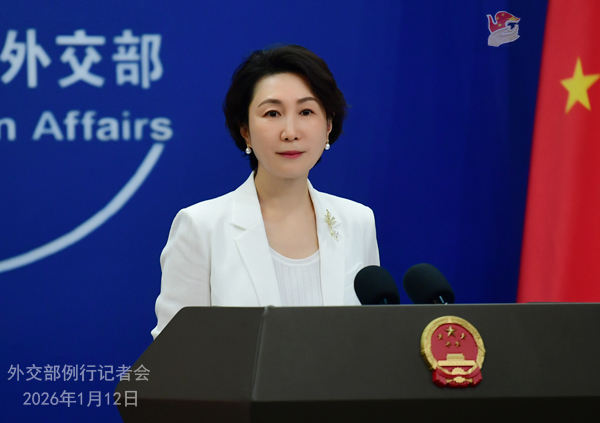
At the invitation of Premier of the State Council Li Qiang, Canadian Prime Minister Mark Carney will pay an official visit to China from January 14 to 17.
CGTN: To follow up on the announcement that Prime Minister Mark Carney will visit China, can you brief us on the backdrop and China’s expectation of the visit?
Mao Ning: Through the joint effort of the two sides, China-Canada relations have been gradually improved and developed since last year. President Xi Jinping met with Prime Minister Carney in Gyeongju, the ROK, charting the course for the turnaround of the bilateral relations and the resumption or restart of exchanges and cooperation in various fields. The upcoming visit by Mark Carney is Canadian Prime Minister’s first visit to China in eight years. China attaches high importance to the visit. President Xi Jinping will meet with Prime Minister Carney to provide new strategic guidance for the further improvement and development of bilateral relations. Premier Li Qiang and Chairman Zhao Leji of the Standing Committee of the National People’s Congress will hold talks and meet with him respectively to have broad-based and in-depth exchange of views on bilateral relations and issues of mutual interests.
The sound and steady development of China-Canada relations serves the common interest of the two countries and two peoples, and is conducive to world peace, stability, development and prosperity. China hopes that, through Prime Minister Carney’s upcoming visit, the two sides will step up dialogue and communication, enhance political mutual trust, expand practical cooperation, properly handle differences, address each other’s concerns, consolidate the momentum in the turnaround of China-Canada relations, and deliver more benefit to the two peoples.
Asahi Shimbun: It’s reported that permit reviews over rare earth exports to Japan for civilian use have been suspended, and Chinese state-owned enterprises have notified some Japanese companies that they would not sign new contracts on rare earth supplies. Are you aware of the situation? The Ministry of Commerce has said that the strengthened export controls over dual-use items toward Japan do not affect exports for civilian use. Is the suspension of reviews related to the export control measure?
Mao Ning: I’d refer you to competent authorities for anything specific. Let me stress that China’s measures, which were taken in accordance with the laws and regulations, are fully legitimate, justified and lawful.
RT: Reports say that at a meeting with U.S. oil executives at the White House, President Trump said China and Russia can only purchase Venezuelan crude oil under Washington’s control. He also said if the U.S. didn’t take control of Venezuela’s oil, China or Russia would have. Reuters reported that one of the aims of the U.S. operation in Venezuela was to tell China to “stay away from the Americas” and thwart China-Venezuela energy cooperation. What’s China’s comment?
Mao Ning: Latin American and Caribbean countries are independent sovereign countries and have the right to choose their cooperation partners. No matter how the situation develops, China will continue deepening practical cooperation with countries in the region, including Venezuela, and promote common development.
Prensa Latina: Yesterday, the U.S. President issued a new threat against the people and government of Cuba, amidst international condemnation of U.S. intervention against Latin America. What is China’s comment on this situation?
Mao Ning: China firmly supports Cuba in safeguarding national sovereignty and security and opposing external interference. We urge the U.S. to stop the blockade, sanctions and coercion of all forms against Cuba at once, and act in ways conducive to regional peace and stability.
Anadolu Agency: U.S. President Donald Trump on Sunday argued that taking over Greenland is necessary for the U.S. to prevent Russia or China from gaining control of the Arctic territory. He said: “We’re talking about acquiring, not leasing, not having it short-term. If we don’t do it, Russia or China will.” What’s China’s comment?
Mao Ning: The Arctic bears on the common interests of the international community. China’s activities in the Arctic are aimed at promoting the peace, stability and sustainable development of the region. They are in line with the international law. Countries’ right and freedom to carry out activities in the Arctic in accordance with the law needs to be fully respected. The U.S. should not use other countries as a pretext for seeking selfish gains.
Bloomberg: Officials from the G7 and other countries are meeting in the U.S. to discuss rare earth supply chains. Nikkei has also reported that Japanese companies are having difficulty getting rare earth supplies for civilian use. Would the Foreign Ministry like to comment on either one of these?
Mao Ning: China stepped up export controls of dual-use items toward Japan to safeguard national security and interests and fulfill international obligations such as non-proliferation. The measures are fully justified, legitimate and lawful. On keeping the global industrial and supply chains of critical minerals safe and stable, China’s position has not changed. All parties have the responsibility to play a constructive role for this end.
Beijing Youth Daily: It’s reported Taiwan said on January 9 that the Taiwan-related part in the Joint Press Release of the China-African Union Strategic Dialogue is a serious distortion of facts and undermines the island’s “sovereignty,” and called the African Union (AU) aligning with Beijing’s stance regrettable. What’s China’s comment?
Mao Ning: The one-China principle is a prevailing international consensus and a basic norm governing international relations. It is also the political foundation of relations between China and African countries. The 2024 Beijing Summit of the Forum on China-Africa Cooperation adopted the Beijing Declaration, in which participating African countries and the AU Commission reaffirmed their firm commitment to the one-China principle and reaffirmed that there is but one China in the world, Taiwan is an inalienable part of China’s territory and the Government of the People’s Republic of China is the sole legal government representing the whole of China. They also expressed their firm support to all efforts by the Chinese government to achieve national reunification. The Joint Press Release of the 9th China-AU Strategic Dialogue fully and faithfully represents the consistent and clear stance of the African side on the Taiwan question. The AU Commission Chairperson Mahmoud Ali Youssouf said in an interview on Friday that “We will be on board with China on the issue of one-China principle forever.”
We urge the Taiwan authorities to see the facts and stop its poor political stunts that will only disgrace itself.
Anadolu Agency: I want to go back to my Greenland question. I think you answered it as the common use of the Arctic territory. You said that Arctic is open for all countries, but Greenland is a part of Denmark. My question was about what’s China’s comment of the U.S. taking over sovereign territory of another country? If that happens, what China’s interests in the particular territory will be? What’s your comment on this?
Mao Ning: China always believes that state-to-state relations should be handled in accordance with the purposes and principles of the UN Charter. Regarding the Arctic, let me say that countries’ right and freedom to carry out activities in the Arctic in accordance with the law needs to be fully respected.
RIA Novosti: To follow up on the Arctic question, German Foreign Minister Johann Wadephul earlier offered U.S. President Donald Trump to work together within NATO to counter the “threats” posed by Russian and Chinese ships and submarines in the Arctic. What’s China’s comment?
Mao Ning: As I just said, the Arctic bears on the common interests of the international community. China’s activities in the Arctic are conducive to peace, stability and sustainable development of the region. They are in line with the international law. We oppose the U.S. using China or Russia as a pretext for seeking selfish gains.
Bloomberg: The death toll in the Iran protests is now more than 500 and Donald Trump has indicated that he may strike Iran if it uses lethal force against demonstrators. Would the Foreign Ministry like to comment on this?
Mao Ning: China hopes the Iranian government and people will overcome the current difficulties and uphold stability in the country. China always opposes interference in other countries’ internal affairs, advocates that all countries’ sovereignty and security should be fully protected by international law, and opposes the use or threat of force in international relations. We call on parties to act in ways conducive to peace and stability in the Middle East.
PTI: India on Friday criticized China’s infrastructure development projects in the Shaksgam valley and said that it reserves the right to take necessary measures to safeguard its interests as it is an Indian territory. We also do not recognize the China-Pakistan Economic Corridor, said by the Indian Ministry of External Affairs spokesperson. He said Shaksgam valley is an Indian territory and that we have never recognized the so-called China-Pakistan “boundary agreement” signed in 1963. We have consistently maintained that the agreement is illegal and invalid. Critics also say that China is trying to seek to validate its hold on the area with investments. What’s China’s comment and response to this?
Mao Ning: The territory you mentioned belongs to China. It’s fully justified for China to conduct infrastructure construction on its own territory. China and Pakistan in the 1960s signed a boundary agreement and delimited the boundary between the two countries, which is the right of China and Pakistan as sovereign countries. The China-Pakistan Economic Corridor (CPEC), as an economic cooperation initiative, aims at promoting local socioeconomic development and improving people’s livelihood. The China-Pakistan boundary agreement and CPEC do not affect China’s position on the Kashmir issue and the position remains unchanged.
AFP: It’s a follow-up question about the protests in Iran. Some press reports mentioned several hundreds died. Were any Chinese citizens among the dead or injured and are you calling on Chinese nationals to leave Iran?
Mao Ning: We are following closely the situation in Iran. So far we have not received report about Chinese casualties in the country. We will do everything we can to protect the safety of Chinese nationals in Iran. We would like to remind Chinese nationals there to follow the developments of the local security situation, and take necessary measures to keep themselves safe. Those in need for help can contact the Chinese Embassy in Iran or dial the consular service hotline.
Anadolu Agency: President Donald Trump also in yesterday’s remarks said that his administration is closely monitoring the situation in Iran and he is presented with “very strong options.” It’s been reported that a range of options, from sanctions and cyber measures to potential military action had been considered. What’s China’s comment?
Mao Ning: We stand against interference in other countries’ internal affairs, advocate that all countries’ sovereignty and security should be fully protected, and oppose using or threatening to use force in international relations.
AFP: I got a question on the Chinese Foreign Minister Wang Yi. He was supposed to visit Somalia last week but his visit was postponed due to a schedule change. What was the reason behind the schedule change? Was it due to security reasons?
Mao Ning: After friendly consultation between the foreign ministries of China and Somalia, the schedule of Foreign Minister Wang Yi’s visit was adjusted. While in Africa, Foreign Minister Wang Yi had a phone conversation with Somalian Foreign Minister Abdisalam Dhaay, during which he stressed that China will, as always, support Somalia in safeguarding sovereignty, unity and territorial integrity, and the two sides reached new common understandings on deepening cooperation in various areas.